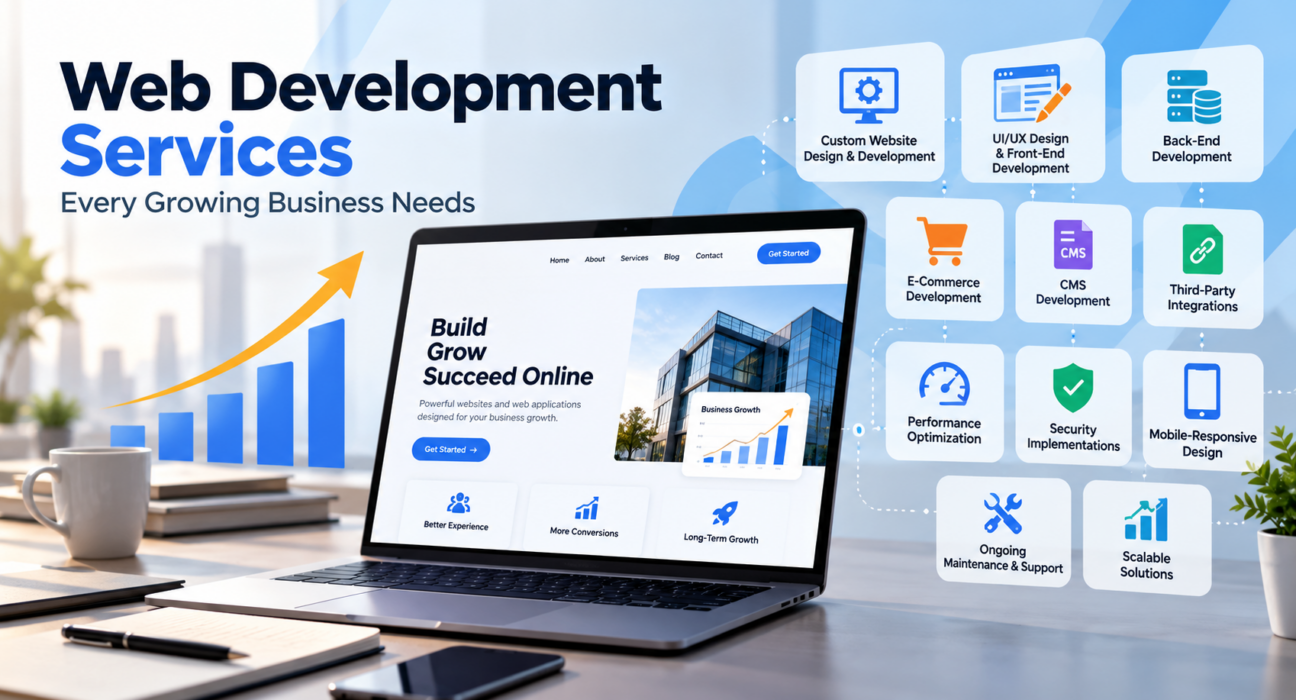
Most growing businesses don’t fail online because they lack a website. They struggle because the website they built two years ago can’t keep up with more traffic, more products, more customers, and higher expectations. The right web development services fix that gap, and knowing which ones you actually need saves both money and months of trial and error.
In short: a growing business typically needs custom website design and development, e-commerce development, a content management system, third-party integrations, performance and security work, mobile-responsive design, and ongoing maintenance. This guide explains each service, when you need it, and how to choose a development partner who can deliver it.
What Are Web Development Services?
Web development services are the technical work involved in building, improving, and maintaining websites and web applications. They cover everything from the visual layer visitors see (front-end development) to the servers, databases, and logic running behind the scenes (back-end development), plus the ongoing care that keeps a site fast, secure, and useful.
For a growing business, web development isn’t a one-time project. It is closer to an ongoing capability that evolves alongside your products, audience, and goals.
Why Growing Businesses Need More Than a Basic Website
A simple brochure site works well at the start. Growth changes the requirements:
- More visitors expose slow page loads and weak hosting.
- A larger catalog or service list needs better navigation and content management.
- Sales, support, and marketing teams need tools that connect to the website.
- Customers expect smooth experiences on every device.
- Handling customer data brings security and privacy responsibilities.
If your team regularly says “the website can’t do that,” it’s likely time to invest in stronger web development services.
1. Custom Website Design and Development
Custom web development means building a site around your specific business processes rather than forcing your business into a template.
Templates and website builders are fine for launching quickly. But as you grow, you may run into limits on layout, functionality, speed, and integrations. Custom development gives you:
- A structure designed for your audience and sales journey
- Cleaner code that loads faster and is easier to scale
- Features built for your exact workflows
- Freedom from restrictions imposed by a template or plugin ecosystem
Best for: businesses with unique processes, complex user journeys, or a brand that needs to stand apart.
2. UI/UX Design and Front-End Development
Front-end development turns designs into the interface people click, scroll, and tap. Good UI/UX work makes that interface easy to use.
Strong front-end services usually include:
- Wireframes and prototypes before development begins
- Clear navigation and page hierarchy
- Accessible design that works for people with different needs
- Consistent branding across pages and components
- Conversion-focused layouts for key pages such as pricing, product, and contact
A visually attractive site that confuses visitors still loses customers. Treat UX as part of development, not an afterthought.
3. Back-End Development and Web Applications
Back-end development is the server-side work that powers features like user accounts, payments, dashboards, databases, and APIs.
If your business needs a customer portal, booking system, internal tool, or any experience that stores and processes data, you need solid back-end engineering. It determines how reliably your site performs when usage grows.
Common back-end services include:
- Database design and management
- User authentication and role-based access
- API development
- Custom web application development
- Workflow automation
4. E-Commerce Development
If you sell products or services online, e-commerce development is often the highest-impact investment.
Key areas include:
- Product catalog and category structure
- Shopping cart and checkout flow
- Payment gateway and shipping integrations
- Inventory and order management
- Discount, subscription, or loyalty features
- Support for multiple currencies or regions, if relevant
Many businesses begin with a hosted platform and later move to a more customized setup as order volume and complexity increase. A good development partner can help you decide when that move makes sense rather than pushing a rebuild too early.
5. Content Management System (CMS) Development
A content management system lets your team publish and update pages without relying on a developer for every change. As your marketing grows, this becomes essential.
When evaluating CMS options, think about:
- Who will edit content, and how technical are they?
- How many pages, authors, and languages do you expect?
- Do you need custom content types, such as case studies, locations, or product pages?
- How easily can the CMS connect with your marketing tools?
Popular choices include WordPress, headless CMS platforms, and custom-built systems. The best option depends on your team’s skills and long-term plans, not on what’s trending.
6. Third-Party Integrations and API Development
Growing businesses rarely run on one tool. Your website needs to talk to your CRM, email platform, analytics, payment provider, ERP, or support software.
Integration services help you:
- Capture leads directly into your CRM
- Sync orders and inventory automatically
- Reduce manual data entry and errors
- Give teams a single view of customer activity
Well-planned integrations quietly remove hours of repetitive work every week, which becomes more valuable as your team grows.
7. Mobile-Responsive and Progressive Web App Development
Mobile-responsive design ensures your website adapts to any screen size. It is now a baseline expectation, and it also affects how search engines evaluate your site.
Some businesses go further with a Progressive Web App (PWA), which offers app-like features such as offline access and home-screen installation without requiring a full native app. This can be a cost-conscious way to improve mobile experience before committing to a separate mobile app project.
8. Website Performance Optimization
Speed affects user experience, conversions, and search visibility. Performance optimization is a service worth budgeting for as traffic grows.
Typical work includes:
- Image and media compression
- Code cleanup and caching
- Better hosting or content delivery setup
- Database query optimization
- Monitoring Core Web Vitals and fixing issues
Slow sites rarely announce their problems. They simply lose visitors quietly, so regular audits help.
9. Technical SEO and Search-Friendly Development
Your developers and SEO team should work together. Technical SEO built into development helps search engines crawl and understand your site.
Look for services that cover:
- Clean URL structure and site architecture
- XML sitemaps and robots.txt setup
- Structured data (schema markup)
- Proper redirects during migrations
- Mobile usability and page speed
Fixing technical SEO after launch costs more than building it in from the start.
10. Web Security and Compliance
As your customer base grows, so does the responsibility of protecting their data. Security should be part of every web development engagement.
Essential practices include:
- HTTPS with properly managed SSL/TLS certificates
- Secure authentication and access controls
- Regular updates for software, plugins, and dependencies
- Backups and a tested recovery plan
- Protection against common web threats
Depending on your industry and customer locations, privacy and data-protection rules may also apply. Confirm the specific requirements with a qualified legal or compliance professional before launch.
11. Website Maintenance and Support
Launching a website is the beginning, not the finish line. Maintenance services keep things running smoothly and prevent small issues from becoming expensive ones.
A solid maintenance plan generally covers:
- Software and plugin updates
- Security monitoring
- Bug fixes
- Backups
- Minor design and content updates
- Performance and uptime checks
Ask any potential partner what their support process looks like after launch, including response expectations and how requests are handled.
Which Web Development Services Do You Need First?
The services you need first depend on your business model and your biggest current bottleneck.
| Business Situation | Services to Prioritize |
|---|---|
| Startup launching its first site | Custom or CMS-based development, UI/UX, mobile responsiveness |
| Online store with growing orders | E-commerce development, integrations, performance optimization |
| Service business generating leads | CMS, technical SEO, CRM integrations |
| SaaS or platform business | Web application development, back-end, security |
| Established business with an outdated site | Redesign, performance, security, maintenance |
If you’re unsure, start with a short audit of your current site. Ask where visitors drop off, which tasks your team does manually, and what keeps the site from supporting your next stage of growth.
How to Choose a Web Development Partner
Picking the right provider matters as much as picking the right services. Use this checklist:
- Define your goals first. Know whether you want more leads, higher sales, faster operations, or a better customer experience.
- Review relevant portfolios. Look for projects similar to yours in industry, size, or complexity.
- Ask about process. A good team can explain how they handle discovery, design, development, testing, and launch.
- Check technical fit. Make sure their experience matches the technologies you need.
- Discuss communication. Clarify who your point of contact is and how progress is reported.
- Understand pricing. Ask for a clear scope, timeline, and what’s included or excluded.
- Plan for support. Confirm what happens after launch.
Directories like GoFirms can help at the research stage. You can browse web development companies, compare their service offerings, and build a shortlist before reaching out for proposals. Treat any directory as a starting point, then verify fit through conversations and references.
[Internal Link Suggestion: GoFirms Web Development Companies Category Page]
Common Mistakes to Avoid
- Choosing on price alone. The cheapest quote can become costly if it leads to rework.
- Skipping discovery. Rushing into design without clear requirements often causes scope creep.
- Ignoring scalability. A site that works today may struggle after a year of growth.
- Treating security as optional. Retrofitting protection is harder than planning it from day one.
- Forgetting maintenance. Unmaintained sites become slow, vulnerable, and outdated.
- Not owning your assets. Make sure your agreement clearly states who owns the code, designs, and accounts.
Frequently Asked Questions
What are web development services?
Web development services include designing, building, integrating, securing, and maintaining websites and web applications. They typically cover front-end development, back-end development, CMS setup, e-commerce, integrations, performance optimization, and ongoing support. Businesses use them to create reliable online experiences that support sales, marketing, and operations.
Which web development services does a small business need?
Most small businesses need a mobile-responsive website, a CMS they can update easily, basic technical SEO, security essentials, and regular maintenance. If you sell online, add e-commerce development and payment integrations. Start with the essentials and add advanced services as your traffic and requirements grow.
How do I choose a web development company?
Start by defining your goals and budget. Then review portfolios for similar projects, ask about their process and communication style, and compare proposals on scope, timeline, and support. Using a directory such as GoFirms to shortlist providers can speed up research before you contact them directly.
What is the difference between front-end and back-end development?
Front-end development covers what users see and interact with, such as layouts, buttons, and forms. Back-end development covers what happens behind the scenes, including databases, servers, user accounts, and integrations. Most business websites need both working together to deliver a smooth, secure experience.
How much do web development services cost?
Costs vary widely based on project scope, complexity, design needs, integrations, location, and the provider’s experience. A simple informational site costs far less than a custom web application. The best approach is to request detailed quotes from several providers using the same written requirements, so you can compare them fairly.
How often should a business update or redesign its website?
There’s no fixed schedule. Instead, watch for signs such as slow performance, poor mobile experience, outdated branding, security concerns, or features your team can’t add. Regular maintenance should be continuous, while a major redesign is usually driven by changing business goals or technical limitations.
Do I need ongoing website maintenance?
Yes. Websites need regular updates, security monitoring, backups, and performance checks to stay reliable. Without maintenance, software becomes outdated and vulnerabilities can appear. Many businesses set up a monthly support plan with their development partner so issues are handled quickly.
Conclusion
The right web development services depend on where your business is today and where you plan to be next. For most growing companies, that means a solid foundation of custom or well-configured development, strong UX, e-commerce or CMS capabilities, thoughtful integrations, and consistent attention to performance, security, and maintenance.
Start by identifying your biggest bottleneck, prioritize the services that address it, and choose a partner who communicates clearly and understands your goals. If you’re building a shortlist, you can research and compare web development providers on GoFirms to find teams that match your needs.