Introduction
Most PG owners plan one month at a time. Rent comes in, bills go out, and whatever is left feels like profit. It works until the year throws something at you: a slow quarter, a water tank that needs replacing, a lease renewal with a higher rent, or a tax bill you forgot to set aside for.
PG financial planning means looking at the whole year in advance, so those surprises become line items. This guide shows you how to build an annual plan step by step, with a worked example you can adapt. If you use PG and hostel management software, your rent, expense and occupancy records can feed straight into the plan and the monthly checks that follow.
What Is PG Financial Planning?
PG financial planning is a yearly plan for your PG’s money. It estimates income for each part of the year, lists regular and one-off expenses, sets aside a reserve and tax money, and sets targets you review every quarter.
A monthly budget tells you what next month looks like. An annual plan tells you whether the year works, and when the tight months will hit.
Step 1: Look Back Before You Plan Ahead
If you’ve been running your PG for a while, start with last year’s records. They’re more honest than any estimate.
Pull out:
- Monthly rent collected, and how much was delayed or lost
- Occupancy for each month, not just the yearly average
- Total spending by category (rent, staff, electricity, repairs, food and so on)
- One-off costs, such as repainting, new furniture or a big repair
- Months when cash felt tight, and why
Then ask three questions. When did beds sit empty? What costs surprised you? What did you pay for that you didn’t plan?
If you’re new, you won’t have history yet. Use cautious estimates, then replace them with real numbers every quarter.
Step 2: Plan Income Season by Season
Annual income isn’t twelve equal months. Demand changes through the year, and the pattern depends on who your tenants are. Students tend to move in around the start of the academic year. Working professionals may follow job cycles. Look at your own records instead of assuming.
Build quarterly occupancy estimates
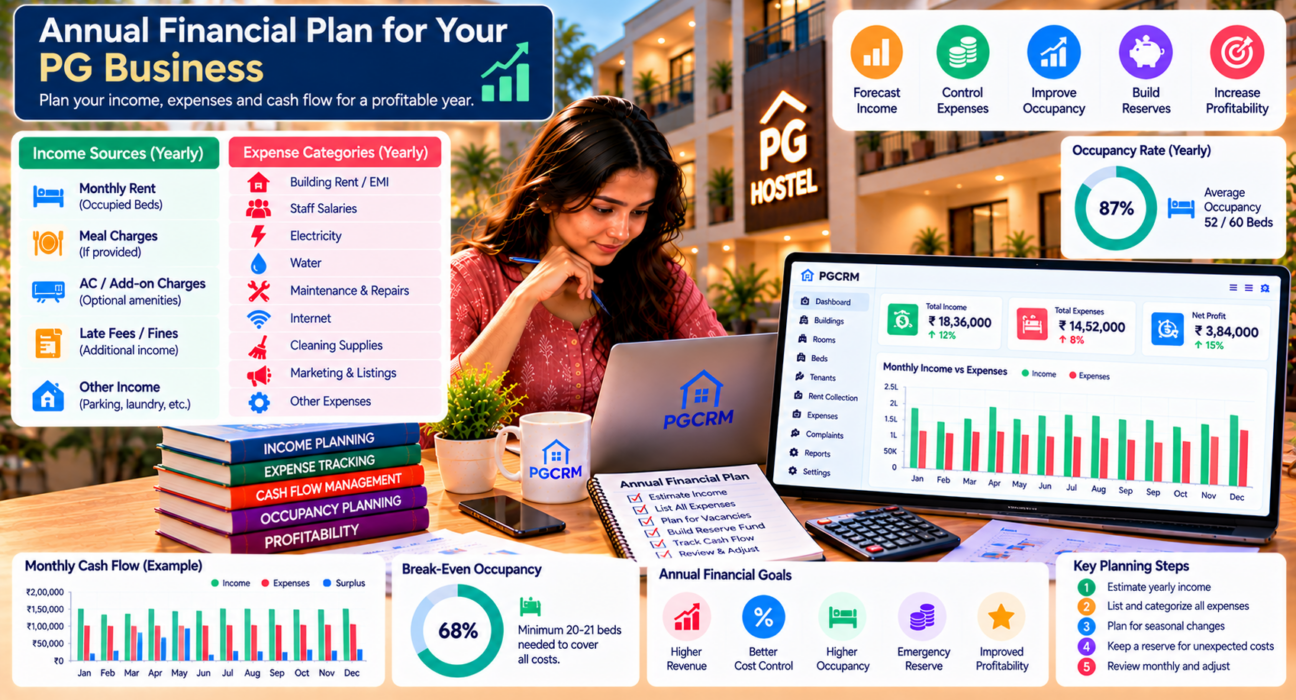
Annual rent estimate = beds × rent per bed × 12 × expected occupancy
But don’t use one yearly percentage. Break the year into quarters and estimate each one separately. Here’s a worked example with assumed figures.
Assumptions: a 30-bed PG, ₹6,000 rent per bed, maximum monthly rent of ₹1,80,000.
| Quarter | Assumed occupancy | Expected rent income |
|---|---|---|
| Jan–Mar | 80% | ₹4,32,000 |
| Apr–Jun | 90% | ₹4,86,000 |
| Jul–Sep | 92% | ₹4,96,800 |
| Oct–Dec | 78% | ₹4,21,200 |
| Year | 85% average | ₹18,36,000 |
Seeing the quarters side by side shows you when to build up cash and when to expect a squeeze.
Don’t count deposits as income
Security deposits belong to tenants until they leave. Keep them separate from your income plan, so you can always refund them without borrowing.
Add other income carefully
If you earn from meals, AC charges or other add-ons, list each separately. Keep late fees out of the plan. They’re a bonus, not something to rely on.
Step 3: Plan Every Expense, Including the Ones That Aren’t Monthly
This is where annual planning beats monthly budgeting. A monthly view misses costs that arrive once or twice a year.
Regular costs
These repeat every month: building rent or loan EMI, staff salaries, electricity, water, internet, groceries if you serve meals, cleaning supplies, routine repairs and marketing. If you want to trim these, our guides on controlling electricity, food and maintenance costs go deeper on each.
Planned one-off costs
Walk through the building and list what will need attention this year:
- Repainting rooms or common areas
- Mattress and furniture replacement
- Appliance replacement (geysers, ACs, water purifiers, washing machines)
- Waterproofing or terrace repairs before the monsoon
- Licence, registration or renewal fees, if they apply to you
Assign each one a month and an estimated cost. A rough number is better than leaving it out.
Lease or loan changes
If you lease the building, check when your agreement ends and whether the rent may rise. If you have a loan, note any change in EMI. Build the higher figure into the plan from the month it starts, not when it surprises you.
Step 4: Build the Full-Year Plan
Now bring income and expenses together. Continuing the same example with assumed figures:
| Annual expense | Amount |
|---|---|
| Building rent (₹60,000 × 12) | ₹7,20,000 |
| Staff (₹25,000 × 12) | ₹3,00,000 |
| Electricity (₹18,000 × 12) | ₹2,16,000 |
| Maintenance and repairs (₹6,000 × 12) | ₹72,000 |
| Water, internet, supplies and marketing (₹9,000 × 12) | ₹1,08,000 |
| Planned one-offs (repainting, mattresses, appliances) | ₹1,30,000 |
| Reserve fund contribution (₹5,000 × 12) | ₹60,000 |
| Total | ₹16,06,000 |
Planned surplus: ₹18,36,000 − ₹16,06,000 = ₹2,30,000
That surplus is before your own pay, income tax and any loan principal not already counted. Decide how much of it you need for those, and how much you’ll reinvest.
Stress-test the plan.
Now ask what happens if things go worse than expected.
- Occupancy averages 75% instead of 85%. Rent income falls to ₹16,20,000, which leaves about ₹14,000 after planned costs. The year barely works.
- Electricity runs 15% higher. That adds roughly ₹32,000 to your costs.
- One big repair you didn’t plan for. It could use up most of what’s left.
Most PG costs are fixed, so empty beds hurt much more than they look. A plan that only works at 85% occupancy isn’t a safe plan. If your stress test comes out close to zero, that’s your signal to cut costs, adjust rent, or build a bigger reserve.
Step 5: Set Aside Money You Can’t Spend
Some money in your account isn’t yours to spend. Plan for it from the start.
- Security deposits. Keep enough cash to refund tenants whenever they leave.
- Taxes. Tax rules depend on your situation and change from time to time. Speak to a chartered accountant about what applies to your PG, how much to set aside, and when payments are due.
- A reserve fund. This covers slow months and surprise repairs. Many owners build up a cushion that could cover a few months of fixed costs, adding a fixed amount every month. The right size depends on your costs and how steady your occupancy is.
- Your own pay. If you work in the PG, decide what you pay yourself. Otherwise, you can’t tell whether the business is really profitable.
Step 6: Set Clear Yearly Targets
Planning isn’t only about protecting what you have. It also helps you decide what to improve. Pick a few targets you can measure.
- An occupancy target, such as holding your slowest quarter above a certain level
- A cost target, such as keeping electricity or maintenance below a set amount per bed
- A collection target, such as how quickly rent comes in each month
- A reserve target, such as reaching a set amount by year-end
- A growth decision, such as whether to add rooms or another building, and what cash you’d need first
Keep it to three or four. A long list never gets reviewed.
When to review rent
Check your rent against nearby PGs and your own costs once a year. If your costs have gone up, a small, well-explained increase may be fairer than letting your margin shrink. Rules and local practice differ, so check your rental agreement and any notice requirements before changing rent.
Step 7: Review the Plan Every Quarter
A plan you never check is only a guess. Review it four times a year, in a short sitting.
- Compare actual income with the plan. Look at each quarter’s occupancy and rent collected.
- Compare actual expenses with the plan. Note which categories ran over or under.
- Find the reasons. Was it a one-off or a pattern?
- Update the remaining quarters. Adjust for what you’ve learned.
- Check your reserve and your targets. Are you on track?
Where records come in
Quarterly reviews only work with reliable numbers. PG management software such as PGCRM can record rent collection by cash and UPI, show who is pending, track expenses by category and building, and give income, expense and occupancy reports. It won’t build your financial plan for you, but it gives you clean actuals to compare with it, which is the part most owners find hardest to keep up with.
| Notebook or spreadsheet | PG management software | |
|---|---|---|
| Quarterly income total | Add up pages or sheets | Check the income report |
| Expense by category | Sort bills yourself | Expenses recorded by category |
| Occupancy trend | Count beds manually | Occupancy reports |
| Multiple buildings | Separate files | One view across buildings |
Common Mistakes in PG Financial Planning
- Planning for full occupancy all year. It rarely happens.
- Ignoring seasonality. A yearly average hides the slow months.
- Leaving out one-off costs. Painting, furniture and appliances add up.
- Treating deposits as income. They’re refundable, so they aren’t profit.
- Skipping tax planning. A surprise tax bill can wreck your cash flow.
- Mixing personal and business money. You can’t see true profit if the two blend together.
- Never reviewing the plan. Costs and demand change during the year.
FAQ
How do I make an annual financial plan for a PG?
Review last year’s income and expenses, estimate occupancy for each quarter, list regular and one-off costs, and compare income with expenses to find your surplus. Add a reserve, set aside money for deposits and tax, set a few targets, and review the plan every quarter.
What should be included in a PG financial plan?
Include expected rent and other income, fixed and variable expenses, planned one-off costs like repainting and appliance replacement, a reserve fund, money set aside for deposit refunds and tax, your own pay, and a few measurable targets for occupancy, costs and collections.
How do I estimate occupancy for the year?
Use your own records first. Look at occupancy for each month over the past year and group it into quarters. If you’re new, start with a cautious estimate and adjust it every quarter as real data comes in. Avoid assuming full occupancy all year.
How much reserve should a PG owner keep?
There’s no fixed rule. It depends on your fixed costs, how steady your occupancy is and how old your building is. Many owners aim for a cushion that covers a few months of fixed costs, adding a set amount each month until they get there.
How often should I review my PG financial plan?
Review it every quarter at a minimum. Compare actual income and expenses with the plan, note the reasons for any gaps, and update the remaining months. If something changes sharply, such as a big repair or a drop in occupancy, review it sooner.
Do I need an accountant for PG financial planning?
You can build the plan yourself, but an accountant is useful for tax and compliance, which depend on your situation and local rules. Bring your income and expense records so they can advise on what to set aside and when payments are due.
Conclusion
Good PG financial planning comes down to a few steady habits. Learn from last year’s numbers, plan income season by season, include one-off costs, stress-test the result, set aside money for deposits, tax and reserves, and review the plan every quarter. A plan like this doesn’t remove risk, but it shows you problems while you still have time to act.
Reliable records make each review easier. If you’d like rent, expenses and occupancy in one place, explore PGCRM to simplify your PG and hostel management.