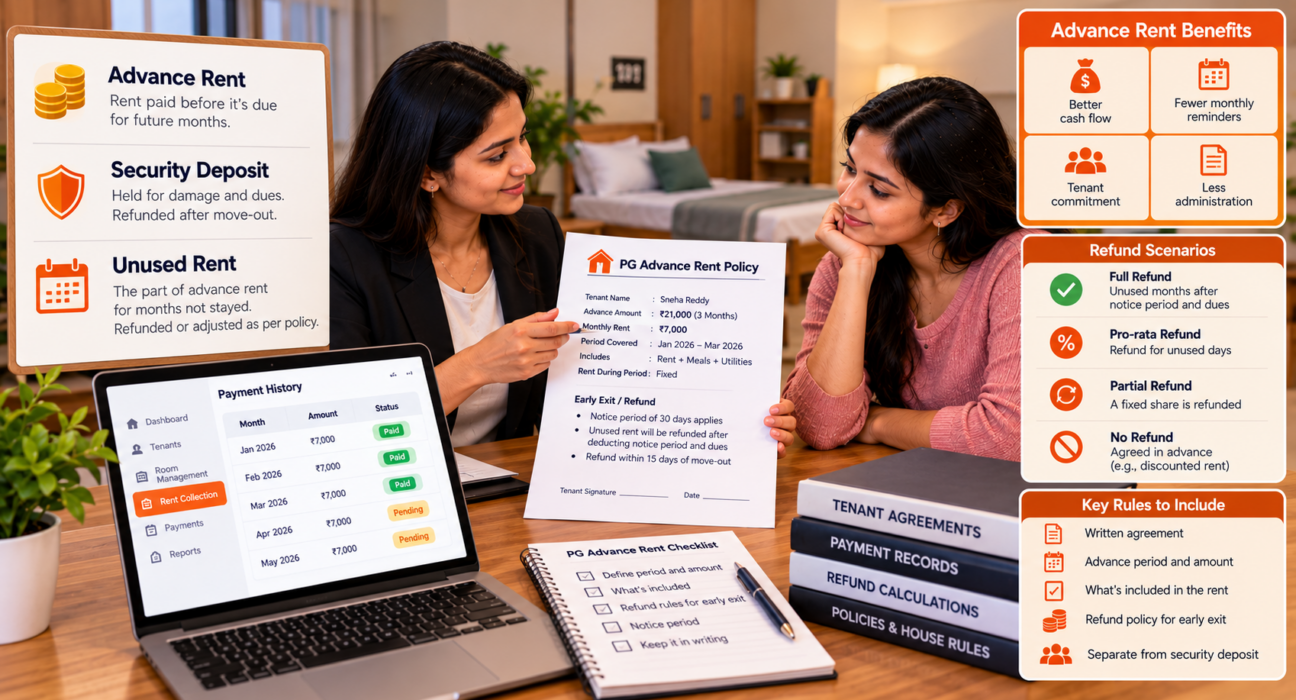
A tenant offers to pay three months of rent up front. It sounds like good news: money in hand, no reminders to send, one less thing to chase. Then, five weeks later, they get a job offer in another city and ask for the rest of their money back. You’ve spent some of it. The agreement says nothing about advance payments. Now you’re having a tense conversation with no rule to point to.
A clear PG advance rent policy prevents that. It says whether you accept advance rent, what it covers, what happens if the tenant leaves early and how unused rent is returned or adjusted. This guide shows how to set those rules, with a worked refund example and a sample clause. If you use PG and hostel management software, recording payments against each tenant helps you keep the numbers straight.
The Short Answer
A good PG advance rent policy states whether advance rent is accepted, how many months it covers, whether the rent stays fixed during that period, how it’s applied month by month, what happens to unused rent if the tenant leaves early and when any refund is paid. Keep it separate from the security deposit, and put it in writing before taking any money.
Advance Rent vs Deposit vs Unused Rent
People mix these up, and so do owners. Keep them apart in your records and in your agreement.
| Term | What it is | Whose money is it? | Typical use |
|---|---|---|---|
| Security deposit | A sum held against damage, dues and unpaid charges | The tenant’s, until deductions are settled | Refunded at move-out after deductions |
| Advance rent | Rent paid before it’s due, for one or more future months | Becomes yours month by month as the stay passes | Applied against each month’s rent |
| Unused rent | The part of advance rent covering days or months the tenant won’t stay | Depends on your agreement | Refunded, adjusted or forfeited, as agreed |
The key point: advance rent isn’t income until the period it covers has passed. Treat it as money you’re holding, not money you can freely spend. Spend it before it’s earned, and a refund request becomes a cash flow problem.
Why You Need Written Rules
Without rules, every early exit becomes a negotiation, and these questions come up:
- Does the tenant get unused months back, or not?
- Does the notice period still apply?
- If rent was discounted for paying in advance, does the discount stay?
- What if rent rises during the advance period?
- Who covers rent if the bed was refilled quickly?
- When is the refund paid, and how?
Answer these before any money changes hands, and most disputes never start.
Step 1: Decide Whether to Accept Advance Rent at All
Accepting advance rent isn’t compulsory. Weigh the benefits against the risks.
| Benefits | Risks |
|---|---|
| Better cash flow | Refund pressure if the tenant leaves early |
| Fewer reminders and late payments | Temptation to spend money you haven’t earned |
| Tenant commitment for the period | Confusion over what’s refundable |
| Less admin each month | Disputes if terms aren’t written |
If you accept it, decide the limits: a maximum number of months, a standard period such as quarterly or half-yearly, or only for tenants with a good record. Many owners are comfortable with a modest advance and cautious beyond that.
Step 2: Define Exactly What the Advance Covers
Be specific so there’s nothing to argue about later.
- Which months it covers, with start and end dates
- What it includes: rent only, or also meals, electricity and other charges
- Whether the rent stays fixed during the advance period, even if you raise rents for others
- How it’s applied: each month’s rent is deducted from the advance on the due date
- What happens when it runs out: the tenant returns to normal monthly payment
- What it doesn’t cover: fines, damage and the security deposit
Fixing the rent during the advance period is fair to the tenant and easy to explain. If you want the right to change rent mid-period, say so clearly, and check your agreement and local practice first.
Step 3: Decide What Happens to Unused Rent
This is the heart of the policy. There are a few common approaches, each with trade-offs.
| Approach | How it works | Pros | Cons |
|---|---|---|---|
| Full refund of unused months, after notice period and dues | Tenant gets back rent for months not used | Fair and easy to defend | You must hold the cash until it’s earned |
| Pro-rata refund | Refund calculated by the day, after notice period | Very precise | More calculation |
| Partial refund | A set share is refunded, the rest retained | Protects your income | Can feel unfair unless agreed upfront |
| No refund, with a discount for paying in advance | The tenant gets a lower rent in return for commitment | Clear trade-off | Feels harsh if circumstances change |
| Refund only if the bed is refilled | You return rent for days the bed is re-let | Tracks your real loss | Needs good records and may drag on |
Pick one, explain it plainly and apply it to everyone. Check your agreement and local practice before settling on non-refundable terms, since expectations and rules vary.
Make the notice period explicit
Say whether the usual notice period still applies when a tenant has paid in advance. Most owners say yes: the tenant pays rent through the notice period, and only the remainder is unused.
Step 4: Work Through a Refund Example
Here’s a worked example with assumed figures. The policy: unused rent is refunded pro rata after the notice period and any dues.
| Item | Detail | Amount |
|---|---|---|
| Monthly rent | ₹6,000 | |
| Advance paid on 1 Jan | 3 months, covering Jan to Mar | ₹18,000 |
| Notice given | 15 Jan, with a 30-day notice period | |
| Move-out date | 14 Feb | |
| Rent for January | Full month | ₹6,000 |
| Rent for 1 to 14 Feb | 14 days at ₹200 a day (₹6,000 ÷ 30) | ₹2,800 |
| Total rent owed up to move-out | ₹8,800 | |
| Unused advance | ₹18,000 − ₹8,800 | ₹9,200 |
| Less: electricity charge due | Agreed charge | −₹450 |
| Advance refund | ₹8,750 |
The security deposit is handled separately in the deposit statement, with its own deductions for damage or other dues.
If your policy were different, for example no refund on a discounted advance, the numbers would change, and the tenant should know that before paying. Show new tenants an example like this one, so they understand exactly how it works.
Step 5: Be Careful With Advance Payment Discounts
Some owners offer a lower rent for paying several months at once. It can work, but it needs clear terms.
- State the discount and how it was calculated.
- Say what happens if the tenant leaves early. Does the discount stay, or is the difference repaid?
- Make sure it doesn’t push your rent below your costs. Work out the break-even first.
- Don’t promise it informally. Write it down.
Here’s a quick example with assumed figures. Rent is ₹6,000. For paying 6 months in advance (₹36,000), you offer ₹5,700 a month, a total of ₹34,200. If the tenant leaves after 2 months, the rent actually owed at the normal rate is ₹12,000. You’d have collected ₹34,200, which means ₹22,200 is unused, but whether the discount has to be paid back (the ₹600 difference for those two months) depends on what you wrote. Spell it out.
If you also have a rent concession or discount policy, make sure the advance discount fits with it, so tenants don’t stack benefits you hadn’t intended.
Step 6: Handle Rent Changes During the Advance Period
This causes more arguments than most owners expect.
- If rent is fixed during the advance period, a rise applies only after it ends.
- If you want the option to raise rent, say so up front, and give notice as your agreement requires.
- If your costs jump unexpectedly, you may still be bound by what you agreed. That’s the trade-off of taking advance rent.
- Explain the rule at move-in, and again when you offer advance payment.
A fixed-rent advance is a benefit to the tenant, so it’s reasonable to ask for a modest commitment in return. Check your agreement and local practice before setting terms on rent changes.
Step 7: Handle Special Situations
Real life doesn’t follow the main policy neatly. Decide how you’ll handle these in advance.
| Situation | A fair approach to consider |
|---|---|
| Tenant moves to another room in the same PG | Carry the advance across, adjusting for any rent difference |
| Owner asks the tenant to leave for a rule breach | Follow the agreement. Refund unused rent after dues, unless the agreement clearly says otherwise |
| Tenant leaves without notice | Apply the notice-period rule, and check your agreement before deducting |
| Bed is refilled quickly | Decide whether you refund for the days the new tenant pays. State the rule in writing |
| Tenant dies or has a serious emergency | Handle with compassion, and consider refunding unused rent beyond what the agreement requires |
| The PG closes or you can’t provide the room | Refund unused rent promptly and fully |
| Dispute about the amount | Share the calculation in writing, and talk through each line |
For anything unusual, write down the decision and the reason. That protects you if a similar case arises, and keeps your treatment consistent.
Step 8: Write It Into Your Agreement
A short, clear clause beats a long, vague one. Adapt this sample to your PG and your local requirements.
Sample clause (placeholders in brackets):
Advance rent. The tenant may pay rent in advance for up to [number] months. Advance rent is applied month by month against the rent due on [date]. The monthly rent during the advance period will remain ₹[amount].
Early exit. If the tenant vacates before the end of the period covered by advance rent, rent remains payable up to the end of the notice period of [number] days. After deducting rent owed and any other dues, unused advance rent will be [refunded pro rata / adjusted as stated here] within [number] days of move-out.
Discounts. If a discount was given for advance payment, it will [remain / be recalculated at the standard rent for the months actually stayed].
Deposit. The security deposit is separate and will be settled under the deposit terms.
Have it checked by a local professional if you can, and make sure tenants read it and confirm in writing.
Step 9: Record Advance Payments Properly
A tenant who pays three months at once creates a record you need to maintain. Otherwise, you’ll forget what’s been used.
A simple advance ledger
| Date | Tenant / room | Amount received | Months covered | Rent applied this month | Balance remaining |
|---|---|---|---|---|---|
| 1 Jan | Room 204 | ₹18,000 | Jan to Mar | ₹6,000 | ₹12,000 |
| 1 Feb | Room 204 | ₹6,000 | ₹6,000 | ||
| 1 Mar | Room 204 | ₹6,000 | ₹0 |
(These are made-up examples to show the format.)
Update it each month, and tell the tenant their balance if they ask.
PGCRM records rent payments by cash or UPI against each tenant, handles deposits, fines and refunds, supports monthly or join-date billing cycles and shows income reports. That gives you a clear record of what each tenant has paid. It doesn’t list a dedicated advance rent or credit balance feature, so keep your own advance ledger next to it, and make sure the amounts match your payment records. For more on keeping rent coming in on time, see our guide on how to collect PG rent on time.
Step 10: Keep the Money Safe and Separate
Because advance rent can become refundable, treat it carefully.
- Don’t spend what you haven’t earned. Keep enough in hand to refund unused months, particularly if early exits are common.
- Separate it mentally and on paper from deposits and from earned income.
- Review your balances each month to see how much unearned advance you hold.
- Plan your cash flow so a refund doesn’t cause stress.
- Talk to an accountant about how advance rent should be recorded for tax and accounting purposes, since it depends on your situation.
Common Mistakes With a PG Advance Rent Policy
- Taking advance rent with no written terms. Disputes follow.
- Mixing it up with the deposit. They have different rules.
- Spending unearned money. A refund becomes a crisis.
- Ignoring the notice period. Decide how it interacts with advance payments.
- Giving discounts without saying what happens on early exit. It leads to arguments.
- Raising rent mid-advance without agreement. It breaks trust.
- Not keeping a ledger. You lose track of balances.
- Being vague about refund timing. Say when and how.
- Handling exceptions inconsistently. Tenants notice.
- Never reviewing the policy. Circumstances change.
FAQ
What is a PG advance rent policy?
It’s a written set of rules covering whether advance rent is accepted, how many months it covers, whether rent is fixed during that period, how it’s applied each month, what happens to unused rent on early exit and when any refund is paid. It’s kept separate from the security deposit.
Is advance rent refundable in a PG?
It depends on your agreement. Many owners refund unused months after the notice period and any dues, either pro rata or in full. Others keep part of it, particularly when a discount was given. Whatever you choose, state it in writing before taking the payment.
What is the difference between advance rent and security deposit?
A security deposit is held against damage and unpaid dues and is refunded at move-out after deductions. Advance rent is rent paid early for future months, and it becomes yours month by month as the stay continues. Keep them separate in your records and agreement.
Can I give a discount for paying rent in advance?
Yes, if you’ve worked out that it still covers your costs and you state what happens on early exit. Say whether the discount stays or is recalculated at the standard rent for the months actually stayed. Put the terms in writing before accepting the payment.
Does the notice period apply if a tenant has paid in advance?
Usually yes. Most owners require rent through the notice period, then refund or adjust whatever remains unused. State this clearly in the agreement, and check your agreement and local practice for notice requirements.
Can software help track advance rent in a PG?
It helps with payment records. PGCRM records rent by cash or UPI against each tenant, handles deposits, fines and refunds and shows income reports. It doesn’t list a dedicated advance rent feature, so keep a simple advance ledger and check it against your records.
Conclusion
A solid PG advance rent policy comes down to a handful of decisions: whether to accept advance rent, what it covers, how unused rent is handled, how the notice period works and when refunds are paid. Write it into the agreement, show tenants a worked example, keep a ledger and treat unearned money with care.
Clear records make the rules easy to follow. If you want tenant details, rent payments, deposits, and refunds in one place, explore PGCRM to simplify PG and hostel management.