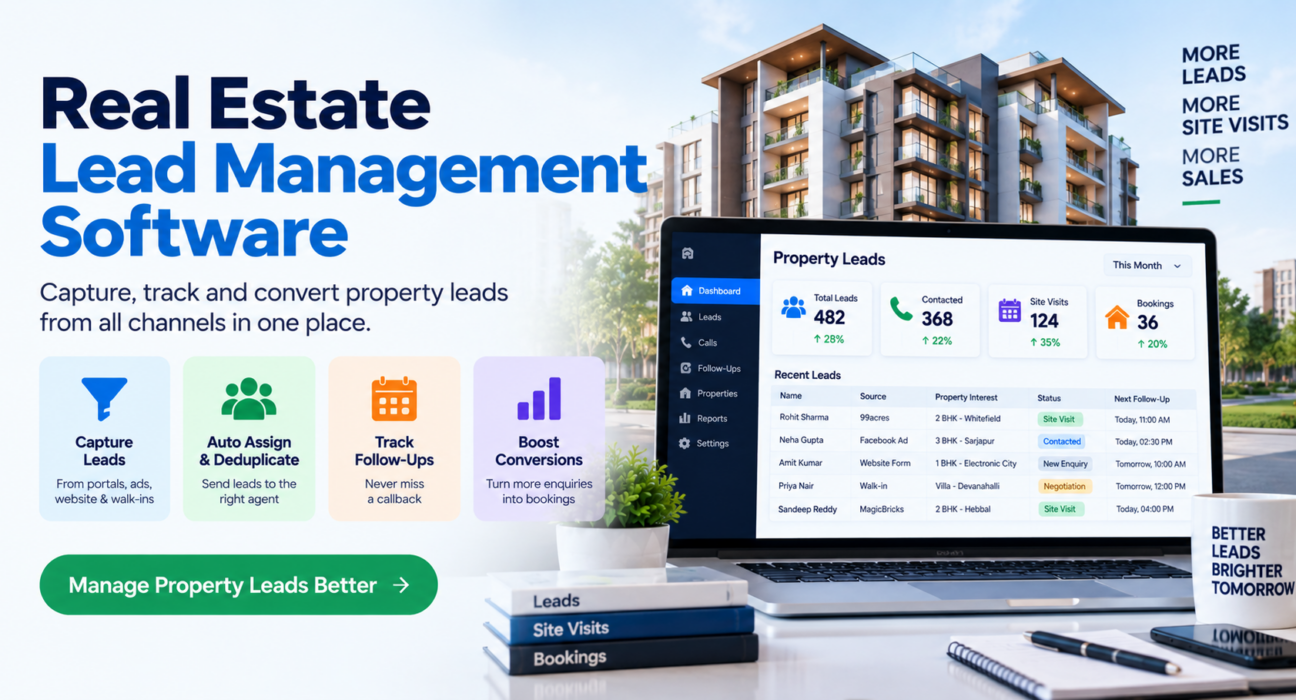
Real Estate Lead Management Software: Manage Property Leads Better
A property buyer rarely enquires just once. They fill a form on 99acres. They message an Instagram ad. They call the site office directly. Sometimes all three happen in the same week.
If these enquiries land in three different places, someone on your team has to spot that it’s the same person. Otherwise you get a duplicate call that annoys the buyer, or a real lead falls through the cracks.
This is exactly the problem real estate lead management software solves. It brings enquiries from portals, ads and walk-ins into one system. Agents know who to call, when, and with what information in hand.
What Is Real Estate Lead Management Software?
Real estate lead management software captures property enquiries from multiple sources. It organises them by stage — enquiry, site visit, negotiation, booking. It also helps agents follow up on time, with call tracking and reporting built around how property sales actually happen.
Unlike a generic contact list or spreadsheet, this software fits the real estate sales cycle. A lead isn’t just a name and number. It carries budget, property type, configuration (1/2/3 BHK), preferred location and possession timeline — details an agent needs before the first call.
Why Real Estate Teams Struggle Without It
Most real estate teams don’t lose deals because buyers aren’t interested. They lose deals because of process gaps that are easy to miss until you measure them.
Common problems include:
- Leads scattered across channels. Portal enquiries, ad form-fills and website leads sit in separate inboxes or spreadsheets. Nobody has one view of the pipeline.
- Slow first response. A lead that isn’t called within the first hour cools down fast. This matters even more when the buyer is also talking to a competing project.
- Duplicate contact. The same buyer enquires twice through different channels. Two agents call them separately, and it looks disorganised.
- Follow-ups forgotten. A buyer who did a site visit but hasn’t decided yet needs a scheduled callback. They don’t need a hope that someone remembers.
- No visibility into what’s selling. Without deal values attached to leads, management can’t tell which source, project or agent drives revenue.
These aren’t small inefficiencies. A single unit sale can be worth lakhs of rupees. A missed follow-up carries a real cost.
How Real Estate Lead Management Software Works
Step 1: Capture
Leads come in automatically from property portals like 99acres, Housing.com and MagicBricks. They also arrive from Facebook and Instagram ads and website forms. Nobody has to copy them manually from email or WhatsApp.
Step 2: De-duplicate and assign
The system checks whether a lead already exists. It routes new enquiries to the right agent or team based on rules you set — by project, location or agent workload.
Step 3: Track through stages
Each lead moves through a pipeline: New Enquiry, Contacted, Site Visit Scheduled, Site Visit Done, Negotiation, Booked, Closed or Lost.
Step 4: Follow up on schedule
Callback reminders and overdue alerts keep a lead visible. A buyer who isn’t ready to decide today doesn’t disappear from view.
Step 5: Report on outcomes
Dashboards show conversion rate, pipeline value, and which source or agent converts best.
Teams that also do outbound calling — following up on enquiries, not just receiving them — usually run this process through dedicated telecalling software built for high call volumes, rather than a general CRM adapted for the job.
Real Estate Lead Fields That Actually Matter
A generic CRM captures a name, number and email. Real estate lead management works better when it captures the details an agent needs before the second call:
| Field | Why It Matters |
|---|---|
| Budget | Filters out mismatched properties early |
| Property type (Flat/Plot/Villa) | Routes lead to the right inventory or project |
| Configuration (1/2/3 BHK) | Speeds up shortlisting for the buyer |
| Preferred location | Helps match leads to nearby projects |
| Possession timeline | Flags urgency — ready-to-move vs under-construction interest |
| Loan required? | Signals whether a home-loan conversation is needed |
| Lead source | Shows which channel produces quality buyers |
Capturing this at first contact means the second call becomes a real conversation. It stops being a repeat of questions already asked.
Practical Example: A Builder Sales Team
Consider a mid-sized builder launching a new residential tower. Enquiries come in from a Facebook ad campaign, a 99acres listing, and the project’s own landing page — often within minutes of each other during a launch weekend.
Without a lead management system, a sales coordinator might export leads from each channel into a spreadsheet once a day. By then, some buyers have already lost interest or contacted a competing project. With a system that auto-imports and auto-assigns leads, agents can call fresh enquiries within minutes, while the buyer’s interest is still active.
This is a hypothetical scenario. It illustrates how the process typically improves — actual results vary by project, team size and market conditions.
Practical Example: A Broker or Channel Partner
A broker handling inventory across several developers faces a different problem. They need to track which buyer is interested in which project, and which site visits are still pending a decision.
A tailored pipeline — Site Visit Scheduled, Site Visit Done, Negotiation, Booked — shows at a glance which leads need a nudge and which are close to converting. Nobody has to rely on memory or scattered notes across multiple projects.
Benefits of Real Estate Lead Management Software
- Faster response times. Leads reach an agent’s queue automatically instead of waiting for manual entry.
- Fewer missed follow-ups. Reminders and overdue alerts cut down how many leads go cold silently.
- Better source visibility. Teams see which portals or ad campaigns actually produce booked deals, not just enquiries.
- Clearer team accountability. Managers see call volume, talk time and conversion per agent, instead of relying on self-reported updates.
- Organised pipeline value. A deal value on each lead gives a realistic picture of open and closed revenue, not just lead counts.
Common Mistakes to Avoid
- Treating every enquiry as equally hot. Without budget and timeline fields, agents waste time on leads that were never a real match.
- Ignoring duplicate leads. Calling the same buyer twice from two different agents damages trust and wastes effort.
- Skipping the follow-up stage. A “Site Visit Done” lead needs a follow-up within a few days, or it often goes cold or books elsewhere.
- Not tracking lead source performance. If you don’t know which portal or campaign brings serious buyers, you can’t allocate marketing budget sensibly.
- Choosing software that doesn’t fit real estate stages. A generic sales pipeline built for software deals rarely matches how property sales progress.
What to Consider Before Choosing a System
Before you pick real estate lead management software, check for:
- Portal integrations. Does it connect directly to the property portals and ad platforms you actually use?
- De-duplication. Does it catch repeat enquiries from the same buyer automatically?
- Real estate-specific fields. Look for budget, configuration, possession timeline — not just generic contact data.
- Follow-up automation. You want reminders, overdue alerts and recurring callbacks, not manual tracking.
- Reporting by source and agent. You need visibility into what’s actually converting.
- A working mobile app. Field agents and site visits need calling and logging from a phone, not just a desktop dashboard.
How TeleCallingCRM Supports Real Estate Lead Management
TeleCallingCRM treats real estate as one of its core use cases. It pulls in leads from sources like 99acres, Housing.com, MagicBricks, and Facebook and Instagram ads. It de-duplicates them and auto-assigns them to agents.
Leads carry real estate-specific fields such as budget, property type, configuration and possession timeline. They move through a pipeline built for property sales — from New Enquiry through Site Visit Scheduled and Site Visit Done to Booked.
An auto dialer works through assigned lead lists, so agents spend their time talking to buyers instead of dialling numbers manually. Follow-up reminders help make sure a lead that did a site visit but hasn’t decided yet still gets a callback. A live dashboard shows pipeline value, conversion rate and agent activity, and the mobile app lets field agents call and log outcomes from their phone.
This context is only useful if it fits your team’s process. The right software for you depends on your lead volume, channels and how your sales team currently works.
FAQs
What is real estate lead management software?
It’s software that captures property enquiries from multiple channels — portals, ads, websites — and organises them by sales stage. It helps agents follow up so leads don’t slip through the cracks.
How is it different from a generic CRM?
A generic CRM tracks contacts and deals in general terms. Real estate lead management software builds around property-specific fields (budget, configuration, possession timeline) and stages (site visit, negotiation, booking) that match how property sales actually progress.
Can it pull leads automatically from portals like 99acres or MagicBricks?
Many systems, including TeleCallingCRM, connect directly to major property portals and ad platforms. New enquiries land in the pipeline automatically instead of getting copied over by hand.
Does real estate lead management software help with follow-ups?
Yes. Most systems include reminders, overdue alerts and recurring callback scheduling. This matters especially for buyers who’ve done a site visit but haven’t yet decided.
Is this only useful for large builders, or also for individual brokers?
Both. Builders use it to route high volumes of launch-day enquiries to the right pre-sales agents. Brokers use it to track buyers across multiple projects and developers in one place.
Does it work for teams that make a lot of outbound calls?
Teams with high call volumes typically pair lead management with an auto dialer. Agents move through assigned lead lists efficiently instead of dialling manually and logging outcomes by hand.
What data should real estate lead management software capture?
At minimum: budget, property type, configuration, preferred location, possession timeline, loan requirement and lead source. These are the details an agent needs before the next conversation with a buyer.
Is a mobile app important for real estate teams?
Yes, particularly for field agents and site visits. Agents need to call, log outcomes and check follow-ups from a phone — this matters more in real estate than in many other sales environments.
Conclusion
Real estate lead management isn’t about adding more software for its own sake. It’s about making sure a genuinely interested buyer gets called quickly, doesn’t get contacted twice by mistake, and isn’t forgotten after a site visit. Getting these basics right matters more than any single feature.
If your team is evaluating options, look closely at how well a real estate lead management software system fits your actual lead sources, your sales stages, and how your agents work day to day. That fit matters more than a long feature list.