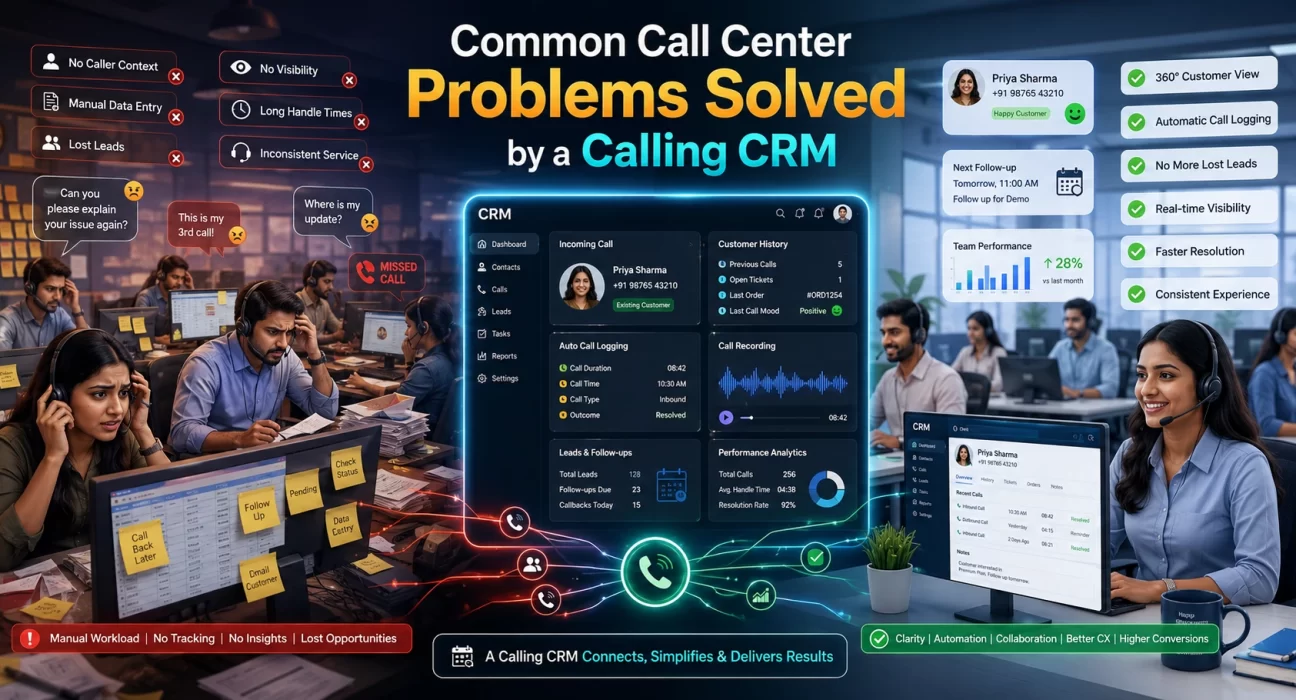
Let us go through the real problems call centers deal with and how a calling CRM helps solve them, one by one.
1. Agents Have No Idea Who Is Calling
This is probably the most common frustration. A customer calls in, and the agent has zero context. They do not know if this person called yesterday, what their issue was, whether it got resolved, or even what product they are using.
A calling CRM fixes this instantly by showing complete customer history the moment a call comes in. No repeated questions. No frustration. Just smooth conversations.
2. Manual Data Entry After Every Call
Agents often spend too much time logging call details after every conversation. This slows them down and leads to skipped entries when the queue gets heavy.
A CRM automates call logging, saving time and improving data accuracy.
3. No Visibility for Managers
Without real-time dashboards, managers are often guessing what is going wrong.
A calling CRM gives full visibility into agent activity, call volumes, performance, and outcomes in real time.
4. Leads Getting Lost or Forgotten
Follow-ups often get buried in spreadsheets or forgotten entirely.
A CRM ensures every lead is tracked with reminders and automated follow-ups so nothing slips through the cracks.
5. Long Call Handling Times
Switching between multiple tools increases call duration.
A CRM keeps everything in one place, reducing handle time and improving efficiency.
6. Inconsistent Customer Experience
Different agents handle the same issue in different ways, leading to inconsistent service.
A CRM standardizes communication using scripts, workflows, and templates.
7. Difficulty in Tracking Team Performance
Without data, performance tracking becomes guesswork.
A CRM provides clear metrics like call volume, resolution rates, and productivity per agent.
8. Poor Coordination Between Teams
Sales, support, and service teams often lack shared visibility.
A CRM ensures everyone works from the same customer data, improving coordination.
9. No Way to Review Calls for Quality
Random call sampling is not enough for proper training.
A CRM with call recording allows structured quality checks and better coaching.
10. Scaling Is a Nightmare
Adding new agents often means new systems, confusion, and setup delays.
A CRM makes scaling smooth by centralizing everything in one platform.
Conclusion
Running a call center without a proper system leads to missed leads, frustrated customers, and overloaded agents. Every small inefficiency adds up and directly impacts revenue and customer satisfaction.
A modern CRM does not just organize calls it transforms the entire workflow into something faster, cleaner, and more scalable.
If you are serious about improving performance, reducing manual work, and delivering consistent customer experiences, then upgrading to a call center CRM solution is no longer optional it is essential.
Explore more about a call center CRM solution and how it can streamline your operations, improve agent productivity, and help you scale without chaos.