Introduction
Choosing PG management software can feel overwhelming, especially with several options claiming to “simplify everything.” The real question isn’t which software has the most features — it’s which PG management software features actually solve the day-to-day problems PG owners face, like late rent, unclear tenant records, or scattered complaint tracking.
This article breaks down the nine essential features PG owners should look for when evaluating PG management software, why each one matters, and how these features address common operational challenges. Whether you’re comparing tools or considering PG and hostel management software for the first time, this guide will help you evaluate options based on what genuinely matters for daily operations.
Why Feature Selection Matters When Choosing PG Management Software
Not every PG needs every feature available in the market. A 15-bed single-building PG has very different needs from an owner managing 200 beds across five properties. Understanding which features matter most for your situation helps you avoid paying for complexity you don’t need, or worse, choosing software that lacks something essential.
With that context, here are the features that consistently matter across most PG and hostel operations.
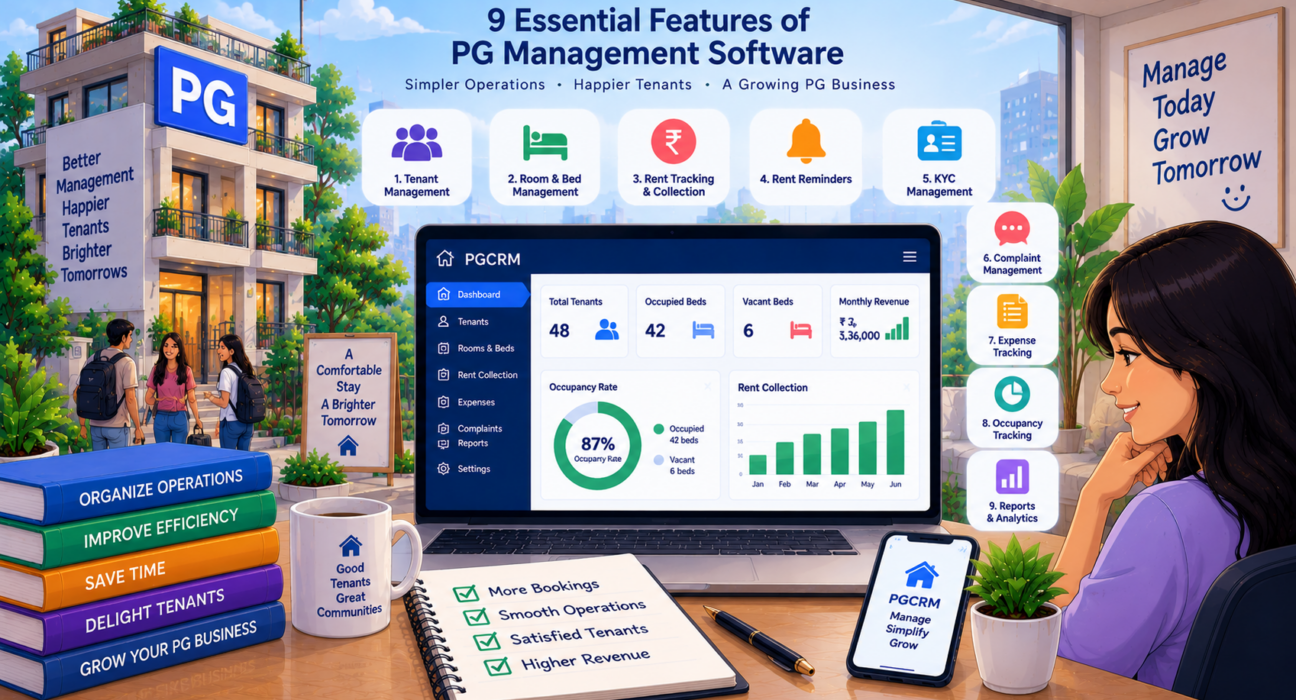
1. Tenant Management
What it does: Centralises tenant information — names, contact details, room assignments, move-in dates, and agreement terms in one accessible place instead of scattered notebooks or files.
Tenant management is foundational because almost every other function, from rent tracking to complaint handling, depends on having accurate, up-to-date tenant records. Without this, owners often struggle to quickly answer basic questions like “which room is this tenant in” or “when did they move in.”
2. Room and Bed Management
What it does: Tracks room and bed-level details, including which beds are occupied, vacant, or reserved, across single, double, or shared room configurations.
For PGs with multiple sharing types, this feature helps owners quickly see availability without physically checking each room. It’s particularly valuable for larger properties or those managing multiple buildings, where manually tracking bed status becomes time-consuming and error-prone.
3. Rent Tracking and Collection
What it does: Records rent due dates, payments received, and outstanding balances for each tenant, giving owners a clear view of who has paid and who hasn’t.
Rent is the core revenue stream for any PG, so having accurate, real-time visibility into payment status is essential. This feature helps owners catch late payments early rather than discovering gaps only when reviewing monthly totals.
4. Cash and UPI Payment Management
What it does: Supports recording and reconciling payments made through multiple methods, including cash and digital payments like UPI.
Many PG tenants prefer different payment methods, and owners need a system that can log all of them accurately rather than being restricted to just one format. This flexibility reduces friction for tenants while keeping owner-side records consistent.
5. Rent Reminders
What it does: Sends automated or scheduled reminders to tenants ahead of or on the rent due date.
Reminders address one of the most common causes of late payments: simple forgetfulness. Rather than relying on the owner to manually follow up with each tenant, this feature helps maintain consistent payment discipline across the board.
6. KYC Management
What it does: Stores and organises tenant identification and verification documents in a centralised, accessible format.
Proper KYC record-keeping is important for both security and administrative purposes. Having tenant ID proof and verification details digitally stored, rather than in physical files that can be lost or misplaced, makes retrieval faster when needed.
7. Complaint Management
What it does: Allows tenants to log complaints or maintenance requests, and lets owners or managers track their status until resolution.
Unresolved or poorly tracked complaints are a common reason tenants leave a PG. A structured complaint management feature ensures issues are recorded, assigned, and followed up on, rather than getting lost in casual conversations or forgotten messages.
8. Expense Tracking
What it does: Records operational costs such as utilities, staff salaries, maintenance, and supplies, helping owners understand where money is being spent.
Expense tracking complements rent tracking by giving owners a fuller financial picture. Knowing total expenses alongside rental income is necessary to calculate actual profitability, not just gross revenue collected.
9. Occupancy Tracking and Reports
What it does: Provides visibility into current occupancy rates, vacant beds, and trends over time, often supported by reports and analytics.
For owners managing multiple properties, occupancy tracking helps identify which buildings or rooms are underperforming. Combined with reporting, this feature turns raw data into insights that support pricing, marketing, and operational decisions.
Quick Feature Reference Table
| Feature | Primary Benefit |
|---|---|
| Tenant Management | Centralised, accurate tenant records |
| Room and Bed Management | Real-time visibility into occupancy status |
| Rent Tracking and Collection | Clear view of paid vs pending rent |
| Cash and UPI Payment Management | Flexible payment recording for tenants |
| Rent Reminders | Reduced late payments through timely nudges |
| KYC Management | Organised, accessible tenant verification records |
| Complaint Management | Faster resolution and better tenant satisfaction |
| Expense Tracking | Clearer picture of operational costs and profitability |
| Occupancy Tracking and Reports | Data-driven decisions on pricing and marketing |
How to Evaluate Which Features You Actually Need
Not every PG owner needs to prioritise all nine features equally. Consider these questions when evaluating options:
- How many tenants and properties do you manage? Smaller PGs may prioritise simplicity, while larger operations benefit more from multi-building tracking and reporting.
- What’s your biggest current pain point? If rent defaults are a recurring issue, prioritise rent tracking and reminders. If complaints go unresolved, prioritise complaint management.
- How do your tenants prefer to pay? If most tenants use UPI, flexible payment recording becomes more important than if you primarily deal in cash.
- Do you need detailed reporting, or just basic tracking? Owners focused on growth and multi-property comparisons benefit more from analytics-heavy tools.
Matching software features to your actual operational challenges is more useful than choosing based on the longest feature list.
Manual Operations vs Software With These Features
| Aspect | Manual Operations | Software With Core Features |
|---|---|---|
| Tenant record accuracy | Scattered across notebooks or files | Centralised and consistently updated |
| Rent visibility | Manually checked per tenant | Clear, real-time payment status |
| Complaint tracking | Often informal, easily forgotten | Logged and tracked to resolution |
| Occupancy insight | Estimated or manually counted | Real-time and reportable |
| Scalability | Difficult beyond a small number of tenants | Easier to manage as operations grow |
This comparison isn’t about manual methods being wrong for every PG — smaller operations can manage reasonably well manually. The gap widens as tenant count, buildings, or complexity increase.
How PGCRM Brings These Features Together
Using PG management software such as PGCRM can help owners centralise tenant management, rent tracking, room and bed management, KYC management, complaint management, expense tracking, and occupancy tracking in a single platform, rather than juggling separate tools or manual records for each function.
PGCRM is a PG and hostel management platform built around these core operational needs, giving owners a centralised view of property information alongside daily tasks like rent collection and tenant communication. For owners evaluating options, checking whether a platform genuinely covers these essential areas — rather than offering unrelated extras is a practical way to assess fit.
FAQ: PG Management Software Features
What features should I look for in PG management software? Look for tenant management, room and bed tracking, rent collection and reminders, KYC management, complaint tracking, expense tracking, and occupancy reporting. These cover the core operational needs most PG owners face daily, regardless of property size.
Do small PGs need all these features? Not necessarily. Smaller PGs with a handful of tenants might prioritise just tenant management and rent tracking initially, while larger or multi-property operations benefit more from the full range, including reporting and occupancy tracking.
Is rent reminder a necessary feature in PG software? Rent reminders help reduce late payments caused by forgetfulness, making them valuable for most PG owners regardless of size. Automated reminders reduce the manual effort of following up with every tenant individually before or on the due date.
How does complaint management improve tenant retention? When complaints are tracked and resolved systematically, tenants feel heard, and issues get addressed faster. Unresolved or forgotten complaints are a common reason tenants choose not to renew their stay, making this feature important for retention.
Why is expense tracking important in PG management software? Expense tracking gives owners visibility into operational costs like utilities, staff wages, and maintenance, which is necessary to calculate actual profitability rather than relying on rent collected alone as a measure of business performance.
Can PG management software handle both cash and digital payments? Good PG management software should support recording multiple payment methods, including cash and UPI, since tenants often have different payment preferences. This flexibility helps maintain accurate records regardless of how tenants choose to pay.
How do I know if PG management software is right for my property? Evaluate whether the software addresses your specific pain points such as late rent, scattered tenant records, or unresolved complaints rather than choosing based on the number of features listed. A good fit covers your core operational needs without unnecessary complexity.
Conclusion
Choosing the right PG management software comes down to identifying which features genuinely address your daily operational challenges, from tenant records and rent tracking to complaint handling and occupancy insights. Rather than being swayed by long feature lists, focus on the essentials that solve real problems for your property.
If you’re evaluating options, exploring PGCRM can give you a sense of how these core features come together in a single platform for PG and hostel owners. Explore PGCRM to simplify your PG and hostel management.