How to Build an Effective Telecalling Script for Sales Teams
Two agents on the same team, calling the same kind of lead, can get completely different results. One gets a callback booked in ninety seconds. The other gets hung up on. Usually the difference isn’t skill — it’s that one of them has a script that actually works, and the other is improvising.
A telecalling script isn’t about making agents sound scripted. In fact, done right, it works the opposite way: it frees agents up to sound natural, because they’re not scrambling to think of the next question or fumbling through an objection they weren’t ready for. It gives them an opening, a set of things to find out, a way through the usual pushback, and somewhere to land the call. So, teams handling a real volume of leads usually connect this structure to their lead management software, which means the script an agent sees actually matches where that lead sits in the pipeline.
Below is a practical walkthrough: how to structure a script, what it should look like across a few different industries, and where most scripts quietly go wrong.
What Is a Telecalling Script?
Simply put, it’s a structured guide for handling a sales call — not a speech to read word-for-word. A working script covers the opening line, the questions that matter, the key talking points, a way to answer common objections, and a clear next step, whatever the call’s outcome turns out to be.
The point isn’t to control what agents say. Instead, it’s to make sure nothing important slips through on the fortieth call of the day, when everyone’s a little tired and a little less careful.
Why Scripts Matter More Than Most Teams Realise
Skip the script, and call quality comes down to whoever happens to be on the phone that day. New hires freeze up or ramble. Meanwhile, your best agents develop habits that work for them personally but can’t be taught to anyone else. And because nothing is standardised, a manager has nothing concrete to coach against.
A decent script changes that:
- Every agent, new or experienced, starts from the same place
- Less dead air, fewer awkward silences mid-call
- Agents ask the right qualifying questions, not just the obvious ones
- Objections meet a plan instead of a shrug
- Call quality becomes something you can actually measure and improve
The payoff compounds with volume, too. If a script shaves even thirty seconds of confusion off each call, that adds up fast across a floor making hundreds of calls a day.
Why Most Existing Scripts Don’t Actually Work
Most teams aren’t starting from zero — they already have “a script” of some kind. Usually, though, the problem comes down to one of these:
- It’s read word-for-word. The moment a lead senses someone is reading to them, they get guarded.
- It stops after the opening line. Great first sentence, then nothing — no plan for objections, no structure for the rest of the call.
- It treats every lead the same. A cold lead who’s never heard of you and a warm lead calling back for the third time need very different openings, but a lot of teams hand agents one script for both.
- Nobody’s touched it in years. Objections shift, pricing changes, competitors change their pitch — yet the script just sits there, untouched since it was written.
Ultimately, a script that isn’t revisited every few months stops being a working tool. It becomes a document nobody trusts.
The Six Parts of a Script That Actually Holds Up
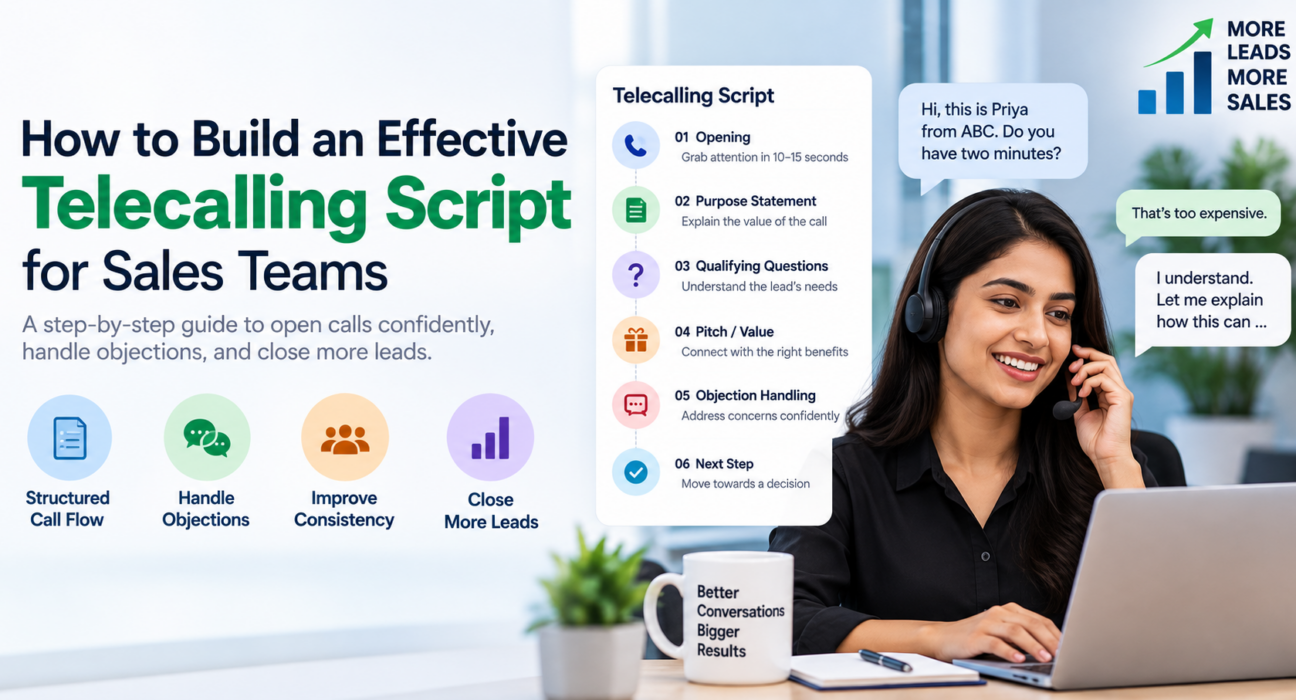
1. The Opening — First 10 to 15 Seconds
This is where the call is won or lost — or rather, where the lead decides almost immediately whether to stay on the line. So the opening needs three things: who’s calling, why, and a quick check that this is an okay time to talk.
Example (Real Estate): “Hi, this is Priya calling from [Company Name]. I saw you enquired about 2BHK flats in Kondapur. Do you have a couple of minutes to discuss your requirement?”
2. Why You’re Calling
Next, say plainly why you’re on the phone and what’s in it for the lead — not just what you’re trying to sell them.
Example (Education): “We’re reaching out because you registered interest in our BBA program. I wanted to walk you through the admission process and answer any questions you have.”
3. Finding Out What They Actually Need
Here, the agent digs into budget, timeline, eligibility — whatever matters for that industry. The questions should be open-ended, not the kind that get a one-word answer.
| Industry | Sample Qualifying Question |
|---|---|
| Real Estate | “What is your preferred budget and location?” |
| Insurance | “Do you currently have any active policy we should consider alongside this?” |
| Recruitment | “What is your notice period, and are you open to relocation?” |
| Finance | “What loan amount and tenure are you looking at?” |
4. The Pitch
Once you know what the lead actually needs, connect the product to that specific need. Otherwise, reciting a full feature list at someone who just told you their one concern is a fast way to lose them.
5. Handling Objections
Arguably the most important part, and the one most scripts leave out entirely. Every common objection deserves a prepared, non-defensive response — ready before the call starts, not invented mid-sentence.
Example:
Lead: “I need to think about it.” Agent: “Totally understandable. Just so I can help better — is it the pricing, the features, or the timing you’d like to think through?”
6. Closing With an Actual Next Step
Finally, don’t let a call end on “okay, I’ll call you back.” Every call should close with something concrete — a follow-up time on the calendar, a document sent, a decision confirmed. Otherwise, vague endings are how leads quietly go cold.
Sample Telecalling Script Template
Here is a simplified, adaptable template:
Opening: “Hi, this is [Agent Name] from [Company Name]. Am I speaking with [Lead Name]?”
Purpose: “I’m calling regarding [reason — enquiry, application, renewal, etc.]. Do you have a few minutes right now?”
Qualifying: “Before I share details, can I ask a couple of quick questions to understand your requirement better?”
Pitch: “Based on what you’ve shared, here’s how [product/service] can help with [specific need].”
Objection Handling: “I understand your concern about [objection]. Here’s how most of our customers have thought about this…”
Closing: “Let’s schedule a follow-up on [date/time] so I can share the next steps. Does that work for you?”
What Changes by Industry
A single script rarely works across every kind of business. What matters shifts depending on what you’re selling:
- Real estate: budget, location preference, and getting a site visit on the calendar.
- Education: eligibility, whether the program actually fits, and looming application deadlines.
- Insurance: what coverage they already have, life stage, and when their current policy renews.
- Healthcare: simple, unhurried language and getting an appointment booked — heavy sales pressure tends to backfire here.
- Recruitment: fit for the role, availability, and where they stand on compensation.
- B2B sales: figuring out who the actual decision-maker is and what business problem is pushing them to look for a solution now. These calls run longer and feel more like a conversation than a pitch.
Where Scripts Usually Go Wrong
- They sound like a script. The whole point is to guide the conversation, not replace how a person actually talks.
- Objections get skipped. A script covering only the opening and pitch is half a script.
- One script for every lead. Someone you’re calling cold and someone calling you back for the third time don’t need the same opening.
- Nobody revisits it. So, pull it out every couple of months and check it against what’s actually happening on live calls.
- Agents memorise it without understanding it. Ideally, they should know why each line is there, not just recite it on autopilot.
Where the CRM Fits In
A script only works if agents actually follow it — and that’s harder to track than it sounds once a team is calling from a shared spreadsheet or personal phones. After all, nobody remembers which script version an agent used last week, or what came up on the last call with a given lead.
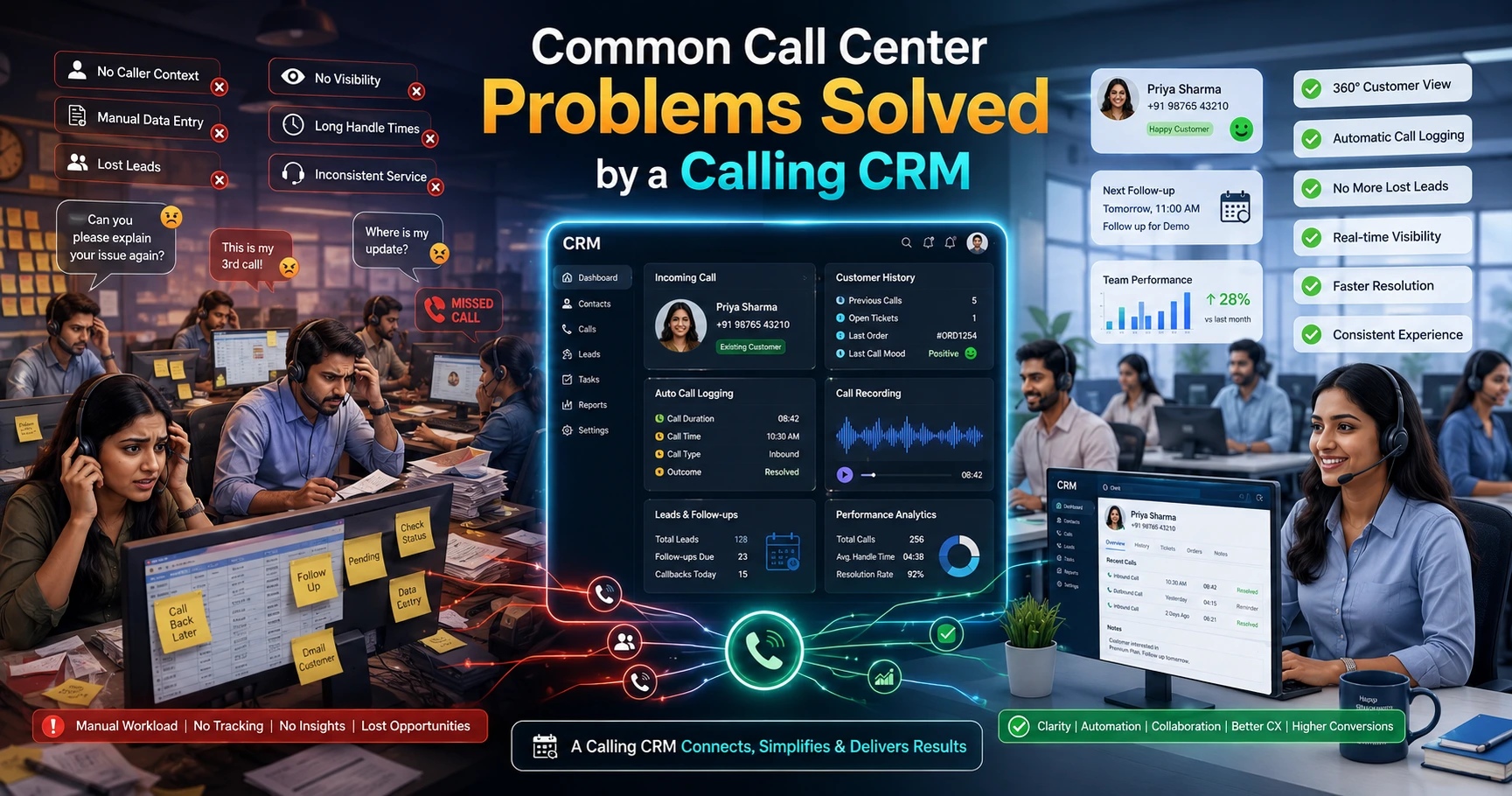
This is the gap telecalling software is built to close. TeleCalling CRM, for instance, attaches the script directly to the calling screen based on where a lead sits in the pipeline — so a first-time cold call sees a different script than a lead three steps from closing. Every call gets logged automatically, and where AI call analysis is switched on, transcripts and summaries let a manager actually see how closely agents stuck to the script and where conversations tend to fall apart.
For teams running any real call volume, that visibility ends up mattering more than the script document itself. After all, a script that reads well on paper but nobody follows won’t move a single number.
What You Get From Pairing a Script With the Right System
- One consistent structure across the whole floor, not five versions floating around
- Managers can pinpoint exactly where calls are losing leads
- New agents get up to speed faster because the script matches the lead’s stage automatically
- Follow-ups actually happen on schedule instead of getting forgotten
- Every outcome gets logged, so coaching relies on real calls, not memory
Frequently Asked Questions
What is a telecalling script? A telecalling script is a structured guide that helps sales agents open calls, ask the right questions, handle objections, and close conversations consistently. In other words, it’s a framework, not a word-for-word speech.
How long should a telecalling script be? Most effective scripts fit on one page. They should cover the opening, purpose, qualifying questions, pitch, common objections, and closing — without so much detail that agents can’t realistically follow it on a live call.
Should every agent read the script exactly as written? No. Instead, agents should use the script as a guide for structure and key points, adapting tone and phrasing so it still sounds natural while covering every part of the script.
How often should a telecalling script be updated? Review scripts every two to three months, or sooner if pricing, offers, or common objections change. Otherwise, scripts that never get revisited tend to fall out of sync with real customer concerns.
Do cold calls and follow-up calls need different scripts? Yes. A cold call needs a stronger opening to earn attention, while a follow-up call can reference the previous conversation directly and move faster into qualifying and closing.
Can a script actually improve conversion rates? A well-structured script can improve consistency and objection handling, which often supports better conversions. That said, results vary by team, industry, and how well agents train on and follow the script — no script guarantees a fixed improvement.
Do I need software to use a telecalling script? No — a script can work on paper or in a document. However, a CRM for telecallers makes it easier to attach the right script to the right lead stage and track how well agents are following it.
Conclusion
A good telecalling script was never about controlling what agents say. Instead, it’s about making sure every call has somewhere to go — a real opening, questions that surface what the lead actually needs, a plan for the objections that always come up, and an ending that isn’t just “we’ll see.”
Writing the script is the easy part. Making sure agents actually use it on call number two hundred of the day is harder — which is why a growing number of teams pair theirs with telecaller CRM tools that tie scripts to lead stages, log every call automatically, and give managers a real window into how conversations are going. Ultimately, that’s usually what turns a decent script into results you can actually see.