Artificial intelligence has moved from a buzzword to a business necessity. Yet most companies still struggle with one core question: how do you turn AI from a scattered set of experiments into a strategy that actually drives growth?
If you’re a founder, business owner, or technology decision-maker, you’ve probably already tried a chatbot, tested an AI writing tool, or asked your team to “look into AI.” The problem is that isolated tools rarely create lasting value. Building a real AI strategy for business growth requires a clear plan that connects AI initiatives to your goals, your data, your people, and your budget.
This guide breaks down exactly how to build that strategy, step by step, so you can move from ad-hoc experimentation to measurable business results.
What Is an AI Strategy, and Why Does It Matter?
An AI strategy is a structured plan that defines how a business will use artificial intelligence to achieve specific goals, such as reducing costs, improving customer experience, increasing revenue, or accelerating decision-making.
A strong AI strategy matters because:
- It prevents wasted spending on tools that don’t align with business needs.
- It ensures AI projects are prioritized based on impact, not hype.
- It builds a foundation for scaling AI across departments instead of keeping it siloed.
- It reduces risk related to data privacy, compliance, and poor implementation.
Without a strategy, most companies end up with fragmented AI pilots that never scale, leaving leadership questioning the return on investment.
Step 1: Define Business Goals Before Choosing AI Tools
The most common mistake businesses make is starting with technology instead of starting with the problem. Before evaluating any AI Strategy for Business initiative, clarify what you’re actually trying to achieve.
Ask these questions first:
- What business outcome are we trying to improve? (revenue, efficiency, customer retention, product quality)
- Which department or process is most affected by this problem?
- How will we measure success?
- What is the realistic budget and timeline?
Once you have clear answers, you can evaluate AI use cases based on business value rather than novelty.
Common Business Goals AI Can Support
| Business Goal | Example AI Use Case |
|---|---|
| Reduce operational costs | Automating repetitive back-office tasks |
| Improve customer experience | AI-powered chat support and personalization |
| Increase sales | Predictive lead scoring and recommendation engines |
| Speed up decision-making | Data analytics and forecasting tools |
| Improve product development | AI-assisted testing and code generation |
Step 2: Assess Your Data Readiness
AI systems are only as good as the data behind them. Before investing in advanced AI capabilities, businesses need to evaluate whether their data is organized, accurate, and accessible.
Key questions to assess data readiness:
- Is your data centralized, or spread across disconnected systems?
- Is the data clean, consistent, and up to date?
- Do you have proper data governance and security policies?
- Who owns and maintains your data internally?
Many companies discover that their biggest AI barrier isn’t the technology itself, but outdated or messy data infrastructure. Addressing this early prevents costly rework later.
Step 3: Identify High-Impact, Low-Risk Use Cases First
Rather than attempting a company-wide AI transformation immediately, successful businesses start with focused use cases that are easy to measure and unlikely to disrupt core operations.
How to Prioritize AI Use Cases
Use a simple framework to evaluate potential projects:
- Impact: How much value will this create if successful?
- Feasibility: Do we have the data, tools, and skills to execute this?
- Risk: What happens if this doesn’t work as expected?
- Time to value: How quickly can we see measurable results?
Start with use cases that score high on impact and feasibility, but low on risk. Examples include automating customer support responses, streamlining internal reporting, or improving content production workflows.
Step 4: Decide Between Building, Buying, or Partnering
Once you’ve identified priority use cases, the next decision is how to execute them. Businesses generally have three options.
Build In-House
Best for companies with strong technical teams and a long-term need for custom AI capabilities. This option offers the most control but requires significant time, talent, and ongoing maintenance.
Buy Existing AI Software
Best for companies that need fast implementation using proven SaaS tools. This is often the most cost-effective route for common use cases like customer support automation or marketing analytics.
Partner With a Technology Provider
Best for companies that need custom AI development, integration support, or specialized expertise they don’t have internally. This is common for businesses building proprietary AI features into their own products or platforms.
Since technology and service-provider selection can significantly affect project outcomes, many businesses use research platforms like GoFirms to compare software development companies, IT service providers, and technology partners before committing to a vendor.
Step 5: Build Internal AI Capabilities and Governance
A sustainable AI strategy requires more than tools, it requires people and processes.
Key Areas to Address
- Skills and training: Ensure relevant teams understand how to use AI tools effectively.
- Ownership: Assign clear responsibility for AI initiatives, whether through a dedicated team or cross-functional leads.
- Governance: Establish policies for data privacy, ethical use, and compliance.
- Change management: Prepare employees for how workflows will shift, and address concerns transparently.
Companies that ignore governance and training often see AI tools underused or misapplied, reducing their potential value.
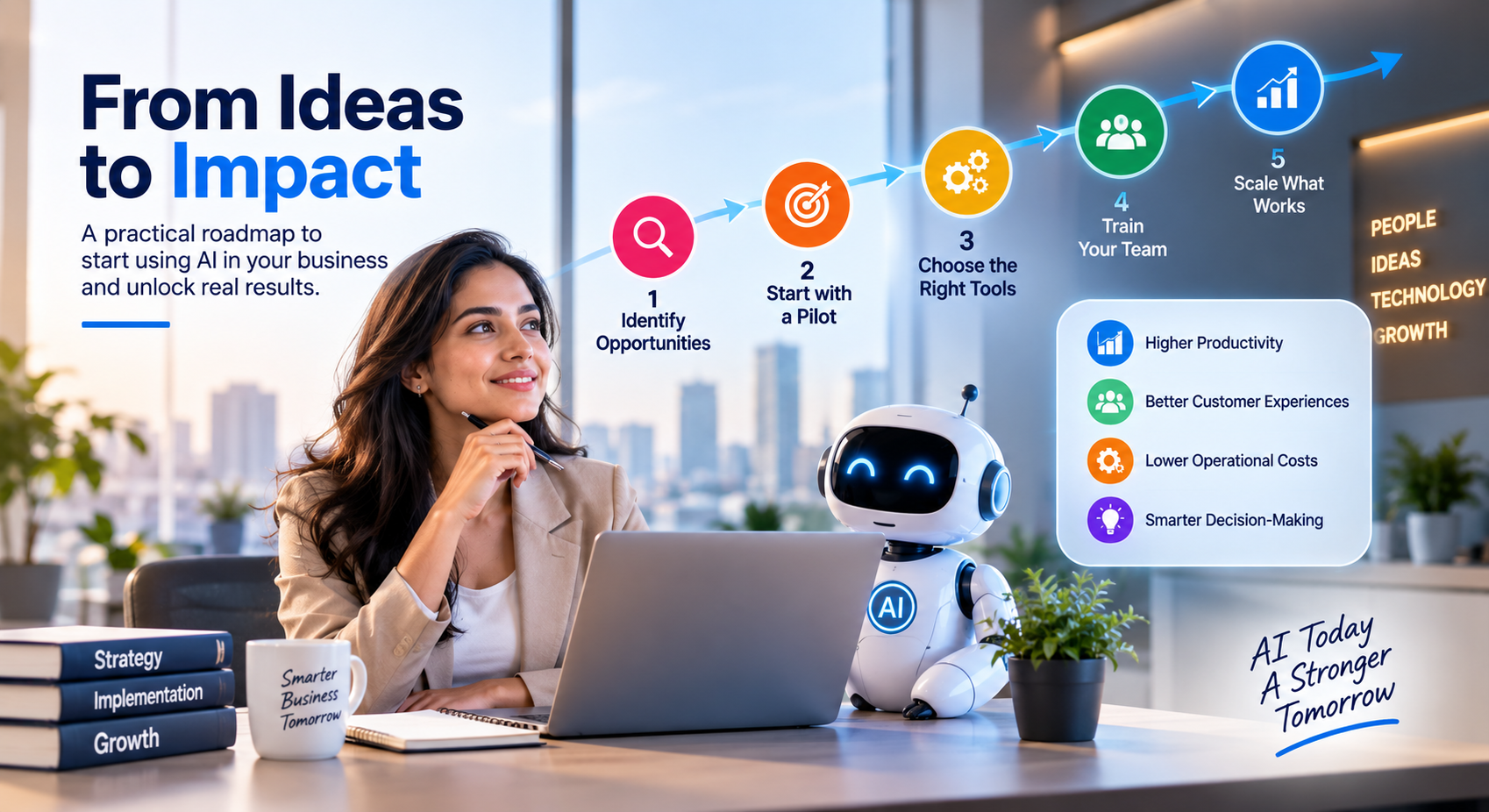
Step 6: Pilot, Measure, and Scale
Before rolling out AI solutions company-wide, run structured pilot programs.
A Simple Pilot Framework
- Select one use case with clear success metrics.
- Implement on a small scale (one team, one process, or one market).
- Measure results against predefined KPIs.
- Gather feedback from users involved in the pilot.
- Refine the approach based on real-world results.
- Scale gradually to additional teams or departments.
This approach reduces risk while creating internal proof points that justify further investment.
How Do You Measure the Success of an AI Strategy?
Measuring AI success requires connecting outcomes directly to business metrics, not just technical performance.
Useful metrics include:
- Time saved on manual tasks
- Cost reduction in specific processes
- Revenue impact from AI-driven personalization or sales tools
- Improvement in customer satisfaction scores
- Accuracy and reliability of AI-generated outputs
Regularly reviewing these metrics helps leadership decide where to expand AI investment and where to pull back.
Common Mistakes to Avoid When Building an AI Strategy
- Starting with technology instead of business goals. This leads to tools that don’t solve real problems.
- Ignoring data quality. Poor data undermines even the best AI systems.
- Trying to do too much at once. Broad, unfocused rollouts are harder to manage and measure.
- Skipping employee training. Even great tools fail without proper adoption.
- Choosing vendors without proper evaluation. Selecting the wrong technology partner can delay projects and increase costs.
Avoiding these mistakes early significantly increases the odds of long-term success.
Choosing the Right Technology Partner for AI Implementation
For many businesses, especially those without large internal engineering teams, working with an experienced technology partner accelerates AI adoption. The right partner brings technical expertise, industry experience, and faster implementation timelines.
When evaluating potential partners, consider:
- Relevant experience with AI or software projects similar to yours
- Technical expertise in data engineering, machine learning, or automation
- Transparent communication and project management practices
- Ability to support long-term maintenance and iteration
Platforms like GoFirms can help businesses research and compare software development companies and IT service providers, making it easier to shortlist partners suited to specific AI project requirements.
Frequently Asked Questions
What is an AI strategy for business? An AI strategy for business is a structured plan outlining how a company will use artificial intelligence to achieve specific goals, such as improving efficiency, reducing costs, or increasing revenue. It includes goal-setting, data readiness, use case prioritization, and implementation planning.
How long does it take to build an AI strategy? Timelines vary based on company size and complexity, but most businesses can develop a foundational AI strategy within four to eight weeks. This includes goal definition, data assessment, and identifying initial use cases before implementation begins.
Do small businesses need an AI strategy? Yes. Small businesses benefit from AI strategies because they help prioritize limited resources toward high-impact use cases, such as automating repetitive tasks or improving customer service, rather than experimenting randomly with tools.
Should I build AI tools in-house or use existing software? It depends on your technical resources and use case complexity. Simple, common needs are often better served by existing SaaS tools, while unique or proprietary requirements may justify in-house development or a specialized technology partner.
How do I know if my business is ready for AI? Readiness depends on having clear business goals, reasonably organized data, and internal support for adoption. Businesses don’t need perfect systems to start, but they do need a plan to address gaps as they scale AI initiatives.
What are the biggest risks of implementing AI without a strategy? Without a strategy, businesses risk wasted spending, poor tool adoption, inconsistent results, and data privacy or compliance issues. Ad-hoc AI use often creates isolated wins that fail to scale into meaningful business impact.
How do I find the right AI or software development partner? Start by clearly defining your project requirements, then research providers based on relevant experience, technical expertise, and communication style. Platforms like GoFirms allow businesses to compare technology and service providers before making a decision.
Conclusion
Building an effective AI strategy for business growth isn’t about adopting every new tool on the market. It’s about aligning AI initiatives with clear business goals, ensuring your data is ready, prioritizing high-impact use cases, and building the internal capabilities needed to scale successfully.
By following a structured approach, defining goals, assessing readiness, piloting carefully, and measuring results, businesses can move beyond experimentation and turn AI into a genuine driver of growth.
If your business is exploring AI implementation and needs the right technology partner, platforms like GoFirms can help you research and compare software development companies, IT service providers, and other technology partners suited to your specific goals.