Your payment gateway goes down during a festival sale. Your core banking system encounters a critical bug during month-end processing. A ransomware attack locks your supply chain management platform. A data centre floods during the monsoon season.
These aren’t hypothetical scenarios. They happen. And when they do, the quality of your incident management and disaster recovery capabilities determines whether you recover in hours or suffer losses that make board meetings uncomfortable.
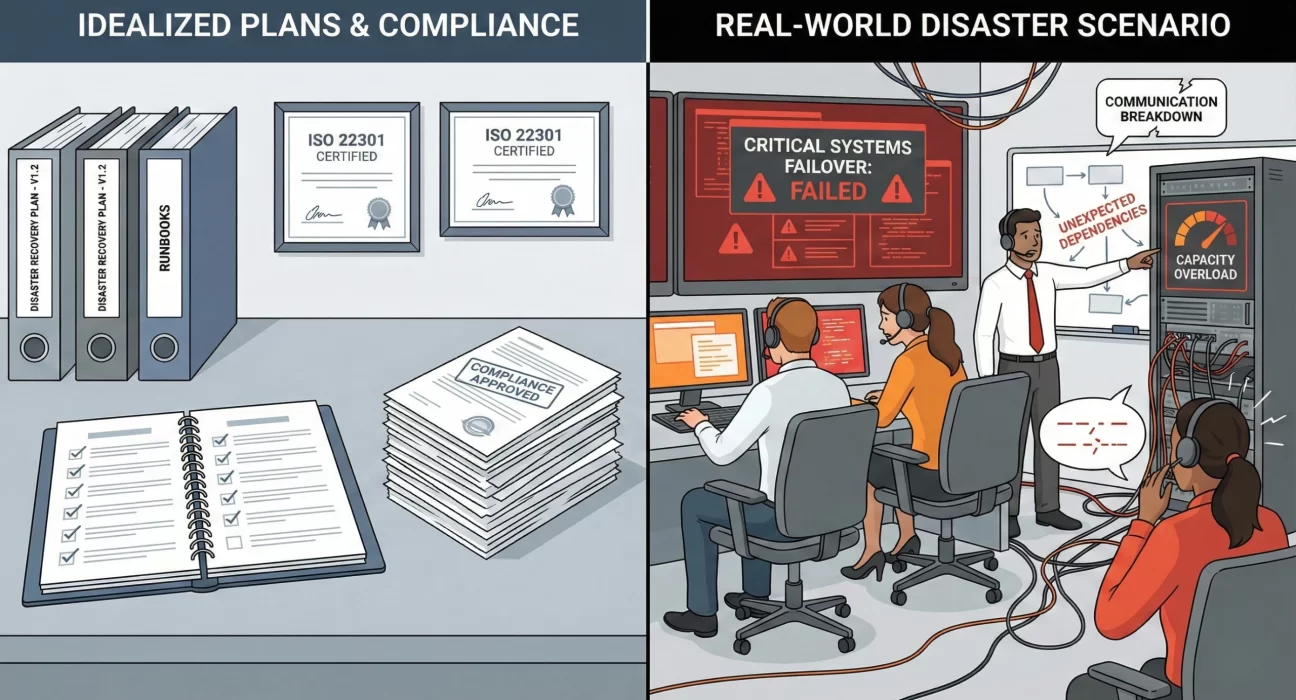
Most enterprises have disaster recovery plans. Many have incident response procedures documented somewhere. But documentation and actual operational readiness are vastly different things. The gap between what’s written in a runbook and what actually happens during a production crisis often defines the difference between controlled recovery and complete chaos.
This matters more than most executive conversations acknowledge. Your digital transformation initiatives, your customer experience investments, your operational efficiency programs, all of them depend on systems that must keep running. And when they don’t, your ability to restore service quickly and completely becomes the only thing that matters.
Yet incident management and disaster recovery remain chronically underprepared areas in enterprise IT programs. Not because organisations don’t care, but because building real operational resilience is hard, expensive, and requires sustained focus that often gets deprioritised when everything seems to be working fine.
The Reality of Enterprise Incidents
Here’s what actually happens when things go wrong in large enterprises.
An incident is detected sometimes by monitoring systems, often by users complaining, and occasionally by someone noticing something odd. An alert goes out. People scramble to join a call. Everyone asks what’s happening. Nobody has complete information yet.
Engineers start investigating. They check logs, but the logs are scattered across multiple systems. They look at monitoring dashboards, but the dashboards weren’t designed for this specific failure scenario. They try to identify the root cause, but the system is complex, with dozens of services, multiple integrations, and dependencies on third-party platforms.
Meanwhile, the clock is ticking. Customers can’t complete transactions. Internal users can’t access critical applications. Revenue is being lost. SLA commitments are being breached. Social media starts buzzing with complaints.
Someone needs to make decisions. Should we roll back the last deployment? Should we switch to backup systems? Should we communicate with customers now or wait until we understand the problem better? Who has the authority to make these calls? Who’s coordinating the response?
This is where most enterprises struggle. Not with the technical problem itself, but with the coordination, communication, decision-making, and execution under pressure.
The organisations that handle incidents well have practised these scenarios. They have clear roles and responsibilities. They have communication protocols that work even when primary systems are down. They have decision frameworks that enable quick action without endless escalation chains.
The ones that struggle have great people working in heroic chaos—everyone trying their best, but without the structure, preparation, or clarity needed to recover efficiently.
Why Disaster Recovery Plans Fail
Every enterprise has a disaster recovery plan. Most have never actually tested whether it works under real conditions.
Testing usually means running through a checklist during a planned maintenance window with full teams available and no actual business pressure. That’s useful, but it’s not realistic. Real disasters don’t wait for convenient times. They happen during holidays, weekends, peak business periods. They happen when key people are unavailable. They happen when you’re already dealing with other problems.
The disaster recovery plan assumes your backup systems are ready. But are they actually synchronised with production? Do they have the same configuration? Are the passwords current? Does anyone remember how to activate them? Have they been patched and maintained, or have they been sitting idle for months?
The plan assumes you can restore from backups. But how old are those backups? Have you ever actually tested a full restore? Can you restore to a specific point in time? What about data that’s distributed across multiple databases and storage systems? Can you ensure consistency when restoring?
The plan assumes your team knows what to do. But documentation gets outdated. People change roles. New systems get added. Processes evolve. The runbook that was accurate two years ago might be dangerously misleading today.
These gaps emerge during actual disasters, not during planning meetings. And by then, you’re learning expensive lessons under the worst possible circumstances.
The Organisational Challenge
Technology is the easy part of incident management and disaster recovery. The hard part is organisational readiness.
When an incident occurs, you need clarity on who’s in charge. Not who’s responsible in theory, but who actually makes decisions during the crisis. In large enterprises, this gets complicated quickly. Development teams built the system. Operations teams run it. Infrastructure teams manage the underlying platforms. Security teams need to be involved if there’s a breach. Business stakeholders need updates. Executive leadership wants answers.
Without clear command structures, you get chaos. Too many people are involved in every decision, which slows everything down. Or too few people with authority, which means critical decisions get escalated repeatedly up chains of command while the problem worsens.
Communication becomes another failure point. During incidents, everyone needs information—what’s happening, what’s being done, and what’s the expected timeline for resolution. But communicating effectively during a crisis requires discipline. You need regular updates even when there’s nothing new to report. You need different communication channels for technical teams, business stakeholders, and customers. You need someone whose job is to manage communication, not just participate in troubleshooting.
Then there’s the handoff problem. Incidents don’t always resolve in a few hours. Sometimes they stretch across shifts, across time zones, across days. How do you ensure continuity when tired engineers hand off to fresh teams? How do you maintain context? How do you avoid repeated investigation of the same dead ends?
These aren’t technical problems. They’re organisational maturity problems. And they’re where enterprise programs often reveal their weaknesses.
What Mature Enterprises Do Differently
Organisations that handle incidents and disasters well share certain characteristics. They’ve usually learned through painful experience, but they’ve learned.
They practice. Not just annual disaster recovery drills, but regular incident response exercises. They simulate failures, network outages, database corruption, and security breaches, and they run through their response procedures under realistic conditions. They involve all the stakeholders who would be involved in a real incident. They time how long things take. They identify gaps in their processes and fix them.
They document obsessively, but keep documentation current. Every incident gets a thorough post-mortem. Every disaster recovery test gets documented. Every process improvement gets updated in the runbooks. And someone is responsible for ensuring documentation doesn’t become obsolete.
They invest in automation where it matters. Automated failover for critical systems. Automated backup verification. Automated health checks. Automated incident notification. Not because automation solves everything, but because it eliminates the delays and errors that happen when people are executing checklists manually under pressure.
They separate concerns clearly. Incident commanders who coordinate response but don’t do technical work. Technical teams that focus on troubleshooting without getting pulled into status meetings. Communication leads who manage stakeholder updates. Business continuity teams who activate alternative processes if systems can’t be restored quickly.
Most importantly, they treat incidents as learning opportunities, not witch hunts. When things go wrong, the focus is on understanding what failed and how to prevent it from failing again, not on finding someone to blame. This creates a culture where people report problems early instead of hiding them, which is essential for catching incidents before they become disasters.
The Economics of Downtime
CFOs care about disaster recovery for a simple reason: downtime costs money.
For an e-commerce platform processing crores in transactions daily, every hour of downtime is directly measurable revenue loss. For a manufacturing operation dependent on supply chain systems, downtime means production delays that ripple through the entire operation. For a financial services company, downtime means SLA penalties, regulatory reporting issues, and potential compliance violations.
But the true cost goes beyond immediate revenue impact. There’s reputation damage when customers lose trust when systems fail repeatedly. There’s a competitive impact; customers who can’t transact with you will transact with someone else, and they might not come back. There’s no employee morale, nothing demotivates teams faster than constantly firefighting production issues.
This is why disaster recovery and business continuity planning require CFO involvement, not just CIO attention. The decisions about how much to invest in redundancy, backup systems, and disaster recovery capabilities are fundamentally business decisions. They require balancing cost against risk, understanding the business impact of different failure scenarios, and making conscious trade-offs.
Some systems need hot failover with near-zero recovery time. Others can tolerate several hours of downtime. Some data requires minute-by-minute backup. Other data can be recovered from end-of-day snapshots. These aren’t technical questions, they’re business questions that determine technical requirements.
Mature enterprises make these decisions deliberately during program planning, not reactively after disasters occur. They classify systems by criticality. They define recovery time objectives and recovery point objectives based on actual business impact analysis. They budget accordingly. And they verify regularly that their investments are actually delivering the resilience they paid for.
The Compliance Dimension
Regulators care deeply about operational resilience. Banking regulators require documented business continuity plans. Data protection regulations mandate specific incident response procedures. Industry-specific compliance frameworks impose requirements for disaster recovery capabilities.
This creates another layer of complexity. Your disaster recovery approach must not only work technically and make business sense financially—it must also satisfy regulatory requirements.
This means demonstrable testing. Regulators want evidence that your disaster recovery plans actually work, which means documented testing results, not just theoretical procedures. It means retention of incident records. It means specific timelines for incident notification to authorities. It means particular types of backup and recovery capabilities for regulated data.
For enterprises operating in India, this includes compliance with RBI guidelines for financial institutions, IRDAI requirements for insurance companies, data localisation requirements, and various sector-specific regulations. For global enterprises with Indian operations, it means navigating the intersection of Indian regulations with international frameworks like GDPR, SOC 2, and ISO 27001.
The challenge is that compliance requirements often lag behind technological change. Regulations written for traditional data centre operations don’t always map cleanly to cloud-native architectures. Guidelines designed for monolithic systems may not address the complexity of microservices and distributed platforms.
Enterprises need to interpret regulatory intent, implement controls that satisfy the spirit of requirements even when the letter is ambiguous, and document their approaches thoroughly. This requires legal input, compliance expertise, and technical implementation, another coordination challenge that tests organisational maturity.
Choosing Partners Who Understand Reality
Many technology vendors will sell you disaster recovery solutions. Fewer partners understand how to build operational resilience into enterprise platforms in ways that actually work when tested.
The difference matters enormously. A vendor provides technology. A partner helps you think through the organisational, procedural, and cultural changes required to make that technology effective.
When Ozrit works with enterprises on large-scale digital transformation programs, the conversation about incident management and disaster recovery happens during architecture design, not after deployment. It’s about building systems that fail gracefully, that provide clear diagnostic information when things go wrong, that support rapid recovery procedures. It’s about helping enterprises establish the governance frameworks, testing regimens, and operational procedures that turn documentation into actual capability.
This approach requires partners who have been through real incidents at scale, who understand the organisational dynamics of crisis response, and who know the difference between theoretical readiness and operational reality.
It also requires partners who stay engaged beyond go-live. Incident management and disaster recovery aren’t one-time implementations; they’re ongoing capabilities that must evolve as systems change, as teams change, as business requirements change. The partner who helped you build your platform should be able to help you operate it reliably over time.
Legacy Systems and Hybrid Complexity
Most enterprise IT transformations don’t involve building everything new. You’re integrating with legacy systems, ERP platforms that have been running for 15 years, core banking systems that can’t be replaced easily, and specialised industry applications that have no modern alternatives.
This creates disaster recovery complexity that purely greenfield environments don’t face. Your shiny new microservices platform might have beautiful automated failover, but what happens when the legacy mainframe it depends on goes down? Your cloud-based disaster recovery might work perfectly for cloud-native components, but how do you fail over the on-premises systems that integrate with them?
These hybrid scenarios require careful orchestration. You need disaster recovery procedures that span multiple technology generations, multiple hosting environments, and multiple operational teams. You need to ensure that recovering your modern platform doesn’t leave it in a broken state because its legacy dependencies weren’t recovered properly.
You also need to manage recovery time objectives realistically. If your legacy system takes 12 hours to restore from backup, your overall recovery time is at least 12 hours, regardless of how quickly you can restore everything else. This might require business process workarounds, manual procedures that can operate temporarily while systems recover, and alternative workflows that route around failed components.
Mature enterprises map these dependencies explicitly. They understand which systems are critical to business operations. They know which integrations can be temporarily disabled and which must be maintained. They have degraded mode operations defined for scenarios where full restoration takes time.
This level of preparedness doesn’t happen by accident. It requires dedicated business continuity planning that involves business stakeholders, not just IT teams. It requires regular validation that the dependencies you mapped six months ago are still accurate. It requires acceptance that perfect availability isn’t achievable, so you need good plans for imperfect scenarios.
Building a Culture of Resilience
The ultimate goal isn’t just having incident response plans and disaster recovery capabilities. It’s building an organisational culture where resilience is a core value.
This means development teams building systems with failure modes in mind, services that fail safely, data stores that maintain consistency even during partial outages, and monitoring that clearly indicates what’s broken and what’s still working.
It means operations teams constantly testing and improving their response capabilities—not waiting for annual disaster recovery drills, but continuously validating that backup systems are ready, that runbooks are current, that newer team members understand critical procedures.
It means business leaders understand that perfect uptime is unrealistic and plan accordingly, having contingency processes, setting realistic availability expectations with customers, and budgeting for the redundancy and backup capabilities that meaningful resilience requires.
It means honest post-incident reviews that focus on system improvements rather than individual blame, creating psychological safety for teams to report problems early, to acknowledge when procedures didn’t work as expected, and to suggest changes without fear of repercussion.
This cultural shift is harder than implementing technology. It requires sustained leadership commitment. It requires resources even when everything is working fine. It requires celebrating successful incident responses and disaster recovery tests with the same enthusiasm that product launches receive.
Enterprises that make this shift find that their overall system quality improves. When teams design for failure from the start, they build better systems. When operations teams practice recovery procedures regularly, they find problems before they become critical. When business stakeholders understand resilience trade-offs, they make better-informed decisions about investment priorities.
Practical Steps Forward
If you’re leading enterprise IT transformation or managing complex technology platforms, certain actions deliver disproportionate value.
Start by knowing your actual recovery capabilities, not your theoretical ones. Test your disaster recovery plans under realistic conditions. Time is how long things actually take. Identify where your assumptions were wrong. Fix the gaps.
Classify your systems by actual business criticality. Not everything needs the same level of disaster recovery investment. Focus your resources where downtime truly impacts business operations. Be honest about what you can tolerate, longer recovery times.
Build incident response as a discipline, not a side activity. Define clear roles. Establish communication protocols. Train your teams. Run practice scenarios. Make incident response muscle memory, not something people figure out under pressure.
Document obsessively, but keep documentation ruthlessly current. Outdated runbooks are worse than no runbooks—they give false confidence. Assign ownership for keeping procedures updated. Make documentation review part of your change management process.
Invest in observability and diagnostics. When incidents occur, the ability to quickly understand what’s wrong is often more valuable than elaborate recovery automation. Systems that clearly indicate their health status and provide detailed diagnostic information enable faster recovery than systems that fail silently.
Create feedback loops. Every incident should improve your capabilities. Every disaster recovery test should identify weaknesses. Every near-miss should trigger preventive action. Treat operational learning as seriously as product development.
The Bottom Line
No enterprise platform runs perfectly all the time perfectly. Systems fail. Dependencies break. Disasters happen. The question isn’t whether you’ll face incidents, it’s whether you’ll recover from them quickly and completely.
Your incident management and disaster recovery capabilities directly impact business continuity, customer trust, regulatory compliance, and financial results. They’re not optional. They’re not “nice to have.” They’re fundamental operational requirements that determine whether your digital transformation initiatives actually deliver sustainable value.
The enterprises that execute well understand this. They invest in resilience during system design, not after failures occur. They practice their response capabilities regularly. They build organisational muscle memory for handling crises. They learn from every incident and continuously improve.
The ones that struggle treat incident management and disaster recovery as paperwork exercises, plans that exist to satisfy auditors but aren’t actually operational. They discover their unpreparedness at the worst possible time, and they pay for it in downtime, lost revenue, reputation damage, and stakeholder erosion.
The difference comes down to execution maturity and organisational discipline. Do you have clear ownership? Do you practice regularly? Do you learn systematically? Do you invest appropriately? Do you have partners who understand not just the technology, but the organisational realities of building operational resilience?
These aren’t questions that get answered in strategy documents. They get answered when your payment system goes down at peak hour, when your data centre fails during monsoon, when a security incident requires isolating critical systems.
That’s when preparation matters. That’s when organisational maturity shows. That’s when the difference between documentation and capability becomes painfully obvious.
Build your incident management and disaster recovery capabilities before you need them. Test them regularly. Keep them current. Treat them as core operational disciplines, not compliance obligations.
Because when systems fail, and they will, recovery speed isn’t determined by how good your technology is. It’s determined by how well you prepared, how clearly you execute, and how honestly you’ve assessed your actual readiness.
That’s the reality of running enterprise platforms at scale. And it’s what separates organisations that deliver reliably from those that hope for the best and scramble when it’s not enough.