

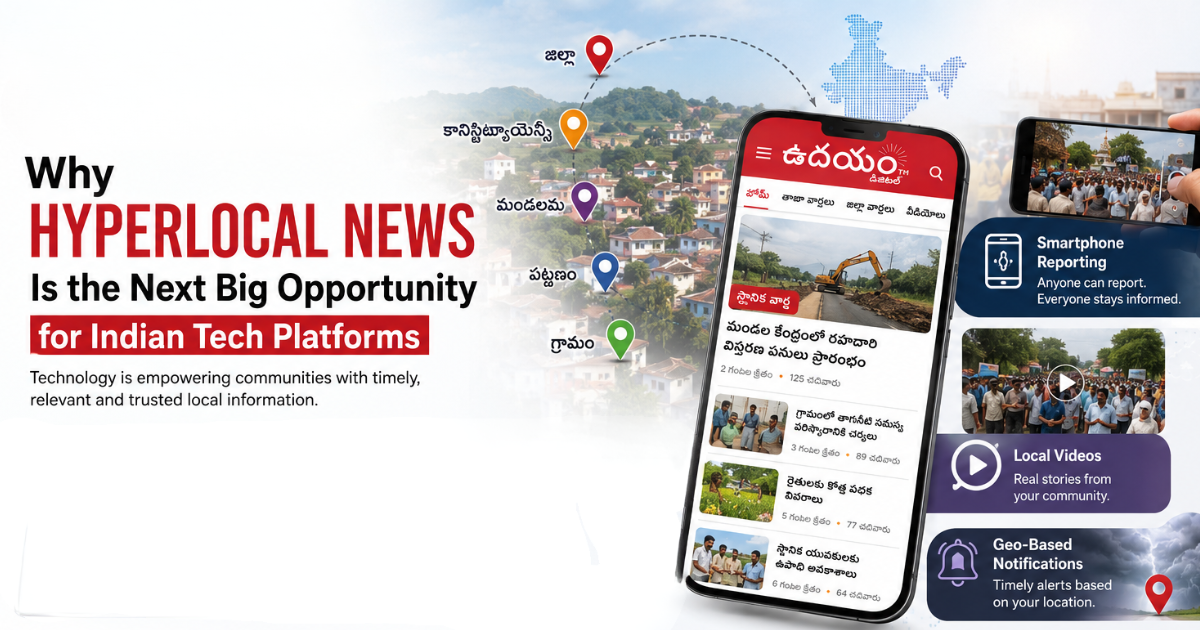
India’s digital revolution has transformed how people consume information. While national and state-level news continues to attract large audiences, readers increasingly want updates that directly affect their daily lives. News about a village road repair, a mandal-level government scheme, a district recruitment drive, or a constituency development project often matters more to local residents than national headlines.
This shift has created a massive opportunity for hyperlocal news, where technology platforms can deliver timely, relevant, and personalized information to specific communities. With smartphones, affordable internet, artificial intelligence, and location-based services becoming more accessible, Indian technology companies are well-positioned to reshape local journalism for millions of users.
What Is Hyperlocal News?
Hyperlocal news focuses on information relevant to a very specific geographic area rather than covering an entire state or country. Instead of broad headlines, it delivers updates related to:
- Villages
- Mandals
- Towns
- Municipalities
- Districts
- Constituencies
- Neighborhoods
This type of reporting covers local governance, education, agriculture, weather, healthcare, employment, public transport, festivals, markets, and community events.
Readers often find hyperlocal news more useful because it directly impacts their everyday decisions and lifestyles.
The Limits of Traditional Centralized Media
Traditional news organizations primarily focus on national, international, and major state-level developments. Due to limited newsroom resources, they cannot consistently report every issue affecting thousands of towns and villages across India.
As a result, many important local stories remain uncovered, including:
- Village infrastructure problems
- Local government announcements
- Panchayat decisions
- Small business developments
- Community welfare programs
- Local education initiatives
- Agricultural concerns
Digital platforms remove many of these limitations by allowing content to be created and distributed quickly without relying on large centralized editorial offices.
Smartphones Are Creating a New Generation of Reporters
One of the biggest reasons behind the rise of hyperlocal news is widespread smartphone adoption.
Today, nearly everyone carries a device capable of the following:
- Capturing high-quality photos
- Recording HD videos
- Streaming live events
- Writing reports
- Sharing updates instantly
Residents witnessing an event can report it within minutes instead of waiting for journalists to arrive.
Whether it is a heavy rainfall, a road accident, a school event, or a government inspection, smartphones enable real-time local reporting that keeps communities informed much faster.
Location-Aware Content Makes News More Relevant
Modern technology platforms use GPS and location services to personalize content.
Instead of showing the same homepage to every user, apps can prioritize stories based on the reader’s location.
For example, someone in Visakhapatnam may receive updates about local civic works, while a user in Tirupati sees information about nearby events, weather alerts, or traffic conditions.
This location-aware approach reduces information overload and increases engagement because users receive news that is immediately relevant to them.
Citizen Submissions Expand Coverage
Citizen journalism has become an important part of digital news ecosystems.
Residents often submit:
- Photos
- Videos
- Event updates
- Public complaints
- Traffic information
- Civic issues
- Weather conditions
These contributions help platforms cover areas where professional reporters may not always be present.
However, user-generated content also introduces challenges.
Platforms must verify submissions before publishing to avoid spreading misinformation, edited media, or inaccurate claims. Editorial review, source verification, timestamp validation, and metadata checks are becoming essential parts of modern publishing workflows.
Local Video Is Driving Engagement
Short-form video has changed how audiences consume news.
Many users now prefer watching a one-minute report rather than reading a lengthy article.
Local video content includes:
- Community events
- Political meetings
- School programs
- Agricultural updates
- Public awareness campaigns
- Festival celebrations
- Local interviews
Video makes stories easier to understand and often generates higher engagement on mobile devices. As internet speeds improve across rural India, video consumption is expected to grow even further.
Geography-Based Notifications Keep Users Updated
Push notifications are among the most effective ways to deliver urgent information.
Technology platforms can now send alerts based on a user’s location.
Examples include:
- Heavy rainfall warnings
- Traffic diversions
- Power outage updates
- Election announcements
- Government scheme registrations
- School closures
- Emergency alerts
Instead of sending generic notifications to everyone, platforms can target only the people affected by a particular event, improving relevance while reducing notification fatigue.
AI-Assisted Translation and Transcription
Artificial intelligence is making hyperlocal journalism faster and more accessible.
AI-powered tools can:
- Transcribe interviews automatically
- Convert speech into regional languages
- Translate stories into multiple Indian languages
- Generate subtitles for videos
- Improve publishing speed
- Assist editors with grammar and formatting
These capabilities allow a single story to reach audiences across different linguistic communities while reducing manual effort.
For Telugu-speaking readers seeking timely district, town, and regional updates, digital platforms continue to play an important role in improving access to local information. Udayam is an example of a Telugu-language news platform serving audiences interested in regional developments through digital channels.
Revenue Opportunities for Hyperlocal Platforms
Hyperlocal news is not only valuable for readers but also attractive from a business perspective.
Potential revenue sources include:
- Local business advertising
- Sponsored community events
- Government awareness campaigns
- Subscription models
- Premium local newsletters
- Classified listings
- Recruitment advertisements
- Local marketplace partnerships
Small and medium businesses often prefer advertising within their own communities, making hyperlocal platforms an effective marketing channel.
As digital payments become more common, subscription-based local journalism may also become increasingly viable.
Trust and Moderation Challenges
The success of hyperlocal platforms depends heavily on maintaining public trust.
Publishing inaccurate or misleading local information can quickly damage credibility.
To build confidence, platforms should invest in:
- Professional editorial review
- Fact-checking processes
- AI-assisted content moderation
- Transparent correction policies
- Verified contributor programs
- Community reporting guidelines
Balancing speed with accuracy is essential, especially when covering emergencies, elections, public health updates, or sensitive community issues.
The Future of Hyperlocal News in India
India’s digital ecosystem is creating unprecedented opportunities for localized journalism. Affordable smartphones, faster internet connectivity, AI-powered publishing tools, and location-aware technology are making it easier than ever to deliver news tailored to specific communities.
As audiences increasingly seek information that directly affects their neighborhoods, villages, towns, and districts, hyperlocal news platforms are likely to become an essential part of India’s media landscape. Organizations that combine reliable reporting, advanced technology, and strong editorial standards will be best positioned to earn public trust and build sustainable digital businesses in the years ahead.
