How AI Lead Scoring Can Help Field Sales Teams Prioritize Customers
Every field sales rep has a limited number of visits per day, and every lead competes for that time. If reps choose who to visit by gut feeling, the easiest or nearest lead wins instead of the most valuable one.
AI lead scoring for sales fixes this by ranking leads and customers by how likely they are to convert, so your team spends its hours where they matter most. This guide explains what AI lead scoring is, how it works, and how to apply it to field visits, routes and follow-ups. It also covers where field force management software fits in.
What Is AI Lead Scoring for Sales?
AI lead scoring is the use of machine learning to assign each lead a score that predicts how likely it is to become a paying customer. The model learns from past outcomes and current behavior, then ranks leads so sales teams know whom to contact first.
Traditional lead scoring uses fixed rules, such as “+10 points if the lead is a decision-maker.” AI-based scoring goes further:
- It finds patterns in historical wins and losses that humans miss.
- It updates scores as new information arrives.
- It weighs many signals together instead of one rule at a time.
For field teams, the score answers one practical question: which customer should I visit next?
Why Field Sales Teams Need Lead Prioritization
Field selling is expensive per interaction. Each visit costs travel time, fuel and a slot in the rep’s day. A wasted visit costs more than a wasted email.
Common problems without prioritization:
- Reps chase familiar accounts instead of high-potential ones.
- Hot leads go cold because follow-ups are delayed.
- Managers can’t compare rep judgment against data.
- Routes are planned by location alone, ignoring deal value.
- New reps lack context on which accounts matter.
Prioritization turns a long list of names into a ranked plan for the day.
How AI Lead Scoring Works
The process follows a consistent pattern, whichever tool you use.
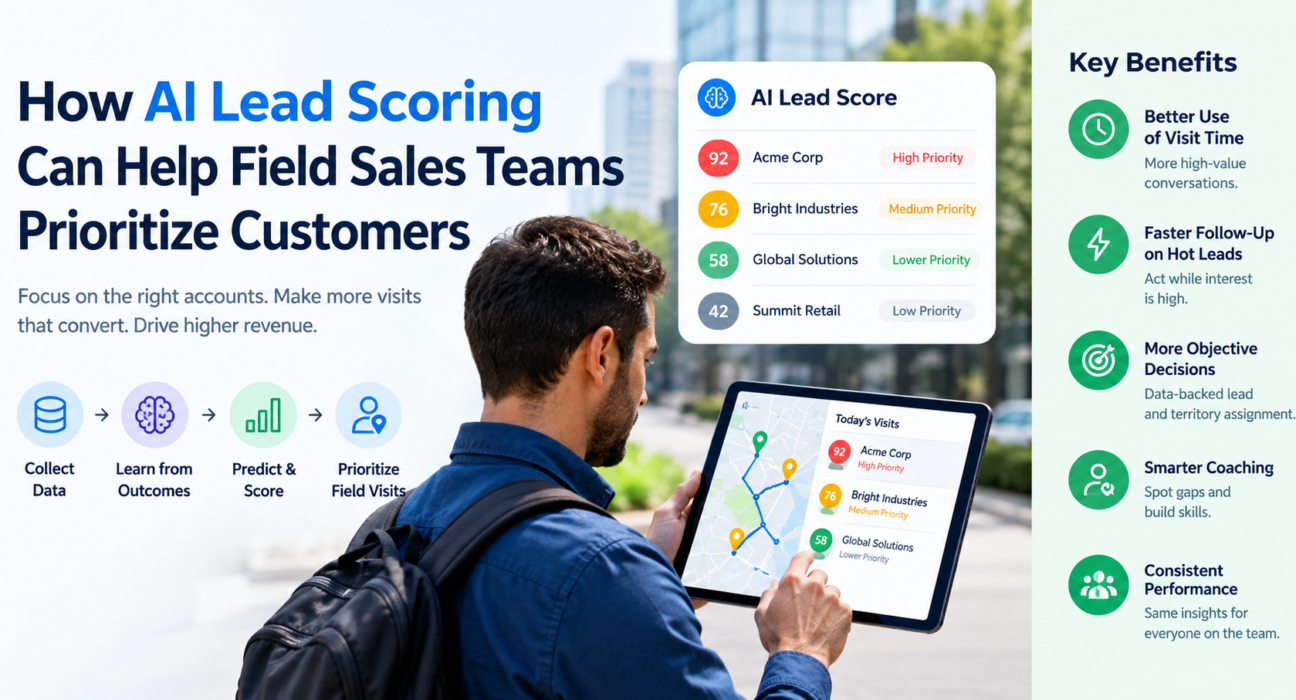
- Collect data. The system gathers lead details, past visits, order history, follow-up activity and outcomes.
- Learn from outcomes. The model studies which leads converted and which did not.
- Identify patterns. It finds which combinations of signals separate strong prospects from weak ones.
- Assign scores. Each lead gets a score or a tier such as hot, warm or cold.
- Refresh continuously. Scores change as reps log visits and outcomes.
Data Signals Used in Lead Scoring
| Signal type | Example | Why it matters |
|---|---|---|
| Profile fit | Business type, size, location | Shows how closely the lead matches your best customers |
| Engagement | Calls answered, meetings held | Indicates real interest |
| Visit history | Number and outcome of past visits | Shows momentum or stalling |
| Recency | Days since last contact | Flags leads going cold |
| Purchase history | Past orders, order frequency | Highlights repeat and upsell potential |
| Field feedback | Notes and form responses from reps | Adds context that raw numbers miss |
The quality of the score depends on the quality of this data. Clean, consistent field data leads to better predictions.
Key Benefits of AI Lead Scoring for Field Sales Teams
1. Better Use of Visit Time
Reps focus on leads most likely to convert. That means fewer low-value visits and more meaningful conversations.
2. Faster Follow-Up on Hot Leads
When a score rises, the lead surfaces immediately. Reps and managers can act while interest is high.
3. More Objective Decisions
Scores give managers a shared, data-backed basis for assigning territories and leads, instead of relying only on personal judgment.
4. Smarter Coaching
Managers can see whether reps are visiting high-scoring leads and converting them. Gaps show where coaching is needed.
5. Consistent Performance Across the Team
New and junior reps benefit from the same prioritization insight as experienced ones.
AI Lead Scoring vs. Traditional Lead Scoring
| Factor | Manual or rule-based scoring | AI lead scoring |
|---|---|---|
| How scores are set | Fixed rules written by people | Learned from historical outcomes |
| Updates | Periodic, manual | Continuous as data changes |
| Signals considered | A handful | Many, in combination |
| Scalability | Hard to maintain as rules grow | Handles large lead volumes |
| Bias risk | Reflects the rule-writer’s assumptions | Can inherit bias from past data |
| Best for | Small, simple pipelines | Growing teams with enough data |
Rule-based scoring still works for small pipelines. AI scoring pays off as lead volume and data grow.
How to Use Lead Scores to Plan Field Visits
A score only helps if it changes what reps do. Here is a practical way to apply it.
- Define score tiers. Group leads into hot, warm and cold, with a clear action for each.
- Assign visit priority. Hot leads get in-person visits first. Warm leads get scheduled visits or calls. Cold leads get low-effort nurturing.
- Combine score with location. Plan routes that cover high-scoring leads in the same area to cut travel time.
- Set follow-up windows. For example, a hot lead not contacted within a set number of days triggers an alert.
- Log every outcome. Visit results feed back into the model and improve future scores.
Example: A Day Plan for One Rep
Say a rep in Hyderabad has ten leads in the area. Instead of visiting them in the order they were added, the manager’s system ranks them. The rep visits the three hot leads first, batches two warm leads on the same route, and moves the cold leads to a phone follow-up. The same working hours now go toward the leads most likely to close.
Best Practices for AI Lead Scoring in Field Sales
- Start with clean data. Standardize how reps record visits, outcomes and customer details.
- Define what “converted” means. The model needs a clear target, such as order placed or contract signed.
- Keep humans in the loop. Reps know things a model can’t see. Let them flag context and override scores when justified.
- Review score accuracy regularly. Compare predicted hot leads against actual results.
- Avoid over-reliance on one signal. A high score based on a single data point deserves a second look.
- Train the team. Reps should understand what a score means and how it should shape their day.
- Respect data privacy. Collect only what you need and follow applicable regulations.
Common Mistakes to Avoid
- Scoring leads without enough historical data
- Ignoring low-scoring accounts entirely, including loyal existing customers
- Treating the score as a final verdict rather than a guide
- Failing to log field outcomes, which starves the model of feedback
How Field Force Management Software Supports Lead Prioritization
A score is only useful if it reaches the rep at the right time and the visit data flows back. That is where field force management software comes in. It connects planning, execution and reporting in one place.
Useful capabilities include:
- Visit and task assignment so priority leads become scheduled work
- Route and beat planning to sequence high-value visits efficiently
- Geofenced check-ins and proof of visit to verify that visits happened
- Custom forms to capture structured outcomes and feedback
- Real-time reporting so managers can track coverage of priority accounts
Together these turn a ranked list into an executed plan and give the model better data for the next round.
How FieldExecutives Can Help
Businesses looking to put lead prioritization into practice can use field force management software such as FieldExecutives. The platform combines the pieces field sales teams need to act on priorities:
- Task and visit assignment with checklists and priority, sent to the rep’s phone
- AI route and beat-plan optimization to reduce travel between stops
- Proof of visit using photo, signature or OTP capture
- Custom forms and workflows to record visit outcomes your way
- Real-time KPIs and reports for managers tracking team performance
FieldExecutives also lists AI lead scoring and churn prediction among its capabilities. Since needs vary by team, it is worth asking for a walkthrough of how scoring would work with your data and sales process. Teams in sectors such as FMCG and distribution or real estate can see how the platform maps to their field workflows.
You can explore the full feature set to see which tools fit your team.
Conclusion
Field sales time is limited, and choosing the wrong visit has a real cost. AI lead scoring for sales ranks leads by conversion potential, so reps spend their days on the customers most likely to buy. It works best when paired with clean field data, clear score tiers, regular review and human judgment.
Field force management software closes the loop by turning scores into planned visits, verified outcomes and useful reports. If you want your field team to prioritize customers with more confidence, see how FieldExecutives can support your process.