AI Call Analysis: How AI Can Improve Sales Call Performance
Most sales managers can tell you how many calls their team made today. Far fewer can tell you what was actually said on those calls, which pitches worked, and why a lead went cold after a promising first conversation. AI call analysis exists to close exactly that gap between call volume and call quality.
If you run an outbound sales or telecalling team, you already know that reviewing calls manually does not scale. A manager can realistically listen to a handful of recordings a week, not the hundreds of conversations happening across the team every day. This is where AI call analysis features built into modern telecalling platforms help — they turn every recorded call into structured, searchable data instead of a wasted recording sitting in a folder.
In this article, we explain what AI call analysis is, how it works, and how sales and telecalling teams can use it to improve call quality, coaching, and follow-ups.
What Is AI Call Analysis?
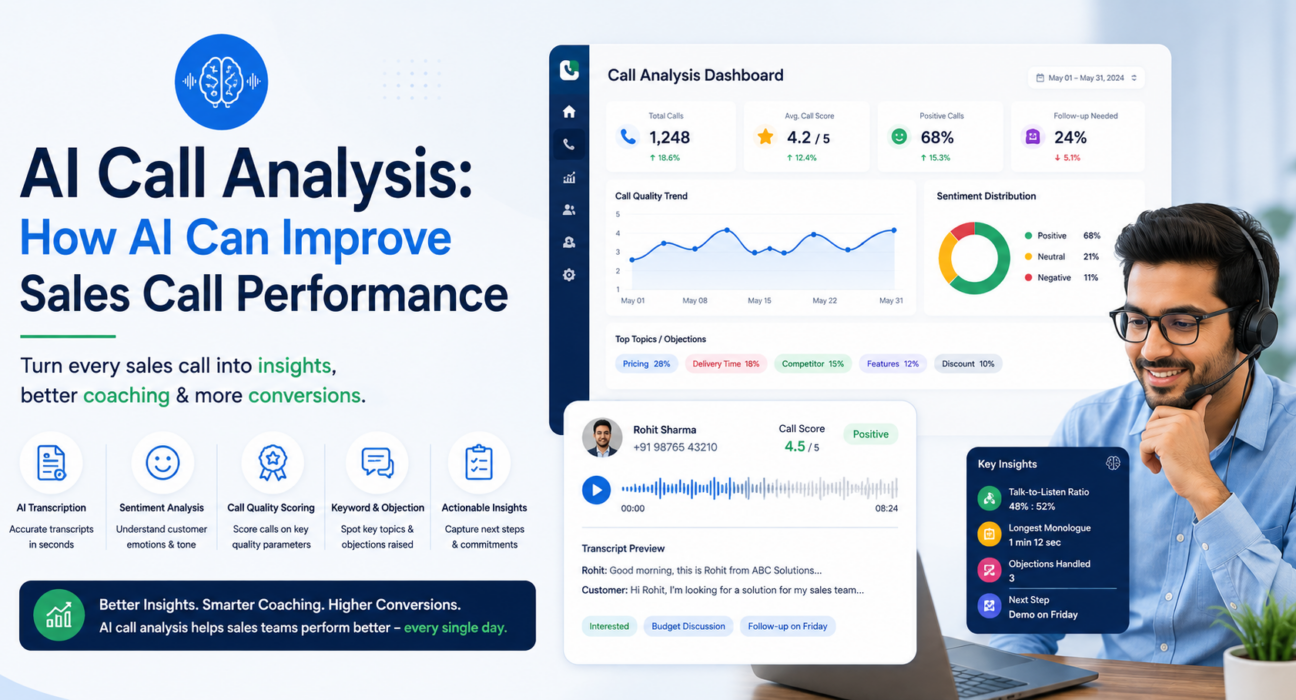
AI call analysis uses artificial intelligence to automatically transcribe, evaluate, and extract insights from sales or customer calls. Instead of a manager listening to a full recording, the system converts speech to text, identifies sentiment, tone, and keywords, and scores the call against quality parameters — usually within minutes of the call ending.
In simple terms, it replaces manual, sample-based call reviews with automated, consistent analysis of every call your team makes.
How AI Call Analysis Works
While tools vary, most AI call analysis systems follow a similar process:
- Call recording – The dialer or CRM automatically records the conversation during or after the call.
- Transcription – Speech-to-text models convert the audio into a written transcript, often supporting regional languages and mixed-language conversations. For Indian teams, this usually means English, Hindi, and Hinglish.
- Summarisation – The system generates a short summary covering what the call discussed and what both sides agreed to.
- Sentiment and tone analysis – The AI classifies the overall tone of the call, typically as positive, neutral, or negative, based on word choice, pacing, and conversational cues.
- Quality scoring – The system scores the call against parameters such as opening, needs discovery, objection handling, and closing, so managers get a consistent benchmark across agents.
- Insight and action extraction – The tool pulls out key points, objections raised, and next steps automatically, so follow-ups do not get missed.
This entire process typically runs in the background after the call ends. As a result, agents are not slowed down, and managers get insights without extra manual work.
What AI Call Analysis Actually Measures
Not every platform measures the same things, but most AI call analysis tools look at a combination of the following:
| What it measures | Why it matters |
|---|---|
| Talk-to-listen ratio | Shows whether the agent is dominating the call or genuinely listening to the prospect |
| Sentiment (positive/neutral/negative) | Flags calls that need manager attention or follow-up |
| Call quality score | Gives a consistent benchmark to compare agents and coach objectively |
| Keywords and objections | Identifies recurring concerns, competitor mentions, or pricing objections |
| Compliance cues | Flags missed disclosures, inappropriate language, or DNC-related risks |
| Next steps and commitments | Captures what the agent promised, so follow-ups do not get missed |
How AI Call Analysis Improves Sales Call Performance
The value of AI call analysis is not the technology itself — it is what a sales team does with the insights. Here is where it typically makes a measurable difference.
1. Consistent, Objective Coaching
Manual call reviews are subjective and depend on which calls a manager happens to pick. AI call analysis, on the other hand, reviews every call the same way, using the same parameters. Therefore, coaching conversations can be based on patterns across dozens of calls, not one cherry-picked example.
2. Faster Identification of Weak Spots
Because sentiment and quality scores generate automatically, a manager can sort calls by score and go straight to the ones that need attention — a negative-sentiment call with a high-value lead, for example — instead of listening through calls at random.
3. Better Onboarding for New Telecallers
New hires can learn from transcripts and summaries of the team’s best-performing calls, rather than shadowing a senior agent for weeks. This shortens the time a new telecaller needs to become productive.
4. Objection Handling Patterns
When keyword and objection data is aggregated across the whole team, patterns emerge. For instance, if “price is too high” turns out to be the most common objection from a particular lead source, that insight is useful for both sales scripting and marketing.
5. Fewer Missed Follow-Ups
Action items and commitments that the system extracts automatically can feed directly into your lead follow-up software workflow. As a result, fewer promised callbacks simply fall through the cracks.
6. Compliance and Quality Assurance
For regulated industries such as insurance and finance, a searchable record of every conversation — plus an automatic flag for risky language — makes quality assurance far less time-consuming than listening to calls manually.
Real-World Examples (Illustrative)
These examples are illustrative scenarios, not verified case studies. They simply show how teams typically apply AI call analysis across different industries.
- Real estate: A sales manager reviews AI-generated summaries each morning instead of listening to every call from the previous day, and prioritises follow-ups for leads that show positive sentiment but no site visit scheduled yet.
- Insurance: A quality team uses automatic transcripts to check that agents read out mandatory disclosures on every policy call, instead of manually sampling a small percentage of calls.
- Education: An admissions team studies transcripts of calls that converted into enrolments to understand which explanations of fees and courses worked best, then shares these with new counsellors.
- Recruitment: A staffing firm scans call summaries for recurring candidate objections about salary or location to refine how recruiters pitch roles.
- B2B sales: A sales lead reviews low-scoring calls involving high-value accounts first, rather than working through recordings in the order they happened.
Manual Call Review vs AI Call Analysis
| Factor | Manual Call Review | AI Call Analysis |
|---|---|---|
| Coverage | A small sample of calls | Every recorded call |
| Consistency | Varies by reviewer | Same criteria applied every time |
| Time required | High – listening takes as long as the call | Low – the system generates insights automatically |
| Bias | Reviewer’s mood or relationship with agent can influence the outcome | Defined scoring parameters drive the outcome |
| Follow-up tracking | Manual note-taking | The system extracts action items automatically |
Common Mistakes to Avoid
- Treating the AI score as the final word. Use scores as a starting point for coaching conversations, not a replacement for a manager’s judgement.
- Ignoring context. Sentiment analysis can misread sarcasm, regional phrasing, or a naturally direct communication style. So, always sense-check flagged calls before acting on them.
- Not acting on the data. Collecting transcripts and scores without using them in coaching sessions or team reviews defeats the purpose.
- Overloading agents with metrics. Sharing too many scores at once can feel punitive. Instead, focus on two or three metrics that matter most for your sales process.
- Skipping compliance review. Automated compliance flags are useful, but sensitive industries should still have a human review flagged calls directly.
How to Implement AI Call Analysis in Your Sales Process
- Start with call recording. AI call analysis depends on having your calls recorded and stored in one place, ideally inside your CRM rather than scattered across phones.
- Define what “quality” means for your team. Before you start scoring calls, decide which parameters matter most: opening, discovery, objection handling, or closing.
- Review a sample together as a team. In the first few weeks, compare AI-generated scores and summaries against your own judgement to build trust in the system.
- Build coaching sessions around the data. Use flagged calls and recurring objections as the basis for weekly team huddles.
- Feed insights into follow-up workflows. Make sure action items extracted from calls translate into actual follow-up tasks, not just a report nobody reads.
How TeleCallingCRM Supports This
TeleCallingCRM includes call transcription, sentiment analysis, and a 0–100 quality score with coaching feedback as part of its calling and CRM features, alongside automatic key-point and action-item extraction after each call. Every plan includes these capabilities rather than charging for them as a separate add-on, and they work alongside the platform’s lead management and follow-up tools, so teams can tie insights from a call back to lead records and follow-up schedules. In other words, this is one way telecalling teams can bring AI call analysis into their existing workflow without switching to a separate, standalone tool — though the same principles in this article apply regardless of which platform you use.
Frequently Asked Questions
What is AI call analysis in simple terms? AI call analysis is technology that automatically transcribes and evaluates sales or customer calls, generating summaries, sentiment, and quality scores without a manager having to listen to the full recording.
Is AI call analysis accurate? It is generally reliable for transcription and pattern detection, but sentiment analysis can occasionally misread tone, sarcasm, or regional language. So, it works best as a starting point for human review, not a final verdict.
Does AI call analysis work for Hindi and Hinglish calls? Yes. Many platforms built for the Indian market, including TeleCallingCRM, support transcription in English, Hindi, and Hinglish, since a large share of sales calls in India mix languages.
How is AI call analysis different from call recording? Call recording simply stores the audio. AI call analysis, however, processes that audio to produce a transcript, summary, sentiment, quality score, and action items — turning a passive recording into usable data.
Can AI call analysis replace sales managers? No. It removes the manual work of listening to every call, but decisions about coaching, hiring, and strategy still need a manager’s judgement and context that AI cannot fully capture.
Is AI call analysis useful for small teams, or only large call centres? It is useful for teams of any size. In fact, small teams often benefit the most, since one manager typically cannot review every call manually and needs a fast way to spot which conversations need attention.
Does AI call analysis help with compliance? Yes, to an extent. It can flag missing disclosures or risky language for review, which is useful in regulated industries like insurance and finance. That said, sensitive or high-risk calls should still get a direct human review.
Conclusion
AI call analysis will not fix a broken sales process on its own. However, it does give sales managers something they have never reliably had before: a consistent, complete view of what is actually happening on every call, not just a sample of them. Used well, it turns call reviews from an occasional, subjective exercise into an ongoing source of coaching and process improvement.
So, if you are evaluating telecalling software for your team, it is worth checking whether call transcription, sentiment analysis, and quality scoring come included as standard. These are the features that make AI call analysis genuinely useful day to day, rather than just a checkbox feature.