Most learner drivers clock the majority of their hours in daylight, but the roads after dark are a completely different world. Being underprepared for night driving is one of the most common gaps in a new driver’s skill set. That’s why understanding night driving tips for new drivers in Perth is essential for building real confidence on the road.
At Trueway Driving School, a professional driving school in Perth committed to producing fully rounded, genuinely road-ready drivers, night driving isn’t an afterthought, it’s a core part of learning to drive safely in the real world. Whether you’re logging your WA supervised hours or preparing for independent driving after your licence, this guide gives you everything you need to handle Perth’s roads after dark with skill and confidence.
1. Why Night Driving Is Genuinely More Dangerous and What That Means for Learners
Understanding the real risks of night driving isn’t about creating fear it’s about creating the right level of respect and preparation.
The Statistics Are Clear
Despite fewer cars being on the road at night, road fatalities in Australia are disproportionately high during nighttime hours. According to the Bureau of Infrastructure and Transport Research Economics (BITRE), a significant percentage of fatal crashes occur between the hours of 9pm and 6am when visibility is reduced, fatigue is higher, and impaired drivers are more prevalent.
For novice drivers specifically, the risk multiplies. The combination of limited driving experience and the additional challenges of darkness creates a genuinely elevated risk profile. In WA, graduated licensing restrictions for P1 drivers include a midnight to 5am driving curfew a rule that exists precisely because of this elevated risk.
What Makes Night Driving Harder
Night driving isn’t simply “like daytime driving but darker.” It changes the experience in several fundamental ways:
- Reduced visibility your effective sightline shrinks dramatically, even with headlights on full beam
- Altered depth perception judging distances between vehicles and from the kerb becomes harder
- Glare from oncoming headlights can temporarily blind you at the worst possible moment
- Fatigue night driving often coincides with the body’s natural sleep cycle, increasing drowsiness
- Wildlife on roads particularly in Perth’s outer suburbs and surrounding areas, kangaroos and other animals are active after dark and frequently cross roads
Knowing these challenges allows you to prepare for them specifically rather than discovering them the hard way.
2. Vehicle Preparation: Start With What You Can Control
Before you even think about pulling out of the driveway at night, make sure your vehicle is properly set up. Many night driving risks are preventable through simple preparation.
Headlights: Your Most Important Night Driving Tool
Your headlights are not just for seeing they’re for being seen. In WA, you must use headlights from 30 minutes after sunset to 30 minutes before sunrise, and whenever visibility is reduced to less than 200 metres.
For new drivers, the key headlight habits to establish are:
- Always use low beam in built-up areas high beam blinds oncoming drivers and is illegal in most urban situations
- Switch to high beam on unlit country roads but flick back to low beam the moment you see oncoming headlights
- Check that all lights are working before night drives including brake lights, indicators, and rear lights. A bulb failure you don’t know about is a serious hazard
Windscreen and Mirror Clarity
A windscreen that’s perfectly acceptable in daylight becomes a visibility nightmare at night when reflections, smears, and chips scatter light from oncoming headlights. Before night driving:
- Clean the inside of your windscreen interior smears are the most commonly overlooked source of nighttime glare
- Clean all mirrors dirty mirrors scatter and distort reflected light
- Check that your defogger works overnight temperature drops in Perth can cause rapid windscreen fogging
Adjust Your Interior Lighting
Many new drivers don’t realise that bright interior lighting from dashboard brightness, phone screens, or interior lights reduces your ability to see clearly outside. Dim your dashboard to a comfortable level and keep your phone screen off and face-down while driving.
3. Key Techniques for Safe Night Driving
Good vehicle preparation gets you ready for the night. These techniques keep you safe once you’re out there.
Reduce Your Speed More Than You Think
Your headlights illuminate approximately 100 metres ahead on low beam. At 80km/h, your stopping distance is roughly 80 metres under ideal conditions. That leaves almost no margin for error if something unexpected appears a pedestrian in dark clothing, a stopped vehicle, a kangaroo crossing. The practical solution is to reduce your speed below the posted limit in conditions where visibility is compromised. The limit is a maximum, not a target.
Increase Your Following Distance
At night, your ability to read the road ahead through the car in front of you is significantly reduced. The standard two-second following distance that applies in daylight should be extended to at least three to four seconds at night giving you more time to react to brake lights, obstacles, and hazards you can’t see until the car ahead reveals them.
Managing Headlight Glare
Oncoming headlights especially high beams can temporarily blind you, creating a dangerous few seconds of reduced vision. The technique for managing glare is counterintuitive: don’t look directly at the oncoming lights. Instead, shift your gaze to the left edge of the road the white line or the kerb and use it as your guide until the vehicle passes and your vision recovers.
If a driver behind you has their high beams on and the glare is reflecting in your interior mirror, adjust the mirror’s anti-glare setting to dim the reflection.
Scanning for Hazards in Low Visibility
In daylight, your eyes constantly gather peripheral information about the road environment. At night, that peripheral input drops dramatically. Compensate by being more deliberate and systematic about your scanning:
- Sweep your eyes methodically across the full width of the road
- Check intersecting driveways and side streets carefully pedestrians and cyclists approaching from the side are much harder to see at night
- Watch for the reflective eyes of animals on the roadside particularly in Perth’s outer suburbs, hills, and rural fringes
- Pay close attention to the edges of your headlight beam hazards don’t always appear in the centre of the road
4. Managing Fatigue: The Invisible Night Driving Risk
Of all the night driving risks, fatigue is perhaps the most insidious because it creeps up slowly and impairs your judgement of how impaired you actually are.
Recognising the Signs of Driver Fatigue
Your body will tell you when it’s getting tired. The warning signs include:
- Yawning repeatedly or having difficulty keeping your eyes open
- Mind wandering or losing track of the last few minutes of driving
- Drifting slightly across lanes or finding your steering less precise
- Feeling irritable or having slowed reaction times
- Noticing you’ve missed an exit or a landmark you know well
None of these are signs to push through. They are all signs to pull over safely as soon as possible.
What Actually Works for Fatigue
Winding the window down, turning the music up, or drinking coffee are popular remedies but research is clear that these techniques only mask fatigue temporarily. The only genuine cure for fatigue is rest. If you’re driving at night and feel tired, find a safe place to pull over and rest for 15–20 minutes before continuing.
For learner drivers, the practical lesson is simpler: don’t schedule long night drives when you’re already tired. Plan supervised night practice for times when you’re alert early evening, not late at night.
5. Perth-Specific Night Driving Hazards Every Learner Should Know
Perth’s road environment after dark has some specific characteristics that every learner driver should be aware of — particularly because many of them aren’t encountered during daytime practice.
Wildlife on Perth Roads
Kangaroos, possums, and other native animals are most active at dawn and dusk the exact times many new drivers are on the road. In Perth’s outer suburbs, the hills, and surrounding areas, wildlife strikes are a genuine and common hazard. Key rules:
- If you see an animal on the roadside, reduce speed immediately animals move unpredictably and often in groups
- Don’t swerve sharply to avoid an animal a controlled, straight-line brake is far safer than losing control of the vehicle
- Use high beam on unlit roads to extend your sightline and spot reflective eyes earlier
Poorly Lit Roads and Intersections
Not all Perth roads are equally lit. Transitioning from a well-lit main road to a darker residential street can temporarily affect your vision. Allow your eyes time to adjust and reduce speed when moving from high-light to low-light environments.
Pedestrians and Cyclists in Dark Clothing
Perth’s cycling and pedestrian culture means roads even at night are shared. Pedestrians and cyclists in dark clothing are dramatically harder to see at night, particularly at unlit crossings and intersections. At every intersection after dark, give pedestrian crossings an extra check before proceeding, even on green.
6. How Truewaydrivingschool Prepares Perth Learners for Night Driving
Many driving schools treat night driving as a minor footnote. Truewaydrivingschool treats it as an essential skill because it is.
Dedicated Night Driving Instruction
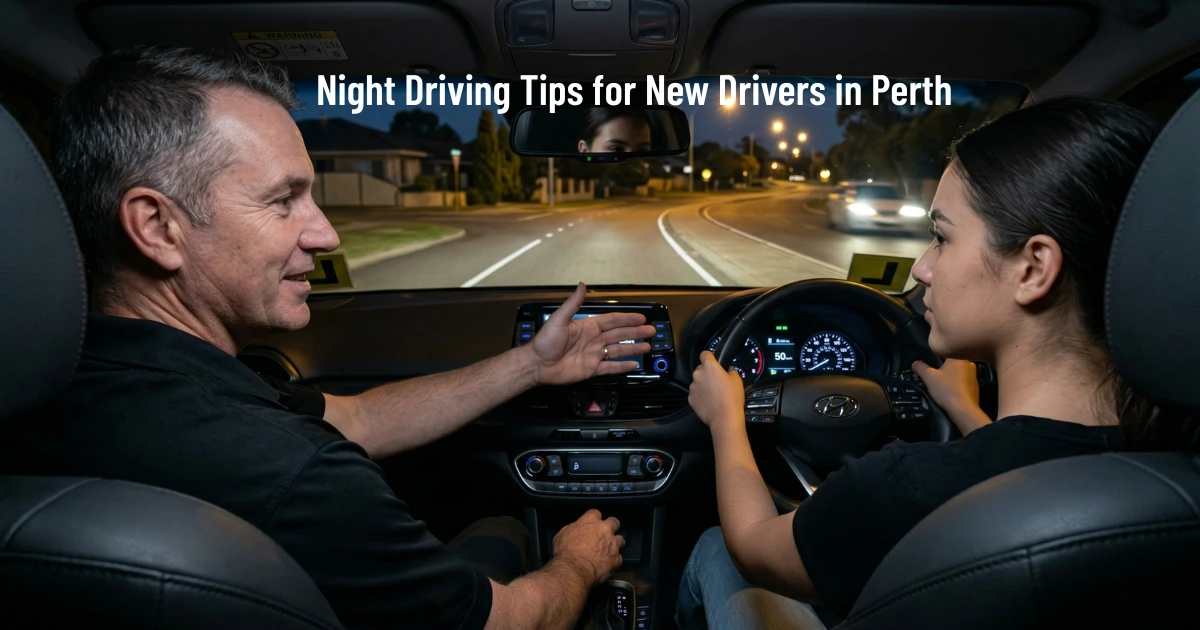
True Way Driving School offers flexible lesson scheduling that includes evening sessions, giving learners the opportunity to practise real night driving under professional supervision before they encounter it alone. Students aren’t just told how to handle night conditions they practise in them, with an experienced instructor guiding them through the specific challenges Perth roads present after dark.
Services Tailored for Every Learner
- Automatic driving lessons Perth ideal for beginners who want to focus fully on visibility management, scanning, and hazard awareness without the added demands of manual gear changes at night.
- Manual driving lessons Perth comprehensive instruction covering full vehicle control in all conditions, including night driving scenarios.
- Flexible lesson times across Perth suburbs including evening availability to cover real-world night conditions.
Why Perth Learners Trust Truewaydrivingschool
- Experienced, fully accredited instructors who teach night driving as a distinct and essential skill set
- High test pass rate students are prepared for every driving condition, not just the easiest ones
- Flexible scheduling including evenings so night practice isn’t left to chance or pushed to the last minute
- Perth-specific knowledge instructors know the local roads, lighting conditions, and wildlife zones that matter for new drivers
- Patient, structured learning environment no pressure, no rushing, just progressive skill-building at every hour of the day
If you’ve been putting off your night driving practice because it feels daunting, a session with Truewaydrivingschool is the most efficient and reassuring way to change that.
7. Building Your Night Driving Hours: A Practical Plan for Learners
WA learner permit holders need to log a minimum of 50 supervised hours and at least some of those should deliberately be at night. Here’s how to build your night hours strategically.
Start in Familiar Territory
Your first few night drives should be on roads you already know well from daytime practice. Familiarity with the route removes one layer of uncertainty and lets you focus specifically on adapting to the night-driving conditions themselves.
Progress From Quiet to Complex
Build your night driving experience progressively:
- Quiet residential streets low traffic, low speed, focus on visibility and scanning
- Main roads in suburban areas more traffic, traffic lights, pedestrian crossings
- Dual carriageways and freeways higher speeds, merging, managing headlight glare
- Complex environments CBD driving, busy intersections, multi-lane roads at night
Each stage builds on the last, so you’re never thrown into conditions you haven’t built a foundation for.
Include a Range of Conditions
Try to include some variety in your supervised night sessions clear nights, overcast nights, light rain, and fog if possible. Each condition has its own challenges, and encountering them under supervision is far preferable to the first time being alone.
Conclusion:
Night driving is not an advanced skill reserved for experienced drivers it’s a fundamental part of being a complete, safe, road-ready driver in Perth. The techniques in this guide from headlight management and fatigue awareness to Perth-specific wildlife hazards and progressive practice planning give you a comprehensive foundation to drive confidently after dark.
But reading about night driving and actually doing it under expert guidance are two very different things. The fastest path to genuine night driving confidence runs through quality instruction, real road experience, and a driving school in Perth that takes every condition seriously.
Trueway Driving School is that school. With evening-available driving lessons in Perth tailored to real-world conditions, expert-led automatic driving lessons Perth for those who want to focus purely on the road environment, and thorough manual driving lessons Perth for learners who want complete vehicle mastery Truewaydrivingschool builds drivers who are ready for every road, at every hour.