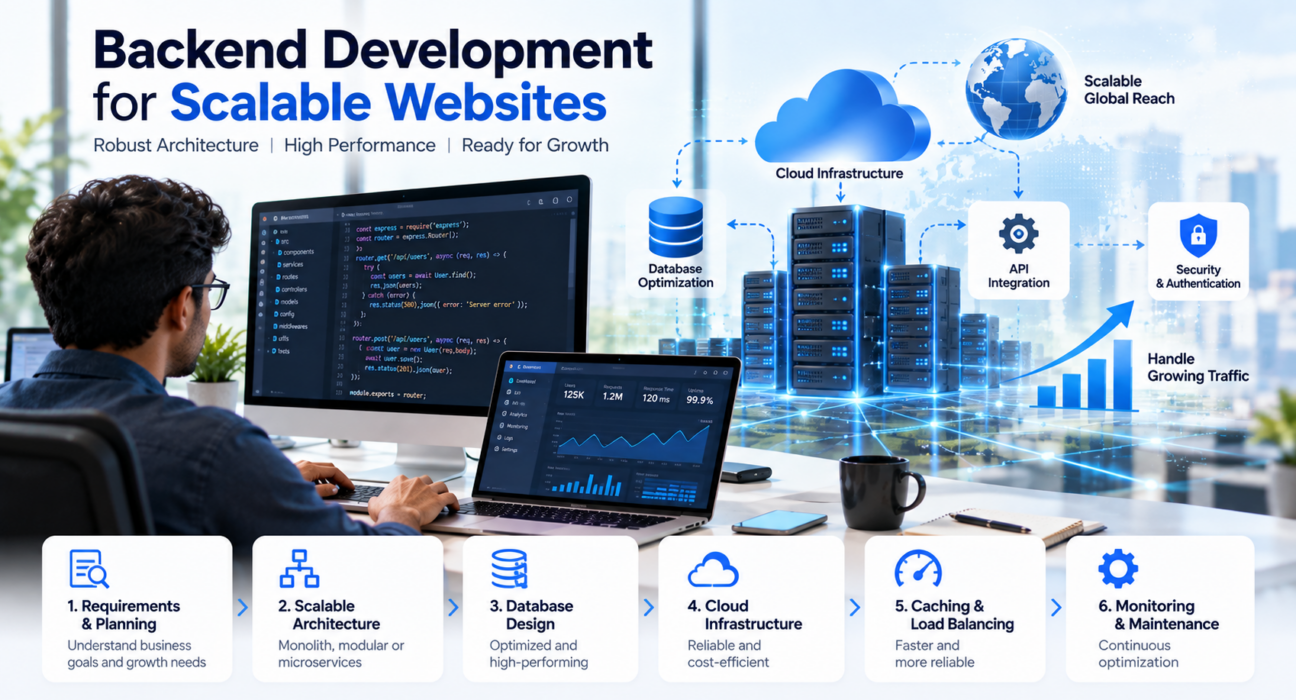
Backend development companies build scalable websites by designing the server-side architecture, database, and infrastructure to handle growing traffic and data without slowing down or failing. In practice, that means modular architecture, efficient databases, caching, load balancing, cloud infrastructure, and continuous monitoring. Ultimately, their goal is to make sure a site that works for 1,000 users also works for 100,000.
If you are planning a product launch, a marketplace, a SaaS platform, or an e-commerce store, scalability is a business decision as much as a technical one. For example, a site that crashes during a sale or slows down as your customer base grows costs you revenue and trust. This article explains how experienced backend development companies approach scalability. Moreover, it covers what to look for when evaluating them and how to compare providers before you commit.
What Does “Scalable” Actually Mean for a Website?
A scalable website can handle more users, more data, and more transactions without a proportional drop in speed or reliability. Likewise, its costs should not jump in proportion to growth.
Scalability usually shows up in three ways:
- Traffic scalability: the site handles spikes from campaigns, seasonal demand, or viral moments.
- Data scalability: the system manages growing databases without slow queries.
- Feature scalability: your team can add new features, integrations, or developers without rewriting the whole system.
Importantly, scalability is not the same as raw performance. A fast site with 50 users can still fall apart at 5,000 if it wasn’t designed to grow.
What Do Backend Development Companies Actually Do?
The backend is everything users don’t see: servers, databases, APIs, authentication, business logic, and integrations with third-party tools. Backend development companies design, build, and maintain these layers.
Typical responsibilities include:
- Designing system architecture and choosing the technology stack
- Building APIs that connect the frontend, mobile apps, and third-party services
- Designing and optimizing databases
- Setting up cloud infrastructure and deployment pipelines
- Implementing security, authentication, and access control
- Monitoring performance and fixing bottlenecks
Because scalability touches every one of these areas, it should be planned from the first architecture discussion. Otherwise, it becomes an expensive afterthought.
How Do Backend Development Companies Build Scalable Websites? A Step-by-Step Look
1. They Start With Requirements and Growth Planning
First, good teams focus on understanding your business rather than picking tools. To do that, they ask:
- How many users do you expect now and in 12–24 months?
- Is traffic steady or spiky (for example, flash sales or campaign launches)?
- What data will you store, and how fast will it grow?
- Which integrations (payments, CRM, ERP, analytics) are essential?
- What are your uptime and compliance expectations?
These answers shape every later decision. For this reason, be wary of any provider that proposes an architecture before asking questions like these.
2. They Choose the Right Architecture
Architecture is the foundation of scalability. The two most common approaches are:
Monolithic architecture: the whole application is built and deployed as one unit. Since it is simpler and faster to build, it is often the right choice for an early-stage product or MVP.
Microservices architecture: the application is split into smaller, independent services (for example, payments, user accounts, and search) that can be scaled and updated separately. Although it adds complexity, it gives large or fast-growing platforms more flexibility.
In addition, many experienced backend development companies recommend a modular monolith as a middle path. You keep one codebase but organize it into clear modules. As a result, you can split out services later when there is a real need.
| Factor | Monolith | Modular Monolith | Microservices |
|---|---|---|---|
| Speed to launch | Fastest | Fast | Slower |
| Operational complexity | Low | Low–Medium | High |
| Independent scaling | Limited | Limited | Strong |
| Best for | MVPs, small products | Growing products | Large, complex platforms |
Ultimately, the right choice depends on your stage, team size, and budget. Microservices are not automatically better.
3. They Design Databases for Growth
Databases are one of the most common bottlenecks. Therefore, scalable database design typically includes:
- Choosing the right database type. Relational databases (such as PostgreSQL or MySQL) suit structured data and transactions. By contrast, NoSQL databases (such as MongoDB or DynamoDB) can suit flexible or very high-volume data.
- Indexing frequently searched fields so queries stay fast.
- Query optimization to avoid slow, repeated, or unnecessary database calls.
- Read replicas, which are copies of the database that handle read traffic so the main database isn’t overloaded.
- Sharding or partitioning, which splits very large datasets across multiple databases when a single one can’t cope.
However, a capable team won’t jump to advanced techniques like sharding too early. Instead, they optimize what you have first.
4. They Use Caching to Reduce Load
Caching stores frequently requested data so the server doesn’t have to rebuild it every time. Common layers include:
- Application caching (for example, with Redis or Memcached) for repeated database results
- CDN caching for static files such as images, scripts, and stylesheets
- Page or API response caching for content that changes rarely
As a result, effective caching can dramatically reduce server load and response times. For many projects, it is also one of the most cost-effective scalability improvements.
5. They Implement Load Balancing and Horizontal Scaling
There are two ways to add capacity:
- Vertical scaling: upgrading a single server with more CPU or memory. It is simple, but it has a ceiling.
- Horizontal scaling: adding more servers and distributing traffic across them.
Scalable websites usually rely on horizontal scaling with a load balancer. This tool distributes incoming requests across multiple servers, so no single machine becomes a point of failure. To make this work, backend teams design applications to be stateless. In other words, any server can handle any request because session data is stored in a shared location rather than on one machine.
6. They Build on Cloud Infrastructure
Most modern scalable websites run on cloud platforms such as AWS, Google Cloud, or Microsoft Azure. Consequently, cloud infrastructure allows:
- Auto-scaling, where servers are added or removed automatically based on demand
- Managed services for databases, queues, and storage that reduce maintenance work
- Multi-region deployment for better speed and resilience
- Pay-as-you-use pricing, which helps control costs during quiet periods
Containerization tools like Docker and orchestration platforms like Kubernetes are also commonly used to make deployments consistent and scalable. That said, not every project needs that level of tooling.
7. They Use Asynchronous Processing and Queues
Not every task needs to finish while the user waits. For instance, sending emails, generating reports, processing images, or syncing data with other systems can run in the background using message queues (such as RabbitMQ or Kafka). This keeps the site responsive during heavy workloads. Furthermore, it prevents one slow task from blocking everything else.
8. They Design Efficient, Well-Structured APIs
APIs connect your frontend, mobile apps, and external services. Accordingly, scalable API design involves:
- Clear versioning so updates don’t break existing clients
- Pagination so large data sets aren’t returned all at once
- Rate limiting to protect against abuse and sudden overload
- Consistent error handling and documentation
9. They Test, Monitor, and Improve Continuously
Scalability is not a one-time achievement. Instead, reliable backend teams keep working on it after launch:
- They run load and stress tests before launch to find breaking points.
- They set up monitoring and alerting for response times, error rates, and resource usage.
- They use logging and tracing to diagnose problems quickly.
- They automate deployments through CI/CD pipelines so updates are safe and repeatable.
- They review performance regularly as usage patterns change.
10. They Build Security Into the Scaling Process
Growth increases risk. For that reason, scalable backends include secure authentication, encrypted data, proper access controls, and regular dependency updates. They also protect against common threats such as injection attacks and DDoS traffic. In short, security should scale with the system rather than lag behind it.
What Should You Look for in Backend Development Companies?
Knowing the technical process helps you ask better questions. When evaluating providers, look for:
- Relevant experience: projects with similar traffic, complexity, or industry requirements
- Architecture thinking: can they explain why they recommend a specific approach for your situation?
- Technology fit: expertise in the languages and frameworks that match your needs (for example, Node.js, Python, Java, .NET, PHP, or Go)
- Cloud and DevOps capability: in-house or well-integrated infrastructure skills
- Testing and QA practices: load testing, code reviews, and automated tests
- Security practices: a clear approach to data protection and compliance
- Communication and transparency: regular updates, documented decisions, and honest trade-offs
- Post-launch support: monitoring, maintenance, and scaling assistance
Questions to Ask Before You Hire
- How would you design the architecture for our expected growth?
- How do you handle traffic spikes?
- What is your approach to database optimization and caching?
- How do you test performance before launch?
- What monitoring and support do you provide after launch?
- Can you share relevant case studies or references?
- How will you document the system so we aren’t locked in?
How Can You Compare Backend Development Companies?
Shortlisting the right partner takes research. First, you can review company websites, portfolios, client feedback, service focus, and location to narrow your options. Additionally, platforms like GoFirms help businesses discover and compare technology and software development providers in one place, which can make the early research stage more organized. Whichever sources you use, verify claims directly with the company through calls, references, and a scoped proposal.
Here is a simple comparison checklist:
- First, define your requirements and budget range
- Next, shortlist 3–5 providers with relevant experience
- Then, request proposals that explain architecture and scaling approach, not just price
- Also, compare communication style, team structure, and timelines
- Finally, start with a paid discovery phase or small pilot when possible
[Internal Link Suggestion: Relevant GoFirms Page/Article on software or web development company listings]
Common Mistakes That Limit Scalability
- Over-engineering too early. Building for millions of users when you have hundreds wastes budget.
- Ignoring the database. In fact, slow queries often cause more problems than server capacity.
- Skipping load testing. As a result, problems appear in front of real customers.
- No monitoring. After all, you can’t fix what you can’t see.
- Tight coupling. When everything depends on everything else, growth becomes painful.
- Choosing technology by trend. Instead, the stack should match your team, product, and goals.
Frequently Asked Questions
What do backend development companies do?
Backend development companies build and maintain the server-side parts of websites and applications, including databases, APIs, business logic, authentication, and cloud infrastructure. Their work determines how fast, secure, and reliable a product is. It also determines how well the product handles growth in users, data, and features.
How do you make a website scalable?
Make a website scalable by using a modular architecture, optimizing the database, adding caching, distributing traffic with load balancers, and hosting on cloud infrastructure with auto-scaling. In addition, testing under load and monitoring performance continuously help you find bottlenecks before users do.
Should I choose microservices or a monolith for a scalable website?
It depends on your stage. Early-stage products often do better with a monolith or modular monolith because it is simpler and cheaper to build. On the other hand, microservices suit large, complex platforms where different components need to scale or be updated independently.
How much does it cost to hire a backend development company?
Costs vary widely depending on project complexity, technology, team location, and engagement model. Rather than relying on generic figures, request detailed proposals from several providers with the same requirements. That way, you can compare scope, timelines, and pricing fairly.
How long does it take to build a scalable backend?
Timelines depend on scope and complexity. For example, a focused MVP backend may take weeks to a few months, while a large platform with many integrations takes longer. Therefore, a discovery phase with a clear roadmap gives you a more reliable estimate than a quick quote.
What technologies do backend development companies commonly use?
Common choices include Node.js, Python, Java, .NET, PHP, and Go for application logic. Similarly, teams often use PostgreSQL, MySQL, and MongoDB for databases, Redis for caching, and AWS, Azure, or Google Cloud for hosting. Ultimately, the best stack depends on your product, team, and long-term goals.
How do I know if a backend development company is reliable?
Review relevant case studies, ask for client references, and check how clearly they explain their architecture and trade-offs. Reliable companies also discuss testing, security, and post-launch support openly. Finally, comparing several providers through directories like GoFirms can help you build a more informed shortlist.
Conclusion
Scalable websites are the result of deliberate decisions: the right architecture for your stage, a well-designed database, smart caching, flexible cloud infrastructure, and continuous testing and monitoring. The best backend development companies explain these choices in plain language. Furthermore, they tie them to your business goals instead of pushing a trendy stack.
Before you sign a contract, define your growth expectations, prepare your questions, and compare more than one provider. You can use GoFirms to research and compare software and web development companies as you build your shortlist. Afterward, confirm fit through proposals and conversations.