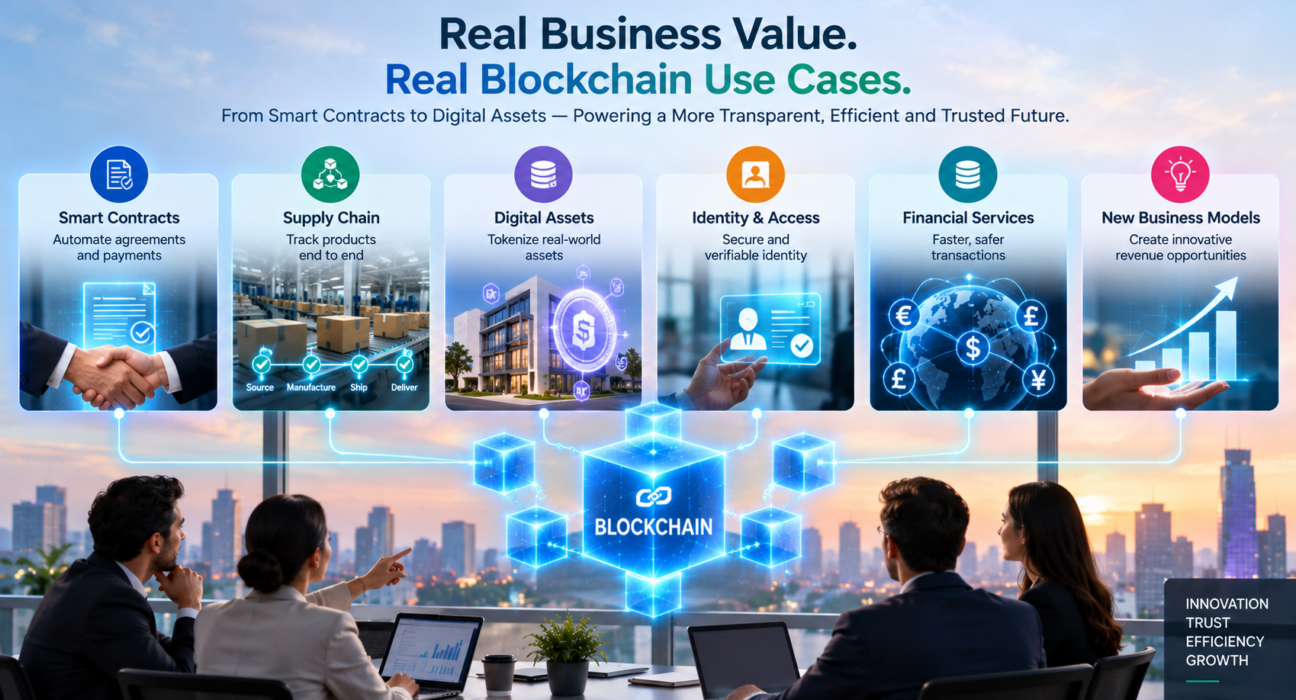
Blockchain has moved well past the point of being a buzzword attached to cryptocurrency headlines. Today, companies across finance, healthcare, retail, logistics, and manufacturing use blockchain technology to solve real operational problems – from verifying supply chains to automating contracts and issuing digital assets. If you’re a business leader trying to understand practical blockchain use cases for business rather than theoretical ones, this guide breaks down exactly where blockchain adds value, how companies are applying it today, and how to decide if it’s the right fit for your organization.
Many businesses still associate blockchain purely with Bitcoin or speculative trading. In reality, however, the underlying technology – a distributed, tamper-resistant ledger – has applications that go far beyond digital currency. Understanding these blockchain use cases for business can help you identify where the technology could reduce costs, improve trust between parties, or open new revenue streams.
What Is Blockchain, in Business Terms?
At its core, blockchain is a shared digital record-keeping system. Instead of one company or institution controlling the master copy of data, multiple parties hold synchronized copies that update together. Once someone adds information to the chain, altering it without detection becomes extremely difficult.
For businesses, this translates into three practical benefits:
- Trust without a middleman. Parties who don’t fully trust each other can still transact confidently because the record is shared and verifiable.
- Transparency. All permitted participants can see the same data, which reduces disputes over “who said what.”
- Automation. Companies can code rules directly into the system, which removes manual steps and reduces errors.
Together, these three benefits form the foundation for nearly every practical blockchain application in business today.
Smart Contracts: Automating Business Agreements
What Are Smart Contracts?
A smart contract is a self-executing agreement where the terms live directly in code. When predefined conditions are met, the contract executes automatically – no manual approval, invoicing, or intermediary required.
How Companies Are Using Smart Contracts
- Automated payments: For example, a smart contract can release payment to a supplier automatically once it confirms a shipment as delivered.
- Insurance claims: Smart contracts can trigger payouts automatically when verifiable conditions, such as flight delays or weather events, occur.
- Licensing and royalties: Companies can distribute royalty payments to content creators automatically based on usage data.
- Real estate transactions: Smart contracts reduce paperwork and cut down on third-party involvement in property transfers.
Why This Matters for Businesses
Smart contracts reduce administrative overhead, minimize disputes, and speed up transaction cycles. As a result, companies that manage high volumes of repetitive agreements – such as vendor contracts or service-level agreements – can save significant time and money.
Supply Chain Transparency and Traceability
One of the most mature and widely adopted blockchain use cases for business is supply chain management.
The Problem Blockchain Solves
Traditional supply chains rely on paper trails and siloed databases across multiple vendors, manufacturers, and logistics providers. Consequently, it becomes hard to verify the origin, condition, or authenticity of goods, and disputes take longer to resolve.
How Blockchain Helps
- The system records each step a product takes – from raw material to manufacturing to shipping to retail – on the blockchain.
- Every participant in the chain can view the same verified data in real time.
- Because product history traces back to its origin, counterfeit goods become easier to detect.
Industries Benefiting Most
- Food and beverage: Companies track produce from farm to shelf so they can quickly identify contamination sources.
- Pharmaceuticals: Manufacturers verify that medications are genuine and haven’t been tampered with.
- Luxury goods and fashion: Brands prove authenticity to combat counterfeiting.
- Manufacturing: Businesses verify supplier compliance and material sourcing.
Digital Assets and Tokenization
What Is Tokenization?
Tokenization is the process of converting a real-world asset – such as real estate, equity, artwork, or even carbon credits – into a digital token that businesses can track, transfer, or trade on a blockchain.
Business Applications of Digital Assets
- Fractional ownership: Companies can divide real estate or other high-value assets into smaller, tradeable digital shares, which opens investment opportunities to a broader audience.
- Loyalty and rewards programs: Companies can issue branded digital tokens that customers redeem or trade, which increases engagement.
- Intellectual property and royalties: Digital assets can represent ownership stakes in creative work, and smart contracts then distribute revenue automatically as it’s generated.
- Corporate bonds and equity: Some companies are experimenting with issuing digital securities to streamline settlement and reduce administrative costs.
Because digital assets remain an emerging area, businesses considering tokenization should work with legal and financial advisors, since regulations vary significantly by industry and jurisdiction.
Blockchain in Financial Operations
Beyond digital assets, blockchain is reshaping core financial processes for companies of all sizes.
| Use Case | Business Benefit |
|---|---|
| Cross-border payments | Faster settlement, reduced fees compared to traditional banking rails |
| Trade finance | Reduced paperwork, faster verification between buyers and sellers |
| Invoice financing | Transparent, verifiable invoice history reduces fraud risk |
| Auditing and compliance | Immutable records simplify financial audits |
For companies operating internationally, blockchain-based payment rails can reduce the delays and fees that come with traditional correspondent banking.
Identity Verification and Data Security
Data breaches and identity fraud remain major business risks, so many companies are turning to blockchain for an alternative approach to identity management.
Decentralized Identity Systems
Instead of relying on centralized databases that are vulnerable to breaches, decentralized identity systems let individuals and businesses control their own verified credentials. This shift reduces the risk of a single point of failure.
Streamlined Compliance Processes
When institutions securely share verified identity data with customer permission, they can streamline Know Your Customer (KYC) processes and cut down on repetitive verification steps. Additionally, businesses can log access to sensitive systems immutably, which improves auditability.
This approach is particularly relevant for financial services, healthcare, and any business that handles sensitive customer data.
Intellectual Property and Content Rights Management
Creators and businesses producing digital content often struggle to prove ownership and track usage. Blockchain addresses this in a few ways:
- It creates a timestamped, tamper-proof record of content creation and ownership.
- Smart contracts distribute royalty payments automatically when licensing or reselling content.
- It simplifies dispute resolution whenever ownership becomes a question.
This capability is increasingly relevant for media companies, software firms, and businesses managing patents or proprietary designs.
How to Decide If Blockchain Is Right for Your Business
Not every business problem needs a blockchain solution. Before investing, therefore, ask yourself the following questions:
1. Do Multiple Parties Need to Share and Trust the Same Data?
If your data lives entirely within one organization, a traditional database may be simpler and cheaper.
2. Is Transparency or Auditability a Major Requirement?
Industries with heavy compliance needs tend to benefit the most from blockchain’s built-in transparency.
3. Would Removing a Middleman Reduce Cost or Delay?
If intermediaries create friction in your process, blockchain-based automation may help you cut both cost and time.
4. Can the Value Justify the Implementation Cost?
Blockchain projects require technical expertise, integration work, and often a learning curve for internal teams, so weigh the investment carefully against the expected return.
If your answers point toward “yes,” it may be worth exploring further with a technology partner experienced in blockchain development.
Choosing a Blockchain Development Partner
Implementing blockchain solutions requires specialized expertise – not just in coding smart contracts, but also in system architecture, security auditing, and regulatory considerations. Many businesses lack this expertise in-house, so they choose to work with an external development partner instead of building a team from scratch.
What to Look for in a Development Partner
When evaluating a blockchain development company, businesses typically look at:
- Prior experience with similar use cases, such as supply chain, fintech, or digital assets
- Security and auditing practices for smart contracts
- Familiarity with relevant regulatory environments
- The ability to integrate blockchain systems with existing business infrastructure
Where to Start Your Search
Platforms like GoFirms can help businesses research and compare technology companies and software development firms with relevant blockchain experience, which makes it easier to shortlist potential partners before starting outreach.
FAQs
What is the most common blockchain use case for businesses? Supply chain traceability and smart contract automation are among the most widely adopted use cases today. Both address concrete operational problems – verifying product authenticity and reducing manual contract processing – so they’re easier to justify from a cost and ROI perspective than more experimental applications.
Do small businesses benefit from blockchain, or is it only for enterprises? Small businesses can benefit, particularly around payments, contract automation, and data verification, but the value depends on the specific problem you’re solving. Enterprises with complex, multi-party operations often see faster returns, so smaller businesses should evaluate cost versus benefit carefully.
Is blockchain the same as cryptocurrency? No. Cryptocurrency is just one application built on blockchain technology; blockchain itself is a much broader data infrastructure that businesses use for many non-currency purposes, including contracts, identity verification, and supply chain tracking.
How long does it take to implement a blockchain solution for a business? Timelines vary widely depending on complexity, ranging from a few weeks for a simple smart contract to many months for enterprise-wide supply chain or financial infrastructure projects. Working with an experienced development partner can help you set realistic timelines.
What industries are adopting blockchain the fastest? Financial services, supply chain and logistics, healthcare, and retail are among the industries with the most active blockchain adoption, largely because they have strong needs around trust, traceability, and compliance.
Are digital assets and tokenization legal for businesses to use? Regulations around digital assets vary by country and industry, and they’re still evolving in many regions. Because of this, businesses considering tokenization should consult legal and financial advisors to ensure compliance with relevant securities and financial regulations.
How do I find a reliable blockchain development company? Look for firms with demonstrated experience in your specific use case, transparent security practices, and strong communication. Comparing multiple vendors through a research platform like GoFirms can help you evaluate options based on relevant expertise before you commit to a partner.
Conclusion
Blockchain has evolved from a niche financial technology into a practical business tool with applications across smart contracts, supply chain transparency, digital assets, identity verification, and financial operations. The key to successful adoption isn’t chasing the technology for its own sake – it’s identifying specific operational problems where shared trust, transparency, or automation can create measurable value.
For businesses exploring blockchain use cases, the first step is a clear-eyed assessment of whether the problem you’re solving actually needs a distributed ledger. The second step is finding the right technology partner to build it correctly. Ultimately, researching and comparing experienced blockchain and software development companies through a platform like GoFirms can help you make that decision with more confidence.