If you’re planning to build an AI-powered product or integrate machine learning into your existing systems, the single biggest factor in whether that project succeeds is who you hire to build it. Choosing among AI software development companies isn’t like picking a general web developer – you’re evaluating data expertise, model selection judgment, infrastructure knowledge, and a track record of shipping AI features that actually work in production, not just in a demo.
This guide walks through exactly what to look for, what questions to ask, and what red flags to avoid, so you can make a confident, informed decision.
What Is an AI Software Development Company?
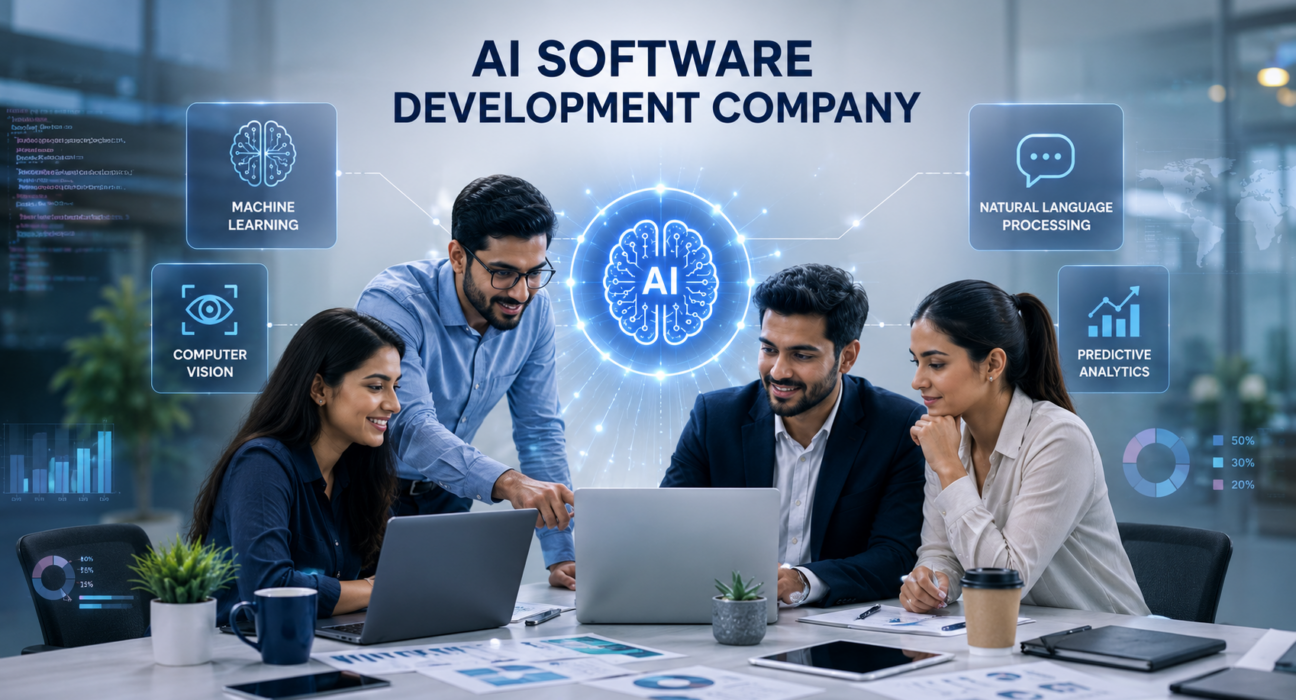
An AI software development company builds custom software that uses artificial intelligence – machine learning models, natural language processing, computer vision, predictive analytics, generative AI, or automation – to solve a specific business problem. This is different from a company that simply bolts a chatbot API onto a website. True AI development involves data pipeline design, model training or fine-tuning, evaluation, deployment, and ongoing monitoring.
Businesses typically look for these companies when they want to:
- Build a custom AI feature inside an existing product
- Automate a manual, data-heavy business process
- Create a new AI-native product from scratch
- Add generative AI (chat, search, content generation) to a platform
- Build predictive models for forecasting, fraud detection, or recommendations
Key Factors to Evaluate Before Hiring
1. Relevant AI Experience (Not Just “AI Experience”)
AI is a broad field. A company skilled in computer vision for manufacturing may have little relevant experience building a generative AI customer support tool. Ask specifically:
- Have they built solutions in your industry or a similar use case?
- What AI techniques do they specialize in – classical ML, deep learning, LLMs, computer vision, NLP?
- Can they show a project with a similar scope and complexity to yours?
Generic claims like “we do AI” without specifics are a warning sign.
2. Data Strategy and Engineering Capability
AI projects live or die on data quality. A capable company should be able to explain, in plain language, how they’ll:
- Assess whether your existing data is usable
- Handle data cleaning, labeling, and structuring
- Build pipelines for ongoing data collection and retraining
- Address data privacy and compliance requirements relevant to your industry
If a vendor jumps straight to “which model should we use” without asking about your data, that’s a gap worth probing.
3. Technical Transparency
The right partner should be able to explain their approach without hiding behind jargon. Look for teams that can clearly answer:
- Why this model or architecture, and not another?
- How will you measure whether the AI is actually working (accuracy, precision, recall, business KPIs)?
- What happens when the model gets something wrong?
- How will the solution be monitored and maintained after launch?
4. Production and Deployment Experience
Plenty of teams can build an impressive AI proof of concept. Fewer can take that proof of concept and turn it into a reliable, scalable production system. Ask about:
- Experience deploying models to production environments (not just notebooks or demos)
- MLOps practices – versioning, monitoring, retraining pipelines
- Infrastructure and cloud platform experience (AWS, Azure, GCP, or specialized AI infrastructure)
- Post-launch support and iteration plans
5. Communication and Project Management
AI projects tend to be more iterative and exploratory than traditional software development, since results often depend on experimentation. A good AI software development company should:
- Set realistic expectations rather than overpromising accuracy or capabilities
- Communicate uncertainty honestly (“we’ll need to test this against your data first”)
- Provide a clear process for iteration, testing, and validation
- Offer a defined roadmap with milestones, not just a vague “we’ll figure it out as we go”
6. Portfolio and Case Studies
Review their past work critically:
- Are the case studies specific about the problem, approach, and outcome?
- Do they show measurable results, or only vague statements?
- Can you speak to a past client as a reference?
Step-by-Step: How to Choose the Right AI Development Partner
Step 1: Define your problem clearly before you start looking. Vendors can’t scope accurate proposals if you can’t articulate the business problem you’re solving. Write down the specific outcome you want – not “we want AI,” but “we want to reduce manual invoice processing time by X.”
Step 2: Shortlist companies with genuinely relevant experience. Use a platform like GoFirms to research and compare software development companies by specialization, so you can filter for teams with real AI and machine learning experience rather than relying on marketing claims alone.
Step 3: Request detailed proposals, not just cost estimates. A strong proposal should outline the technical approach, data requirements, timeline, risks, and how success will be measured – not just a price.
Step 4: Run a small pilot or discovery phase first. Before committing to a full build, consider a paid discovery phase or small pilot project. This lets you evaluate the team’s actual capability and working style with lower risk.
Step 5: Check references and past outcomes. Ask past clients specifically about accuracy, timeline adherence, and how the vendor handled problems when the AI didn’t perform as expected initially – because it often doesn’t, on the first try.
Step 6: Clarify ownership, IP, and long-term support. Confirm who owns the trained models, the code, and the data. Clarify what ongoing support, retraining, or maintenance looks like after launch.
Red Flags to Watch For
- Guarantees of specific accuracy percentages before ever seeing your data
- No mention of data quality, bias, or evaluation methodology
- Pressure to sign long-term contracts before a pilot phase
- Portfolios full of buzzwords but no measurable outcomes
- Inability to explain their approach in plain, non-technical language
- One-size-fits-all “AI packages” that aren’t tailored to your specific use case
In-House Team vs. AI Development Agency vs. Freelancers
| Option | Best For | Considerations |
|---|---|---|
| In-house AI team | Companies with ongoing, large-scale AI needs and budget for full-time specialists | High cost, longer hiring timelines, requires internal AI expertise to manage |
| AI development company/agency | Most businesses building a specific AI product or feature | Access to a full team (data, ML, engineering), proven processes, but requires careful vetting |
| Freelancers | Small, well-defined tasks or short-term experimentation | Lower cost, but higher risk for complex or production-grade systems |
For most businesses without an existing AI team, working with a specialized AI software development company offers the best balance of expertise, speed, and risk management.
How Much Does It Cost to Hire an AI Software Development Company?
Costs vary significantly based on project complexity, data readiness, and scope, so it’s not possible to state a single reliable figure here. Instead of asking “what does AI development cost,” ask each vendor for a detailed cost breakdown by project phase – discovery, data preparation, model development, integration, testing, and deployment – so you can compare proposals on an apples-to-apples basis. Always verify current pricing and estimates directly with vendors, since rates change and depend heavily on your specific requirements.
How GoFirms Can Help
Evaluating AI software development companies takes real research – comparing specializations, reviewing portfolios, and understanding which teams have genuine experience in your use case. GoFirms is a platform built to help businesses discover, research, and compare technology and service providers, including software development companies, so you can narrow your options based on relevant criteria rather than starting from scratch with a generic search.
Frequently Asked Questions
What should I look for first when choosing an AI software development company? Start by confirming relevant experience in your specific use case, not just general AI experience. Ask for examples of similar projects, how they approach data quality, and how they measure success. A company that asks detailed questions about your data and business goals before proposing a solution is usually a stronger sign of expertise than one that jumps straight to a pitch.
How long does it take to build a custom AI solution? Timelines vary widely based on data readiness, project complexity, and integration requirements. Simple AI features can take a few weeks, while complex, production-grade systems with custom model training can take several months. Ask vendors for a phased timeline with clear milestones rather than a single end date.
Do I need my own data science team to work with an AI development company? No. Most AI software development companies provide data scientists, ML engineers, and AI specialists as part of their team. However, having someone on your side who understands your business data and can validate outputs will help the project go more smoothly.
What’s the difference between AI development and traditional software development? Traditional software follows explicit, predefined logic. AI development involves training models on data to make predictions or decisions, which requires additional steps like data preparation, model evaluation, and ongoing monitoring for performance drift after deployment.
Should I choose a company that specializes only in AI, or a general software company with an AI team? Both can work well. AI-only specialists often have deeper technical depth in machine learning, while general software companies with dedicated AI teams may offer stronger end-to-end product development, especially if your AI feature needs to integrate deeply into a larger existing system.
How do I know if an AI vendor’s past results are trustworthy? Ask for specifics: what metrics improved, over what time period, and compared to what baseline. Vague claims like “improved efficiency” without numbers or context are harder to verify. Where possible, speak directly with a past client to ask about their real experience.
Can a small business afford custom AI development? Yes, though scope matters. Many companies start with a smaller, well-defined AI feature rather than a large custom system, which keeps costs more manageable while still delivering value. A discovery or pilot phase can help clarify realistic costs before committing to a larger build.
Conclusion
Choosing the right AI software development company comes down to relevant experience, transparency about data and methodology, and a track record of getting AI solutions into real production use – not just building demos. Take the time to vet vendors properly, start with a smaller pilot where possible, and ask direct questions about data, evaluation, and long-term support before signing a contract.
If you’re starting that research process, platforms like GoFirms can help you compare software development companies side by side, so you can make a decision based on real information rather than marketing alone.