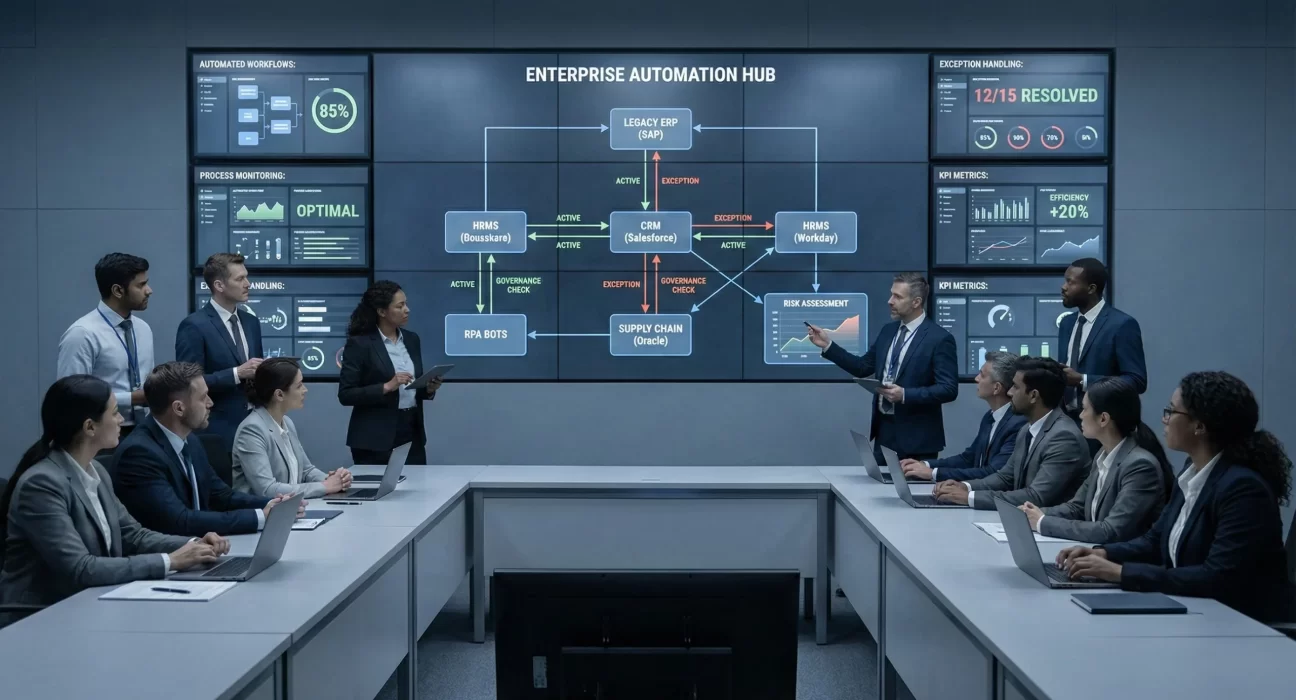
Most enterprise automation initiatives fail not because of technology, but because of execution. After two decades of watching large organisations attempt digital transformation, the pattern is clear: the tools are rarely the problem. The problem is how we think about change, how we plan for it, and how we lead through it.
If you’re a CIO or CTO reading this, you’ve likely seen it firsthand. A promising automation roadmap gets approved. The budget is allocated. Vendors are engaged. Six months later, the project is behind schedule, over budget, and delivering far less value than promised. The executive team loses confidence. The initiative gets quietly shelved or dramatically restructured.
This isn’t about failure of vision. It’s about underestimating what large-scale change actually demands from an organisation.
Why Enterprise Automation Is Different
Small companies can pivot quickly. A startup can rewrite its entire tech stack over a weekend if needed. Large enterprises don’t have that luxury.
When you’re running operations across multiple geographies, serving millions of customers, managing thousands of employees, and working within strict regulatory frameworks, automation isn’t just a technical upgrade. It’s an orchestration challenge that touches compliance, governance, vendor management, change management, legacy system integration, and stakeholder alignment across dozens of departments.
The scale alone changes everything. A process that works for 100 users often breaks at 10,000. A system that performs well in one region may fail completely in another due to data residency laws or network constraints. An automation tool that looks perfect in a demo can become a nightmare when it needs to integrate with 15-year-old ERP systems that nobody fully understands anymore.
Indian enterprises face additional complexity. Many are managing hybrid operating models part of the organisation runs on modern cloud infrastructure while critical functions still depend on legacy mainframes. Regulatory requirements keep evolving. Talent availability fluctuates. Vendor ecosystems are fragmented.
This isn’t a criticism. It’s reality. And the first step to successful automation is acknowledging these constraints rather than pretending they don’t exist.
What Actually Goes Wrong
Let’s talk about the common failure patterns, because understanding them is more valuable than chasing the latest automation trend.
Scope creep without governance. Someone identifies an opportunity to automate invoice processing. Sounds simple enough. But then finance wants to include vendor onboarding. Procurement wants supplier risk scoring. Legal wants contract clause extraction. Suddenly, a three-month project becomes an 18-month program with five times the original budget and no clear owner.
Technology before process. Enterprises often buy automation platforms before truly understanding their current processes. You can’t automate chaos. If your existing workflow is broken, automating it just means you’ll execute the broken process faster. The discipline required to map processes, identify inefficiencies, and redesign workflows is unglamorous work. But skipping it is expensive.
Underestimating integration complexity. Every large enterprise has dozens of systems that need to talk to each other. CRM, ERP, HRMS, legacy databases, third-party APIs, partner portals. Integration isn’t just a technical problem, it’s a data governance problem, a security problem, and often a political problem when different departments control different systems.
Ignoring change management. The best automation in the world is worthless if people don’t use it. Yet most enterprise programs treat change management as an afterthought. Training sessions are rushed. Communication is poor. Employees feel threatened rather than empowered. Adoption stalls. The project is labelled a failure even though the technology works perfectly.
Weak program governance. Large-scale automation requires clear decision rights, escalation paths, and accountability structures. When these are missing or unclear, decisions drag on for weeks. Risks don’t get surfaced until they become crises. Timelines slip because nobody has the authority to make trade-offs.
Vendor misalignment. Many technology vendors are excellent at building products but less experienced in enterprise delivery. They underestimate the change management required. They don’t understand your regulatory constraints. They struggle when faced with the messy reality of legacy system integration. The mismatch between what was promised and what gets delivered creates friction that derails projects.
These aren’t hypothetical problems. They’re the everyday reality of enterprise IT transformation.
What Separates Success from Failure
Successful enterprise automation programs share certain characteristics. They’re not always the most innovative or the best-funded, but they get delivered.
Executive ownership, not just sponsorship. There’s a difference between a CXO who approves a budget and a CXO who owns the outcome. The latter shows up to weekly status meetings. They unblock decisions. They intervene when politics threaten progress. They hold people accountable. Without this level of engagement, large programs drift.
Realistic timelines. The pressure to show quick wins is understandable, but unrealistic timelines guarantee failure. Enterprise automation takes time because integration takes time, testing takes time, training takes time, and building trust takes time. Leaders who accept this and plan accordingly have better outcomes than those who demand impossible schedules.
Incremental delivery over the big bang. The most successful programs break large ambitions into smaller, deliverable phases. Each phase creates tangible value while reducing risk and building organisational confidence. This approach also makes it easier to course-correct based on learnings rather than discovering problems only after massive investment.
Strong program management discipline. This isn’t about excessive documentation or bureaucracy. It’s about clarity. Clear roles and responsibilities. Clear success criteria. Clear escalation paths. Regular, honest status reporting. Proactive risk management. These fundamentals matter more than any technology choice.
The right partner, not just the right vendor. Technology vendors provide tools. Partners understand your business context, share accountability for outcomes, and bring enterprise delivery experience that complements your internal capabilities. The distinction matters. One relationship is transactional. The other is collaborative.
This is where firms like Ozrit differentiate themselves not by selling technology, but by understanding what it actually takes to execute enterprise programs in complex organisational environments. Program execution maturity can’t be purchased off the shelf, but it can be borrowed from partners who’ve been through it before.
Investment in internal capability. Even with the best external partners, enterprises need internal teams who understand both the business and the technology. Automation isn’t a one-time project. It’s an ongoing capability. Building internal expertise or at least internal program leadership is essential for long-term sustainability.
The Real Automation Opportunities
So where should large enterprises actually focus their automation efforts? The answer depends on your specific context, but certain patterns emerge.
High-volume, rules-based processes remain the most obvious candidates. Invoice processing, claims adjudication, customer onboarding, compliance reporting these processes often involve significant manual effort, follow predictable rules, and create measurable ROI when automated.
Data integration and reconciliation is less glamorous but often more valuable. Large enterprises waste enormous effort moving data between systems, reconciling inconsistencies, and generating reports by manually combining information from multiple sources. Automating these workflows doesn’t just save time, it improves data quality and enables faster decision-making.
Exception handling and escalation is where many automation initiatives fall short. The happy path gets automated, but edge cases and exceptions still require manual intervention. Smart automation design anticipates exceptions, routes them appropriately, and learns from how humans resolve them.
Governance and compliance workflows offer significant opportunities in regulated industries. Automating audit trails, approval workflows, policy enforcement, and compliance reporting reduces risk while freeing up experienced professionals to focus on judgment-based work rather than administrative tasks.
Customer experience touchpoints deserve attention, but with caution. Automation that makes customer interactions faster and more convenient creates real value. Automation that frustrates customers because it can’t handle their specific situation damages your brand. The difference is in the execution and in knowing when to route to human support.
The opportunity isn’t in automating everything. It’s in automating the right things, in the right sequence, with realistic expectations about what automation can and cannot do.
Managing Technology Risk
Every automation initiative introduces risk. The question is whether you’re managing it deliberately or discovering it accidentally.
Vendor lock-in is a legitimate concern, especially with proprietary automation platforms. Enterprises should think carefully about data portability, exit strategies, and maintaining optionality. This doesn’t mean avoiding vendors, it means negotiating contracts that protect your long-term flexibility.
Security and access control becomes more complex as automation connects more systems. Each integration point is a potential vulnerability. Robust identity management, encryption, and audit logging aren’t optional. They’re table stakes.
Operational resilience requires that automation doesn’t create single points of failure. What happens when an automated process fails? Do you have fallback procedures? Can your team intervene manually if needed? Have you tested disaster recovery scenarios?
Skills and knowledge concentration can emerge when automation systems are built by a small team or external vendor without adequate knowledge transfer. If only two people understand how a critical automated process works, you have a significant risk that needs mitigation.
Regulatory compliance in India requires attention to data localisation, privacy regulations, sector-specific rules, and evolving legal frameworks. Automation systems must be designed with compliance built in, not bolted on later.
None of these risks should prevent automation. But they require deliberate planning, ongoing monitoring, and honest conversations about trade-offs.
The Role of Leadership
Enterprise automation succeeds or fails based on leadership decisions far more than technology decisions.
Setting realistic expectations is perhaps the most important leadership contribution. When executives promise shareholders a complete digital transformation in 12 months, they set their teams up for failure. When they communicate honestly about timelines, investments, and trade-offs, they create space for actual success.
Making difficult trade-offs is unavoidable. Should you prioritise speed or thoroughness? Innovation or stability? Internal development or external partnerships? There are no universal answers, but leaders must make clear choices rather than hoping to optimize for everything simultaneously.
Protecting team focus means saying no to distractions. Every enterprise has dozens of competing priorities. Successful leaders shield their automation programs from constant scope changes and resource reallocation, allowing teams to actually finish what they start.
Demanding accountability without creating fear is a delicate balance. Teams need to feel safe raising concerns and admitting problems early, but they also need to deliver on commitments. The best leaders create cultures where honesty is rewarded and mediocrity is addressed.
Investing in organisational change is often where leaders underinvest. Technology budgets get approved easily. Change management budgets get challenged. Yet without adequate investment in training, communication, and transition support, even the best technical solution will underdeliver.
Choosing the Right Execution Partner
Most enterprises don’t fail because they chose the wrong technology. They fail because they chose the wrong partner or structured the relationship poorly.
What should you look for in an enterprise delivery partner?
Experience with enterprise complexity. Has the partner worked on programs of comparable scale? Do they understand regulatory requirements in your industry? Have they integrated with legacy systems similar to yours? Experience isn’t everything, but it reduces risk significantly.
Program management maturity. Can they demonstrate disciplined delivery practices? How do they handle scope changes? What’s their track record on budget and timeline adherence? Strong program management capability is often more important than cutting-edge technical skills.
Shared accountability for outcomes. Are they willing to structure engagements around business outcomes rather than just time and materials? Do they proactively flag risks, or do they wait for you to discover problems? The best partners view your success as their success.
Cultural fit and communication. Large programs require constant communication and collaboration. Partners who understand your organisational culture, communicate clearly, and work collaboratively with your internal teams are far more valuable than those with impressive credentials but poor interpersonal skills.
Sustainability and knowledge transfer. Will you be dependent on this partner indefinitely, or are they actively building your internal capability? The goal should be partnership that strengthens your organisation, not creates permanent dependence.
This is the philosophy that drives firms like Ozrit understanding that enterprise delivery is fundamentally about people, processes, and organisational dynamics, not just technology implementation. The technical work matters, but it’s only part of the equation.
What Success Actually Looks Like
Successful enterprise automation doesn’t look like the demos and case studies you see at conferences. It looks messier, takes longer, and involves more compromise.
Success means processes that worked for 100 transactions a day now handle 10,000 without breaking. It means compliance reports that took three people two weeks now get generated in 20 minutes with higher accuracy. It means customer service teams who spent 60% of their time on data entry now spend 60% of their time solving complex customer problems.
Success means senior leaders who have real-time visibility into operational metrics instead of waiting for month-end reports. It means finance teams who can close books faster with higher confidence. It means audit teams who can prove compliance without heroic manual effort.
Success also means problems you didn’t anticipate. Some automated processes will need adjustment based on edge cases you didn’t consider. Some integrations will be more fragile than expected and require ongoing attention. Some users will resist change despite your best training efforts.
But here’s the difference: successful programs adapt. They iterate. They build on small wins. They maintain momentum even when progress is slower than hoped.
Unsuccessful programs declare victory prematurely, ignore warning signs until they become crises, and create cynicism that makes future initiatives harder.
Moving Forward
If you’re leading enterprise automation efforts, you already know it’s harder than it looks. You’re managing technical complexity, organisational politics, budget constraints, timeline pressure, and stakeholder expectations that often conflict with each other.
There’s no magic formula. But there are principles that improve your odds.
Start with clarity about what you’re trying to achieve and why. Invest in understanding your current state before designing your future state. Build realistic plans that account for integration complexity, change management, and organisational readiness. Choose partners based on delivery capability, not just technical credentials. Create governance structures that enable fast decisions without chaos. Communicate relentlessly with all stakeholders. Deliver incrementally to build confidence and learn continuously.
Most importantly, remember that automation is a means, not an end. The goal isn’t to automate everything possible. The goal is to enable your organisation to serve customers better, operate more efficiently, manage risk more effectively, and adapt faster to changing conditions.
Technology keeps evolving. New automation platforms emerge every year with impressive capabilities. But the fundamentals of large-scale enterprise delivery don’t change. Leadership matters. Discipline matters. Realistic planning matters. Partner selection matters. Change management matters.
Get these fundamentals right, and automation becomes a powerful tool for enterprise transformation. Get them wrong, and even the most sophisticated technology won’t save you.
The enterprises that master large-scale automation aren’t necessarily the ones with the biggest budgets or the latest tools. They’re the ones with the maturity to execute complex programs in messy organisational realities. That maturity can be built internally over time, or it can be accelerated by working with partners who’ve already been through the journey.
Either way, success comes down to execution. And execution comes down to taking enterprise delivery seriously as a discipline, not just as an IT project.