Every year, thousands of enterprise software projects are launched with great ambition. Steering committees are formed, budgets are allocated, vendors are shortlisted, and kickoff meetings are held with full confidence. Yet a significant number of these initiatives either fail to deliver the intended business value, run over budget and timelines, or quietly fade into the background as “ongoing transformation efforts.”
The problem is rarely a lack of talented developers or cutting-edge technology. The real issue is something more fundamental: most enterprise software projects are approached as technology implementations rather than product development efforts. And that shift in thinking from project to product makes all the difference between systems that transform your business and those that become expensive liabilities.
Why Enterprise Software Projects Struggle
If you’ve been part of a large-scale digital transformation or custom software initiative, you’ve likely experienced some version of these challenges:
Requirements that keep changing. What seemed clear in the RFP became unclear three months into development. Business units have different interpretations. Stakeholders who weren’t in early conversations suddenly have strong opinions. The original vision starts to blur.
Delivery timelines that slip. The initial estimate was 12 months. Then it became 18. Now you’re looking at phased rollouts spread across two years, and everyone’s trying to manage expectations while keeping executive sponsors engaged.
Systems that don’t talk to each other. The new platform was supposed to integrate seamlessly with existing ERP, CRM, and legacy systems. Instead, you’re dealing with data synchronization issues, manual workarounds, and a growing backlog of integration tickets.
User adoption that falls short. The system was built to specification, but the people who actually need to use it find it cumbersome. Training sessions are scheduled, help desks are set up, but usage remains low and workarounds persist.
Vendor accountability that fades. In the beginning, the vendor was responsive and committed. As the project drags on, key resources rotate out, communication becomes transactional, and you find yourself managing the vendor more than they’re managing the delivery.
These aren’t edge cases. They’re common patterns in enterprise software development, especially in India where complexity is often amplified by scale, regulatory requirements, distributed teams, and the need to balance global standards with local execution realities.
What’s Missing: Product Thinking
The reason so many enterprise initiatives struggle is that they’re built using project thinking, not product thinking. The distinction matters.
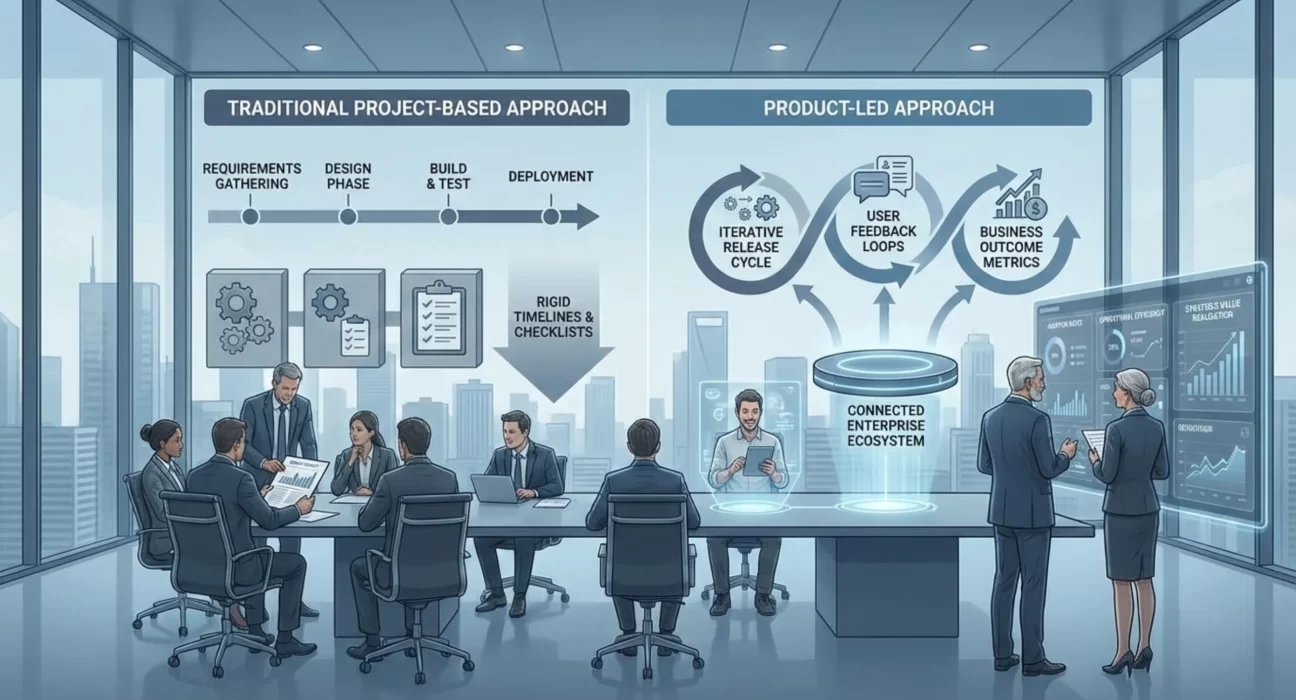
Project thinking focuses on delivery of scope. It’s about building what was agreed upon in the statement of work, hitting milestones, and closing tickets. Success is measured by whether the contracted features were delivered on time and within budget. The orientation is inward toward the plan, the contract, the checklist.
Product thinking focuses on outcomes and value. It’s about solving real business problems, enabling users to do their jobs better, and creating systems that evolve with the organization. Success is measured by business impact, user satisfaction, and long-term sustainability. The orientation is outward toward the user, the business, the future.
In a project mindset, the vendor builds to spec and walks away. In a product mindset, the partner stays engaged to ensure the system actually works in the hands of real users and continues to deliver value as the business changes.
This isn’t just a philosophical difference. It changes how requirements are gathered, how priorities are set, how trade-offs are managed, and how success is defined.
The Enterprise Reality: It’s About Execution, Not Just Technology
C-level executives know this intuitively: technology is never the hardest part of a transformation. The hard part is execution across a complex organization.
Consider what’s actually involved in delivering a large-scale enterprise system:
Aligning stakeholders with competing priorities. Finance wants cost control. Operations want speed. Compliance wants governance. IT wants maintainability. Marketing wants flexibility. Getting these groups to agree on what the system should do and what it shouldn’t requires more than requirements workshops. It requires ongoing negotiation, trade-off discussions, and leadership alignment.
Managing risk and governance. Enterprise systems handle sensitive data, support critical operations, and must comply with regulations that vary by geography and industry. A robust approach to security, data privacy, audit trails, and disaster recovery isn’t optional. It must be embedded from the start, not retrofitted later.
Dealing with legacy systems and technical debt. Your new platform doesn’t exist in isolation. It must coexist with 15-year-old ERP systems, third-party SaaS tools, homegrown applications, and possibly even older mainframe systems. Integration is rarely clean. Data migration is rarely simple. And every dependency introduces risk.
Navigating organizational change. Even the best-designed system will fail if people don’t use it. Change management, training, communication, and phased rollouts are not peripheral activities; they’re central to success. And they require sustained attention from business leaders, not just the project team.
Sustaining momentum over long timelines. Enterprise programs often span 18 to 36 months or longer. Keeping sponsors engaged, maintaining team morale, and adapting to changing business conditions over that time requires discipline and structure. Early wins matter. Visible progress matters. Transparent communication matters.
These are not technology problems. They’re organizational, operational, and leadership challenges. And they require a partner who understands the enterprise context, not just the code.
What Separates Successful Programs from Failed Ones
Over years of working with mid-to-large enterprises across industries, a few patterns become clear about what separates successful programs from those that struggle.
Ownership and accountability are clearly defined. In successful programs, there’s no ambiguity about who owns what. The business sponsor owns the vision and the outcomes. The delivery partner owns execution and delivery quality. IT owns platform stability and governance. When things go wrong and they will, there’s no finger-pointing because roles are clear.
There’s a shared commitment to outcomes, not just outputs. The conversation isn’t just “Did we build these 47 features?” It’s “Are users able to process claims 30% faster? Are we reducing manual errors? Is the finance team closing the books three days earlier?” Partners who think in terms of outcomes ask different questions, challenge assumptions, and course-correct when the path to value becomes unclear.
Governance is real, not ceremonial. Weekly status meetings with green, yellow, and red indicators aren’t enough. Real governance means having the hard conversations early, escalating risks before they become crises, and making decisions when trade-offs are required. It also means having the courage to pause or pivot when the original plan isn’t working.
Execution discipline is maintained. This includes proper version control, code reviews, automated testing, staging environments, rollback plans, and post-deployment support. It sounds basic, but in the pressure of tight deadlines, shortcuts get taken. Successful programs resist that pressure because they know the cost of poor quality is always higher in the long run.
The partnership extends beyond go-live. The riskiest moment in any enterprise system isn’t during development, it’s the first 90 days after launch. User issues surface, edge cases appear, performance under real load is tested. A true partner doesn’t disappear after deployment. They stay engaged through stabilization, provide hypercare support, and help the organization adapt.
The Role of the Right Partner
Choosing a technology partner for enterprise-scale work is one of the most consequential decisions a leadership team makes. The wrong partner can cost you not just time and money, but organizational credibility and momentum.
What should you look for?
Enterprise delivery maturity. This isn’t just about technical capability. It’s about program management discipline, governance frameworks, risk management, quality assurance, and the ability to work within the realities of large organizations. Have they delivered complex, multi-stakeholder programs before? Can they operate in regulated environments? Do they understand change management and user adoption?
Transparency and communication. In long-running programs, trust is built through consistent, honest communication. You need a partner who will tell you when timelines are at risk, when scope needs to be reconsidered, or when a technical decision has downstream implications. Surprises late in the program are almost always more damaging than difficult conversations early.
Product mindset, not just delivery focus. Look for partners who ask about business outcomes, challenge requirements when they don’t align with user needs, and bring insights from other industries or use cases. The best partners act as an extension of your leadership team, not just as vendors executing a contract.
Long-term thinking. The system you’re building today will need to be maintained, enhanced, and scaled for years. A partner who’s thinking about maintainability, documentation, knowledge transfer, and platform evolution is far more valuable than one focused only on hitting the next milestone.
At Ozrit, these principles guide how we approach enterprise programs. We’ve seen too many initiatives struggle because execution discipline was lacking, governance was weak, or the focus was on technology rather than business value. Our approach is grounded in product thinking treating every enterprise system as a long-term asset that must deliver ongoing value, not just a project to be completed. Whether it’s working with financial services firms navigating regulatory complexity, manufacturing companies modernizing supply chain systems, or healthcare providers building patient-centric platforms, the commitment remains the same: disciplined execution, transparent partnership, and a relentless focus on outcomes.
Making Product Thinking Work in Your Organization
If you’re leading or sponsoring an enterprise software initiative, here are a few practical steps to bring product thinking into the process:
Start with the problem, not the solution. Before you write the RFP or scope the statement of work, invest time in deeply understanding the business problem you’re trying to solve. Who are the users? What are their pain points? What does success look like in measurable terms? The clearer you are on the problem, the better your chances of building the right solution.
Involve users early and often. Don’t wait until user acceptance testing to get feedback from the people who will actually use the system. Bring them into design discussions, show them early prototypes, and test assumptions before you’ve invested months of development effort.
Build in phases, deliver incrementally. Large enterprise systems don’t need to be built in one massive release. Breaking the program into phases allows you to validate assumptions, demonstrate value early, and adapt based on real-world usage. It also keeps stakeholders engaged and reduces risk.
Invest in governance that matters. Create a governance structure that includes business sponsors, technical leads, and delivery partners. Meet regularly, review progress honestly, and make decisions quickly. Don’t let governance become a bureaucratic exercise, make it a forum for real collaboration and accountability.
Plan for the long term. Think beyond go-live. How will the system be maintained? How will enhancements be prioritized? Who will support users? What’s the roadmap for the next 12 to 24 months? Treating the system as a product means planning for its lifecycle, not just its launch.
Measure what matters. Define success metrics that go beyond “on time, on budget.” Track user adoption, business outcomes, support ticket volumes, and user satisfaction. If the system isn’t delivering value, no amount of on-time delivery will matter.
Final Thoughts
Enterprise software development is hard. It’s complex, political, risky, and expensive. There are no shortcuts, no silver bullets, and no guarantees.
But the organizations that succeed share a common thread: they approach these initiatives as products, not projects. They focus on outcomes, not just outputs. They invest in partnerships, not just vendor contracts. And they bring the same discipline to software delivery that they bring to any other critical business function.
Product thinking doesn’t make enterprise software development easy. But it makes it manageable. It shifts the conversation from “Did we build what we said we’d build?” to “Are we solving the problem we set out to solve?” And that shift, small as it sounds, makes all the difference.
If you’re embarking on a large-scale digital transformation or evaluating how to get more value from your enterprise systems, the question isn’t just what technology to use or which vendor to choose. The question is: are you set up to think and operate like a product organization, with the discipline, governance, and partnerships required to deliver real business value over the long term?
That’s where success begins.