Growth creates pressure. More customers mean more orders to process. More transactions mean more approvals to manage. More locations mean more complexity to coordinate. The natural response is to add people. Hire more processors, more analysts, more coordinators. The operational budget grows in proportion to volume.
This works until it does not. At some point, leadership recognises that operational costs are increasing faster than revenue. Margins compress. The business that looked healthy at smaller scale becomes marginally profitable at larger scale. Competitors with better operational leverage start winning on price or service while maintaining profitability.
The question becomes urgent. How do we handle 50 percent more volume without increasing operational costs by 50 percent? How do we grow without linear cost increases? The answer is not simply working harder or asking people to do more. It requires fundamentally changing how operations function.
Why Traditional Operations Do Not Scale Efficiently
Most enterprise operations evolved incrementally. A process gets created to handle a specific need. It works. Volume increases, so the organisation adds people to handle the load. The process itself stays largely the same. More transactions just means more people executing the same steps.
This creates predictable inefficiencies. Manual handoffs between steps. Repeated data entry into different systems. Waiting time for approvals. Rework when errors occur. Each inefficiency seems small in isolation, but multiplied across thousands of transactions daily, they consume enormous resources.
The real cost is not just the direct labor. It is the supporting infrastructure required for large operational teams. Management overhead. Training programs. Quality control. Error correction. Office space. Systems access. All these costs scale with headcount, creating hidden expenses that make operations even more costly than they appear.
Legacy systems make this worse. They were designed when volume was lower, and processes were simpler. They require significant manual intervention to handle exceptions. They provide poor visibility, forcing people to spend time tracking status and answering questions. They create bottlenecks that cannot be easily addressed without expensive customisation.
The compounding effect is that as volume grows, these systems slow down. Response times degrade. Processes that took minutes now take hours. This forces the organisation to add even more people just to maintain the same throughput. The cost curve accelerates upward while service quality deteriorates.
The Economic Reality Leadership Must Address
Every business faces competitive pressure on margins. Customers expect better service at lower cost. Investors expect improved profitability. Regulatory requirements increase complexity without increasing revenue. In this environment, operational efficiency becomes a strategic necessity, not a nice-to-have improvement.
Companies that figure out how to scale operations efficiently gain structural advantages. They can price more competitively while maintaining margins. They can invest more in product development because they spend less on operations. They can enter new markets because their cost structure allows profitability at lower volumes.
Companies that do not solve this problem face deteriorating economics. They either accept lower margins, which limits investment capacity and strategic options, or they maintain prices while competitors undercut them, which leads to market share loss. Either path creates long-term vulnerability.
The challenge is that transforming operations to achieve better scaling economics requires upfront investment. New platforms cost money. Implementation takes time and resources. There is a disruption during transition. Leadership must believe the investment will generate returns substantial enough to justify the near-term cost and risk.
Where the Leverage Points Actually Are
Operational efficiency at scale comes from eliminating work, not just doing existing work faster. The highest-value improvements address structural inefficiencies rather than incremental process tweaks.
Automation eliminates entire categories of manual work. Not just robotic process automation that mimics human actions, but redesigned processes where systems handle tasks end to end without human intervention. Routine approvals happen automatically based on rules. Data flows between systems without manual transfer. Status updates are generated without anyone having to check or report.
Intelligent routing directs work to the right people at the right time. Instead of every transaction following the same path, the system evaluates characteristics and routes accordingly. Simple cases get fast-tracked. Complex cases get appropriate expertise. Urgent items get priority. This reduces cycle time and makes better use of skilled resources.
Exception handling becomes systematic rather than ad hoc. The system identifies exceptions, categorises them, and either resolves them automatically or escalates them to people who can address them efficiently. This prevents exceptions from disrupting normal flow and reduces the time spent diagnosing and fixing issues.
Visibility eliminates status-checking work. When everyone can see what is happening in real time, they do not need to ask questions or send emails requesting updates. Customers can check their own status. Managers can monitor operations without interrupting staff. This frees substantial time currently consumed by coordination and communication.
Capacity flexes with demand. Cloud-based infrastructure scales automatically when volume increases and scales back when it decreases. The organisation pays for what it uses rather than maintaining capacity for peak load at all times. This fundamentally changes operational economics for businesses with variable volume.
How Ozrit Designs for Efficient Scaling
Ozrit builds operations platforms specifically to achieve nonlinear scaling. The company was founded by people who understood that most enterprise systems scale poorly and that this represents a solvable engineering problem. The platforms reflect years of learning about what actually drives operational cost.
The architecture separates different types of work so each can scale independently. High-volume routine transactions are processed through automated paths with minimal resource consumption. Complex cases that require judgment go to skilled staff without being slowed by routine work. This specialisation allows the platform to handle much higher total volume without proportional resource increases.
The automation applies intelligence where it creates value. The system learns patterns in transaction data and uses those patterns to make routing decisions, predict issues before they occur, and suggest process improvements. For approval workflows, it can identify low-risk transactions that do not need manual review based on historical patterns. For exception handling, it can propose resolutions based on how similar situations were resolved previously.
This is not automation for its own sake. Ozrit applies automation where it demonstrably reduces cost or improves outcomes. Some work requires human judgment and should not be automated. The platform makes it easy for people to do that work efficiently rather than trying to replace them with algorithms that make poor decisions.
The data architecture provides real-time visibility across all operations. Dashboards show current status, identify bottlenecks, and highlight exceptions requiring attention. Managers can see exactly where volume is concentrating, where cycle times are increasing, and where quality issues are emerging. This allows proactive response rather than reactive firefighting.
Implementation That Delivers Actual Results
Ozrit’s approach to scaling transformations starts with understanding current operational economics. During a typical four to six week assessment, senior Ozrit engineers analyse how work flows through the organisation, where time is consumed, where errors occur, and what drives cost. This produces a clear picture of current efficiency and identifies the highest-leverage improvement opportunities.
The assessment quantifies potential savings realistically. If automation can eliminate 60 percent of manual processing for certain transaction types, the assessment calculates what that means in actual headcount or redeployed capacity. If improved routing can reduce cycle times by 40 percent, it projects the impact on customer satisfaction and operational cost. These projections are conservative and based on actual experience from similar implementations.
The implementation follows a phased approach that delivers measurable value incrementally. The first phase typically focuses on automating the highest-volume, most routine work. This produces quick wins that validate the approach and generate savings that can fund subsequent phases. Each phase builds on previous phases, progressively increasing the proportion of work handled efficiently.
A realistic timeline for meaningful scaling improvement is 6 to 12 months for focused programs addressing specific operational areas, or 12 to 18 months for comprehensive transformations covering end-to-end operations. These timelines assume the organisation can make decisions promptly and allocate necessary resources. Delays typically come from internal approvals or change management challenges rather than technical delivery.
Ozrit assigns senior technical leaders to scaling programs because this work requires both technical expertise and business judgment. The decisions about what to automate, how to route work, and how to handle exceptions have a significant operational impact. Getting these decisions right requires experience with large-scale operations, not just technical capability.
Managing the Transition
Transforming operations while maintaining current performance is one of the hardest challenges in enterprise technology. The business cannot stop while new systems are implemented. Customers expect consistent service. Regulatory obligations continue. The transformation must happen in parallel with ongoing operations.
Ozrit structures implementations to minimise disruption. New capabilities are introduced gradually rather than through big-bang cutovers. For a period, both old and new processes run in parallel with careful monitoring to ensure the new approach works reliably before retiring the old one. This reduces risk but requires more careful planning and coordination.
Change management receives explicit attention throughout implementation. People whose work is changing need to understand why, what is different, and how it affects them. Training happens before go-live, not after. Support resources are available during transition periods when people are learning new systems and processes.
The organisation typically needs to redeploy resources rather than eliminate positions. People who previously processed transactions manually shift to exception handling, quality monitoring, or customer service. The total headcount might not decrease significantly in the first year, but the same headcount handles much higher volume. As the business grows, operational costs increase much more slowly than they would have without the transformation.
Measuring Success
The value of scaling efficiency becomes visible through specific metrics. The transaction processing cost per unit should decrease significantly. Cycle time from initiation to completion should improve. Error rates should drop as automation reduces manual mistakes. Customer satisfaction should increase as operations become faster and more reliable.
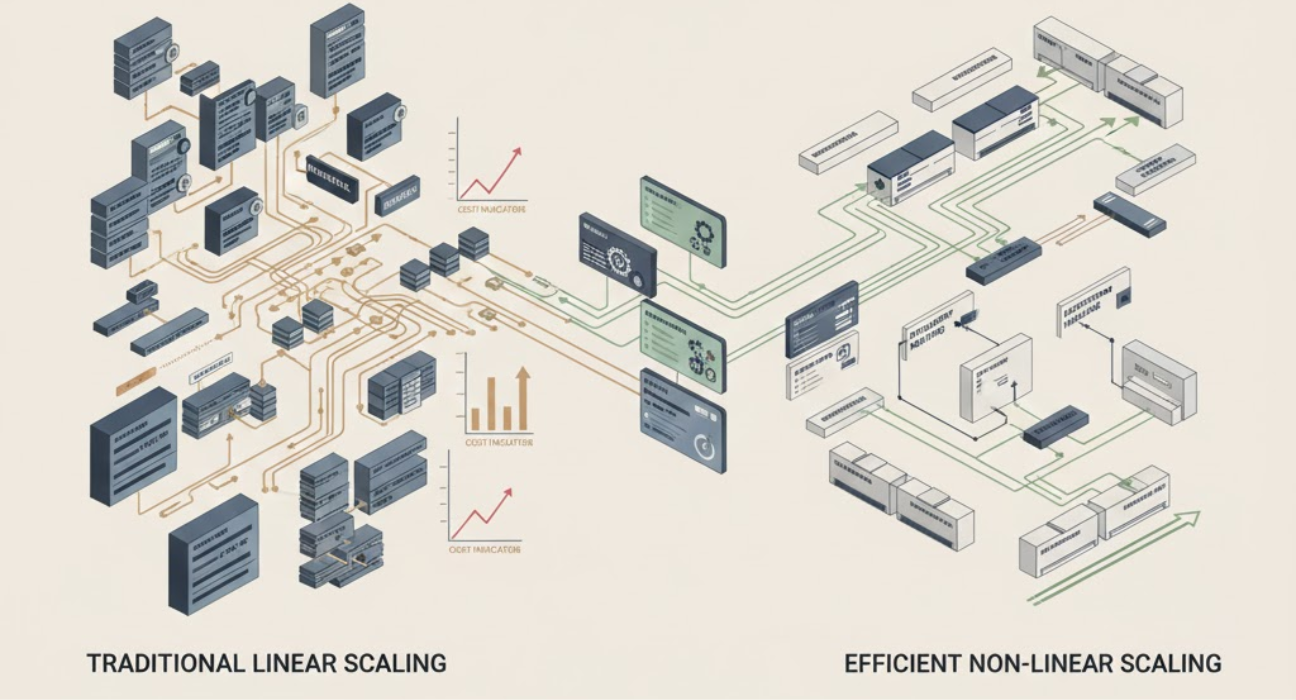
The most important metric is the relationship between volume growth and operational cost growth. In a successfully transformed operation, a 50 percent volume increase might require only a 15 percent cost increase. The gap between volume growth and cost growth represents operational leverage that flows directly to improved margins.
These improvements compound over time. As volume continues growing, the efficiency advantage widens. An organisation that achieves strong operational leverage at 100,000 transactions monthly finds that scaling to 200,000 transactions is relatively inexpensive. The platform and processes are designed for scale, so adding volume is largely a matter of infrastructure capacity rather than human resources.
The Long-Term Support Model
Efficient scaling requires ongoing attention as the business evolves. New products create new operational requirements. Regulatory changes affect processes. Customer expectations shift. The operations platform must adapt continuously to maintain efficiency.
Ozrit provides 24/7 support with access to senior engineers who understand both the technical platform and the operational context. When issues arise, response comes from people who can diagnose problems quickly and implement solutions effectively. This prevents operational disruptions from becoming extended outages that damage customer relationships.
The platform collects operational data that informs continuous improvement. Analysis of transaction patterns reveals opportunities for additional automation. Bottleneck identification shows where capacity or process changes would help. Error analysis highlights where quality improvements are needed. This data-driven approach ensures that operations keep improving rather than becoming static.
Regular business reviews, typically quarterly, assess whether operational efficiency is meeting targets and identify new opportunities. These reviews include senior Ozrit leaders and client executives, focusing on business outcomes rather than technical details. The goal is to ensure the platform continues delivering value as business needs evolve.
What This Means for Enterprise Leadership
Operational scaling efficiency has become a competitive differentiator. Organisations that master it can grow profitably in ways that competitors with linear cost structures cannot match. This creates strategic options and financial flexibility that translate to market advantage.
The path to efficient scaling requires upfront investment and disciplined execution. It is not a quick fix or a series of incremental improvements. It is a fundamental transformation of how operations work. Leadership must commit to this transformation with realistic expectations about timeline, cost, and organisational impact.
The return on this investment appears in improved margins, increased capacity to handle growth, and reduced vulnerability to competitive pressure. These benefits accumulate year after year as the business scales. The organisation that solves operational efficiency builds structural advantages that persist and compound over time.