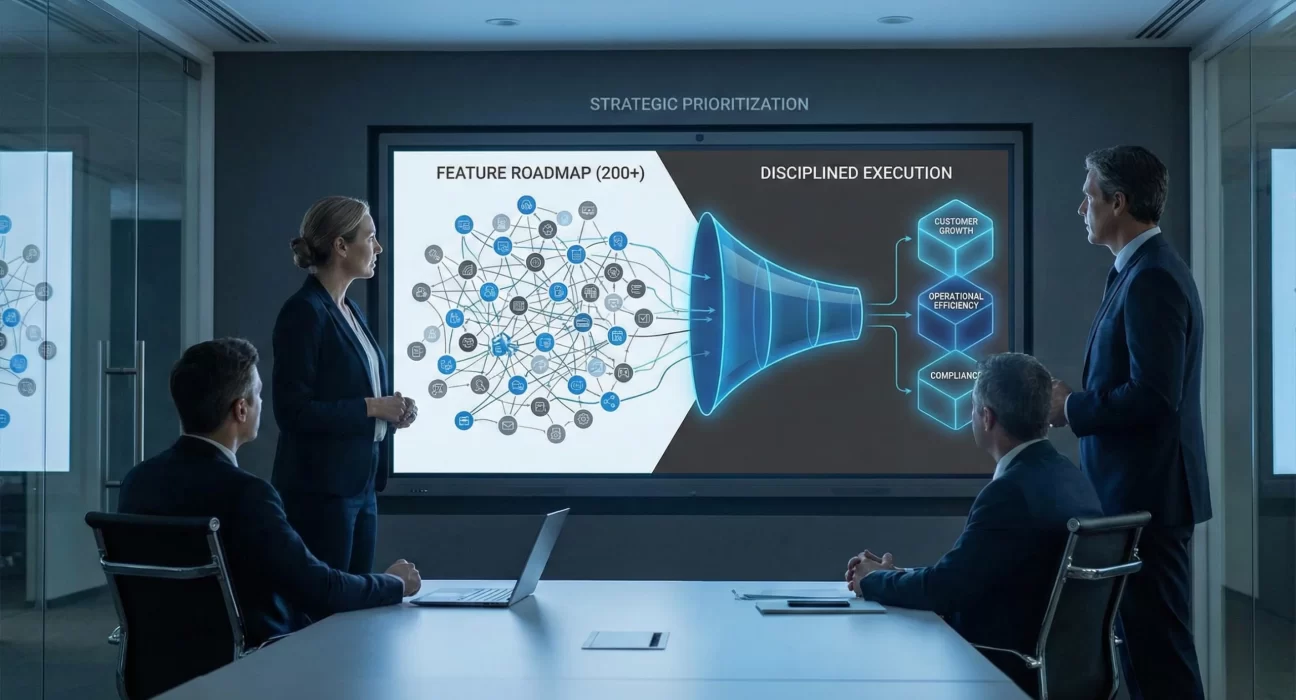
Your steering committee has approved a three-year digital transformation budget. The vendor has presented an impressive roadmap with 200+ features across 12 modules. Marketing wants customer-facing capabilities immediately. Operations are pushing for backend efficiency. Compliance needs regulatory features. Finance wants cost control dashboards. IT is concerned about technical debt.
Everyone has legitimate needs. Everyone believes their requirements are critical. And your program has neither the time nor the budget to build everything at once.
This is where most enterprise software programs begin accumulating the problems that will eventually derail them. Not in the technology choices, not in the vendor selection, but in how features get prioritized or more accurately, how they don’t get prioritized at all.
If you’re leading a mid-to-large enterprise, particularly one operating in India’s complex regulatory and competitive environment, you’ve likely witnessed what happens when feature prioritization is treated as a technical planning exercise rather than a strategic business decision. Scope creep. Timeline extensions. Budget overruns. Solutions that deliver everything except what matters most.
This article addresses what actually works in enterprise feature prioritization and why it requires leadership commitment rather than just better planning tools.
Why Enterprise Feature Prioritization Fails
Let’s examine the common failure patterns. Understanding these helps explain why traditional approaches don’t work at enterprise scale.
The consensus trap
Many organizations try to prioritize features through consensus. Stakeholders from different business units gather in workshops. Facilitated discussions happen. Voting mechanisms are employed. Everyone leaves feeling heard.
The result is a prioritized list that reflects compromise rather than strategic clarity. The most vocal stakeholders get their features included. The politically weak departments get deprioritized. Business-critical capabilities that lack strong advocates get buried in the backlog.
Consensus-based prioritization fails because it assumes all stakeholder input has equal strategic weight. In reality, some capabilities are fundamental to business model transformation while others are incremental improvements. Some features address existential regulatory risks while others offer marginal efficiency gains.
True prioritization requires making hard choices that disappoint some stakeholders. Consensus processes avoid these hard choices, producing bloated scope that programs can’t actually deliver.
The feature factory mentality
Some enterprises approach software development with a manufacturing mindset: specify all requirements upfront, estimate delivery timelines, and maximize feature throughput.
This seems logical. If you’re building 200 features and Vendor A can deliver 30 features per quarter while Vendor B delivers 25, you choose Vendor A. You measure progress by features completed. You hold vendors accountable for feature velocity.
The problem is that features aren’t widgets. A customer login feature might take two weeks while an integration with your legacy ERP system might take six months. Building ten low-value features doesn’t create the same business impact as delivering two high-value capabilities.
The feature factory mentality optimizes for quantity rather than business value. Programs deliver on time and on budget but fail to move key business metrics because they’ve built the wrong things efficiently.
Lack of strategic alignment
Walk into most enterprise programs and ask: “Which features directly support our three most important strategic objectives?” The honest answer is often unclear.
Feature backlogs grow organically. Requirements come from multiple sources: business stakeholders, regulatory mandates, competitive benchmarking, vendor recommendations, technical teams. Each requirement seems reasonable in isolation.
But when you step back and examine the complete backlog against actual business strategy, the disconnect becomes apparent. Significant effort is planned for capabilities that don’t materially advance strategic goals. Meanwhile, features that could create competitive advantage sit deprioritized because nobody connected them to strategy explicitly.
This happens because prioritization is delegated to program management or product teams who lack the business context to make strategic trade-offs. They prioritize based on urgency, stakeholder pressure, or technical dependencies not strategic business value.
The MVP confusion
Minimum Viable Product has become a popular concept in enterprise software. The idea is sound: deliver core functionality quickly, learn from usage, and iterate.
But in enterprise environments, MVP often gets misinterpreted. Instead of “minimum viable,” it becomes “minimum acceptable to the loudest stakeholders.” Instead of focusing on the smallest feature set that delivers measurable business value, programs try to include enough features to satisfy everyone minimally.
The result is a bloated first release that takes as long to build as a traditional big-bang approach, with none of the benefits of true iterative delivery. You don’t get early business value because the first release is delayed. You don’t get learning because you’re building everything upfront based on assumptions.
Real MVP thinking requires brutal prioritization: what’s the absolute minimum we can deploy that will generate measurable business results or validate critical assumptions? This level of focus is rare in enterprise programs.
What Effective Feature Prioritization Looks Like
Organizations that succeed at enterprise software delivery approach prioritization fundamentally differently. Not with better frameworks or tools, but with different governance and decision-making processes.
Business value drives everything
In mature programs, every significant feature is explicitly linked to measurable business outcomes. Not just “improve customer experience” but “reduce customer onboarding time from 7 days to 2 days, enabling us to capture market segment X.”
This specificity forces clarity. When you have to articulate exactly how a feature will impact business metrics, weak justifications become obvious. Features that seemed important because senior stakeholders requested them get deprioritized when nobody can explain their business value clearly.
This doesn’t mean ignoring regulatory requirements or technical necessities. It means being honest about why features exist. Some are mandatory compliance needs. Some are technical infrastructure. Some deliver business value. Each category is acknowledged explicitly rather than pretending everything is equally strategic.
Business leadership owns prioritization
The single biggest differentiator in successful programs is who makes prioritization decisions.
In struggling programs, prioritization happens in product management or IT planning meetings. Technical teams and project managers decide what gets built based on their understanding of business priorities and technical constraints.
In successful programs, business leaders make prioritization decisions. Not rubber-stamping recommendations, but actively engaging with trade-offs. When the CRO has to choose between sales automation features and customer service portal capabilities within a fixed budget and timeline, that’s a business decision requiring business judgment.
This doesn’t mean business leaders need to understand technical complexity. It means presenting prioritization choices in business terms: “We can deliver sales automation by Q2 or customer portal by Q2, but not both. Sales automation is expected to reduce sales cycle time by 20%. The customer portal should decrease service costs by 15%. Which business outcome is more strategically important right now?”
When business leaders own these decisions, prioritization reflects actual strategic priorities rather than technical convenience or stakeholder pressure.
Cost of delay informs decisions
Different features have different time sensitivity. Delaying a regulatory compliance feature might create legal risk. Delaying a competitive feature might cost market share. Delaying an operational efficiency feature might be low-risk if current processes work adequately.
Mature organizations explicitly consider the cost of delay in prioritization. Not with elaborate calculations, but with honest assessment: what’s the business impact if this feature is delivered six months later than planned?
This thinking prevents the common pattern where programs load early releases with low-value features because they’re easier to build, while high-value, complex capabilities keep getting pushed to later phases. When you quantify cost of delay, you often accept technical complexity to deliver high-impact features sooner.
Continuous reprioritization based on learning
Feature prioritization isn’t a one-time planning exercise. It’s an ongoing process that responds to changing business conditions and implementation learnings.
When you deploy the first release and discover that a feature you thought would transform operations barely gets used, that’s data. When market conditions shift and a capability that was low priority becomes competitively critical, that’s reason to reprioritize.
Organizations that treat their roadmap as fixed struggle when reality diverges from plan. Those that embrace continuous reprioritization adapt to new information, delivering better business outcomes even if they deviate from original plans.
This requires governance processes that support reprioritization without chaos. Regular roadmap reviews with business leadership. Clear processes for evaluating change requests against strategic objectives. Authority to say no to new requirements that don’t align with current priorities.
At Ozrit, we’ve found that programs with quarterly business-led roadmap reviews significantly outperform those with annual planning cycles. Not because they plan better, but because they adapt faster.
Managing Stakeholder Complexity
Enterprise programs involve dozens of stakeholder groups, each with legitimate needs and varying political influence. Effective prioritization requires managing this complexity deliberately.
Transparent decision criteria
One reason prioritization becomes political is opacity. When stakeholders don’t understand how decisions are made, they assume it’s about influence and power. This encourages lobbying rather than rational discourse.
Making decision criteria explicitly changes the dynamic. When everyone knows features are evaluated based on strategic alignment, business value, regulatory necessity, and technical dependencies and sees this applied consistently, prioritization becomes less political.
This doesn’t eliminate disagreement. Some stakeholders will still be unhappy with decisions. But transparent criteria at least ensure disagreement is about priorities and values rather than perceived favoritism.
Stakeholder tiers, not equal voice
Trying to give every stakeholder group equal say in prioritization creates the consensus trap discussed earlier. The alternative isn’t ignoring stakeholders, it’s acknowledging that different groups have different roles in decision-making.
Some stakeholders are decision-makers: they own the business outcomes and have authority to make trade-offs. Some are advisors: they provide input and context but don’t decide. Some are informed: they need to know decisions but aren’t consulted on them.
Making these tiers explicit prevents the dysfunction where everyone expects veto power and feels slighted when their priorities aren’t addressed immediately.
Managing the compliance versus innovation tension
Indian enterprises face particular challenges balancing mandatory compliance requirements with innovation priorities. GST changes, RBI guidelines, data localization requirements—these aren’t negotiable. But if your entire development capacity goes to compliance, you never build competitive advantage.
This tension requires explicit capacity allocation. Some organizations dedicate a fixed percentage of development capacity to compliance and regulatory needs, with the remainder available for strategic initiatives. Others create separate workstreams with different governance.
The specific approach matters less than acknowledging the tension explicitly and making conscious allocation decisions rather than letting compliance needs crowd out everything else reactively.
The Role of Architecture in Prioritization
Feature prioritization and technical architecture are deeply connected, though many organizations treat them separately.
Technical dependencies constrain sequencing
You can’t build the customer recommendation engine before you have customer data in analyzable form. You can’t deploy mobile apps before you have APIs exposing necessary functionality. Technical dependencies create constraints on feature sequencing that business stakeholders often don’t appreciate.
Effective prioritization processes surface these constraints early. Not to let technical concerns dominate, but to ensure business leaders understand when their preferred prioritization would require additional technical work or create delivery risk.
The mature approach is presenting business stakeholders with options: “We can deliver the features in your preferred order if we invest three months in infrastructure work first, or we can sequence differently and avoid that infrastructure investment. What’s more valuable?”
Modularity enables flexibility
Tightly coupled architectures constrain prioritization severely. If every feature requires changes across multiple systems, your ability to reprioritize is limited. You’re locked into sequences determined by technical dependencies.
Modular architectures provide more prioritization flexibility. When components have clear boundaries and limited dependencies, you can deliver features in business-optimal order without massive technical ripple effects.
This is why architectural decisions have strategic implications. Leaders who understand this evaluate architecture proposals partly on flexibility: does this approach give us optionality to adjust priorities as we learn, or does it lock us into rigid sequences?
Legacy system integration realities
Most enterprise software programs in India involve integrating new platforms with legacy systems. These integration requirements significantly impact what you can deliver when.
If your new customer portal needs real-time inventory data from a 20-year-old inventory system, you have constraints. Either you build the integration (time and cost), you work with batch updates (limiting functionality), or you deprioritize features requiring that data.
Business leaders need to understand these constraints to make informed prioritization decisions. Technical teams need to surface integration challenges early enough to inform roadmap planning, not surprise stakeholders late in delivery.
Practical Prioritization Approaches
What does effective enterprise feature prioritization look like in practice? Here are frameworks and processes that work.
The strategic filter
Before detailed prioritization, apply a strategic filter. Every feature must connect to one of 3-5 strategic objectives, be a regulatory requirement, or be the technical foundation necessary for strategic features.
Features that don’t pass this filter get removed from consideration entirely, not just deprioritized. This dramatically reduces the backlog to features worth detailed evaluation.
This seems obvious, but most enterprise backlogs are full of features that don’t support strategy. They’re there because someone requested them and nobody questioned whether they should be built at all.
Value versus complexity mapping
Plot features on two dimensions: business value and implementation complexity. This creates four quadrants:
High value, low complexity: prioritize immediately. These are obvious wins.
High value, high complexity: schedule carefully. These deliver impact but need proper planning and resources.
Low value, low complexity: consider for later phases if capacity exists. Don’t let these crowd out high-value work.
Low value, high complexity: eliminate unless they’re mandatory requirements. These are terrible investments.
This simple visualization helps stakeholders understand why some requested features aren’t prioritized despite being “quick to build” low value remains low value regardless of ease.
The regulatory requirement audit
Separate true regulatory requirements from nice-to-have compliance features. In our experience, about 40% of features justified as “compliance needs” are actually about exceeding minimum requirements or implementing best practices.
Minimum viable compliance should be clearly identified. Everything beyond that competes for priority like other business features, evaluated on value versus cost.
This prevents compliance from becoming a catch-all justification that bypasses normal prioritization rigor.
Release-based thinking
Rather than prioritizing individual features, prioritize releases focused on specific business outcomes. Release 1 enables new customer segment entry. Release 2 reduces operational costs in process X. Release 3 addresses regulatory changes.
Each release has clear success criteria and measurable business value. Features are selected to support release objectives, not in isolation.
This approach prevents the common pattern where programs deliver disconnected features across many business areas without creating coherent value in any area.
When Vendor Input Helps and When It Doesn’t
Enterprise software programs typically involve product vendors, system integrators, or development partners. Their input on prioritization can be valuable or misleading depending on how you engage them.
Technical feasibility and sequencing
Vendors understand their platforms’ technical constraints and can advise on implementation complexity, dependencies, and risk. This input is valuable for informed prioritization.
However, vendors often have biases. They prefer building features that showcase their platform’s strengths. They want to avoid complex integrations with systems they don’t control. They sometimes suggest delays for features they find difficult, even when business value is high.
The solution is using vendor input as one factor, not the deciding factor. Technical complexity should inform prioritization, not determine it. Sometimes business value justifies tackling complex implementations.
Product roadmap alignment
If you’re implementing commercial software, the vendor’s product roadmap matters. Features they’re planning to release shouldn’t be custom-built. Features they’re deprecating shouldn’t be prioritized for heavy usage.
But vendor roadmaps aren’t sacred. If your business needs a capability now and the vendor’s roadmap shows it coming in 18 months, that’s a business decision: wait, build custom, or select a different solution. Don’t let vendor timelines override business priorities without conscious choice.
Partnership versus transaction
Some technology partners approach programs transactionally: deliver the contracted features, collect payment, move to the next project. Others approach programs as partnerships: help you succeed even when that means challenging your priorities or suggesting different approaches.
Partners who understand enterprise program management and delivery maturity companies like Ozrit that position themselves around execution excellence often provide better prioritization guidance because they’re focused on business outcomes rather than just feature delivery.
When evaluating how much weight to give vendor input on prioritization, consider whether they’re advising based on your success or their convenience.
The CFO’s Perspective on Feature Prioritization
Feature prioritization decisions have direct financial implications that CFOs understand differently than other executives.
Phased investment and learning
From a financial risk perspective, building everything upfront is high-risk. You invest heavily before knowing whether the solution delivers promised value.
Prioritizing features that enable early value measurement allows phased investment. Release 1 delivers specific capabilities. You measure actual business impact. Then you decide whether to invest in Release 2 based on demonstrated value, not projected value.
This approach reduces financial risk substantially. Yet many programs plan all features upfront because it feels more controlled. CFOs who understand enterprise software delivery increasingly push for prioritization that enables learning before full investment.
Total cost of ownership thinking
Some features create ongoing costs: maintenance, support, training, infrastructure, licensing. These should factor into prioritization alongside development costs.
A feature might be relatively cheap to build but expensive to operate. Another might cost more upfront but have minimal ongoing costs. Over a five-year horizon, the second might be the better investment.
Mature prioritization processes include TCO analysis for significant features, not just development cost estimates.
Opportunity cost of delay
Every month spent building Feature A is a month not spent on Feature B. The question isn’t just whether Feature A is valuable, but whether it’s more valuable than what you could build with the same resources.
This opportunity cost thinking prevents loading roadmaps with marginally useful features just because “we have the budget.” Budget availability doesn’t make low-value work worth doing if it prevents high-value work.
Building Organizational Capability in Prioritization
Feature prioritization isn’t a project activity. It’s an organizational capability that improves with practice and discipline.
Creating prioritization muscle
Organizations that prioritize well have done it repeatedly. They’ve made hard trade-offs, seen the consequences, and refined their approach. This capability develops through experience, not training.
The implication: start practicing rigorous prioritization now, even on smaller programs. Build the organizational muscle for making tough choices, disappointing stakeholders gracefully, and measuring whether prioritization decisions were correct.
Programs where executives make their first difficult prioritization decisions on their largest, most critical initiative often struggle. They lack the experience to navigate stakeholder politics and evaluate trade-offs confidently.
Measuring prioritization effectiveness
How do you know if your prioritization is working? Some indicators:
Are you delivering measurable business value in each release, or just deploying features?
Are stakeholders clear about why features are sequenced the way they are, even when they disagree?
Can you point to features that were deprioritized or eliminated despite stakeholder support?
Do you adjust priorities based on implementation learning?
Organizations that can answer yes to these questions have mature prioritization processes. Those that can’t are likely struggling with the challenges described earlier.
Leadership role modeling
Executives set the tone. When leaders accept bloated scope to avoid difficult stakeholder conversations, the organization learns that prioritization isn’t real. When leaders defend tough prioritization decisions and explain trade-offs clearly, the organization learns that focus matters.
This role modeling is particularly important in Indian enterprises where hierarchical cultures sometimes discourage saying no to senior stakeholders. Leaders who demonstrate that respectful pushback based on strategic priorities is acceptable change organizational behavior.
The Path Forward
Enterprise software feature prioritization is difficult because it requires capabilities many organizations underdevelop: strategic clarity, stakeholder management, business value thinking, and comfort with tough trade-offs.
Technology can’t solve these organizational challenges. Better tools and frameworks help, but they don’t replace the fundamental work of deciding what matters most and accepting that you can’t do everything.
The programs that succeed are led by executives who understand that feature prioritization is a business decision requiring business leadership. They invest time in making trade-offs explicit. They create governance processes that support ongoing reprioritization. They choose partners who understand that successful delivery means building the right things, not just building things right.
As you plan your next large-scale digital transformation or IT transformation strategy, the question isn’t whether you’ll face difficult prioritization decisions. You will. The question is whether you have the organizational maturity and leadership commitment to make those decisions well.
That maturity develops through practice, honest assessment of what’s working, and willingness to change approaches that aren’t delivering results. It requires recognizing that scope discipline and prioritization rigor aren’t constraints on delivery; they’re enablers of delivery success.
The enterprise software programs that deliver meaningful business value are almost always those that built less than originally envisioned but built the right things well. Those that struggle typically built more features but failed to deliver cohesive business value.
That’s the fundamental lesson of enterprise feature prioritization: success comes from focus, not comprehensiveness. From building what matters most, not what’s easiest or most popular.
The capability to make these choices consistently, strategically, and courageously is what separates organizations that successfully navigate complex technology programs from those that accumulate expensive lessons in what not to do.