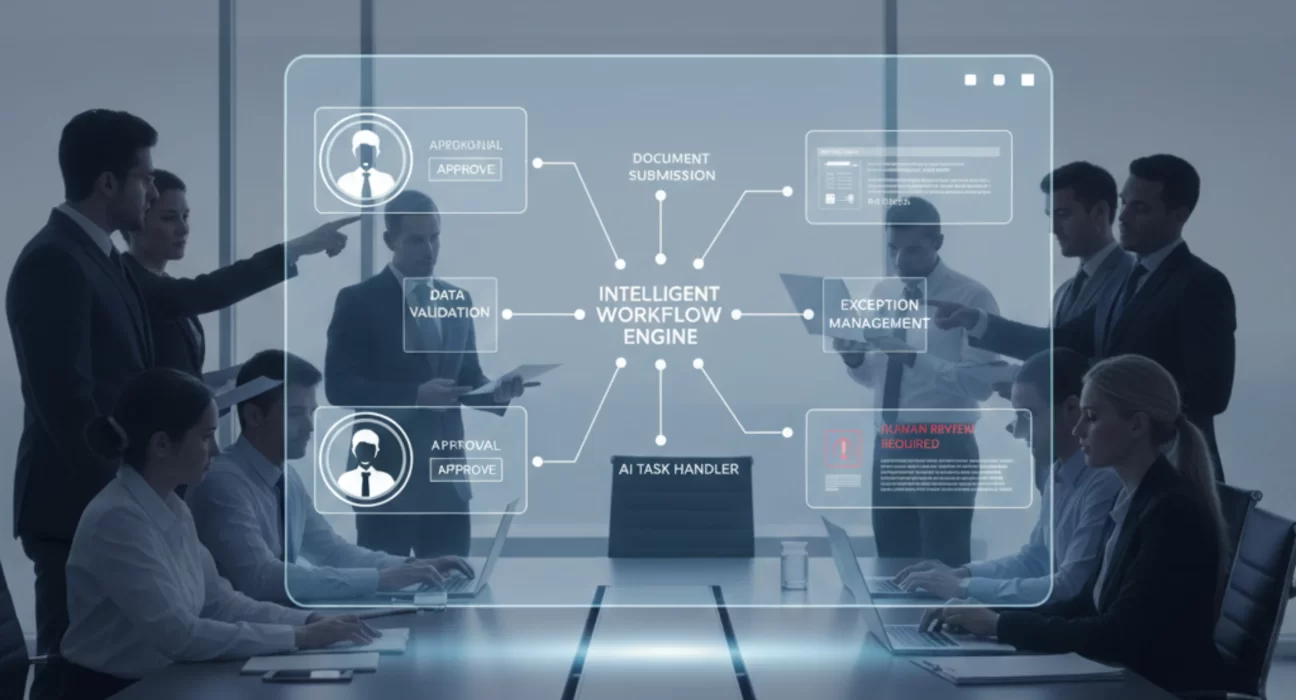
Every COO I know is dealing with the same frustration: workflows that involve too many people doing too many manual tasks, with too many opportunities for error and delay. Purchase approvals that sit in someone’s inbox for days. Invoice processing that requires three people to re-enter the same data. Customer onboarding that takes weeks because documents move through sequential handoffs.
The promise of workflow automation isn’t new. We’ve been automating business processes for decades. What’s different now is that AI can handle the messy, unstructured, judgment-based parts that traditional automation couldn’t touch.
But here’s what I’ve learned watching these initiatives in large organisations: AI-driven workflow automation fails far more often than it succeeds. Not because the technology doesn’t work. It does. The failures happen because enterprises underestimate what it takes to actually change how work gets done at scale.
I’ve seen organisations spend crores on AI automation platforms, only to have them sit unused because nobody addressed the fact that the workflow itself was broken. You can’t automate dysfunction. You just make it faster.
Why Workflow Automation Matters More Now
Your enterprise runs on workflows. Procurement workflows. Hiring workflows. Customer service workflows. Finance workflows. Sales workflows. Each involves multiple steps, multiple systems, multiple people, multiple decisions.
In most large organisations, these workflows are inefficient by design. They evolved over years through compromise between departments. They carry legacy requirements that nobody remembers the reason for. They involve approval steps that add no value. They require manual work that could be automated but hasn’t been.
This inefficiency costs more than just time and money. It frustrates employees who spend their days on repetitive tasks. It slows your response to customers and markets. It creates compliance risks when manual processes are inconsistently followed. It limits your ability to scale because you can’t just hire proportionally more people to handle more volume.
Traditional automation helped with structured, rule-based processes. If this, then that. But most enterprise workflows aren’t that simple. They involve documents in different formats. Emails with varying content. Decisions that require interpretation. Exceptions that need judgment.
This is where AI changes the equation. Natural language processing can understand unstructured text. Computer vision can extract data from documents. Machine learning can make classification decisions. AI agents can orchestrate complex multi-step processes.
The technology exists. The business case is clear. So why do most implementations fail?
The Real Obstacles to Enterprise Workflow Automation
Large organisations don’t fail at AI-driven automation because they pick the wrong platform. They fail because they treat it as a technology project when it’s actually an organisational transformation.
Your workflows cross boundaries that your organisation isn’t designed to cross. A typical enterprise workflow touches multiple departments, each with their own systems, their own data, their own managers, their own priorities.
Automating accounts payable isn’t just an IT problem. It involves procurement, finance, legal, operations, and the business units that requested the purchase. Each department has built their part of the process to optimise for their own needs, often at the expense of the overall workflow.
Getting these departments to agree on a unified, automated process means challenging established territories. Nobody wants to give up control. Nobody wants their metrics to change. The political complexity often exceeds the technical complexity.
Legacy systems weren’t built to support automation. Your core systems were designed when automation meant batch processing and EDI files. They don’t expose modern APIs. They don’t support real-time integration. They don’t have the data structures that AI automation needs.
I’ve seen organisations discover six months into an automation initiative that their ERP system can’t provide the real-time status updates the workflow requires. Or that their document management system can’t trigger external processes. Or that their legacy CRM doesn’t support the webhook integrations the automation platform needs.
Fixing this often requires either expensive system upgrades or building complex middleware layers. Both options add cost, risk, and time that weren’t in the original plan.
The workflows themselves are poorly designed. This is the uncomfortable truth most organisations avoid. Before you automate a workflow, you should fix it. Most enterprise workflows have steps that add no value, approvals that are rubber stamps, handoffs that create delays, redundant data entry, and unclear decision criteria.
Automating a bad workflow just gives you automated dysfunction. Faster dysfunction, but dysfunction nonetheless.
The right sequence is: document the current workflow, identify inefficiencies, redesign for optimal flow, then automate. Most organisations skip straight to automation because redesigning workflows is politically difficult and time-consuming.
Your data doesn’t support intelligent automation. AI-driven workflow automation requires data lots of it, in the right format, with acceptable quality. Historical workflow data to train models. Master data to make routing decisions. Structured metadata to enable search and classification.
In most enterprises, this data is fragmented, inconsistent, and incomplete. Purchase orders use different formats across business units. Customer data has duplicates and errors. Document repositories lack proper tagging. Historical workflow data was never captured systematically.
Cleaning and structuring this data is unglamorous work. It doesn’t show up in demo presentations. But without it, AI automation produces unreliable results.
People resist changing how they work. Workflow automation changes jobs. Tasks that people spent hours on now happen automatically. Roles that existed to move work between steps become unnecessary. Managers lose visibility into work they previously reviewed manually.
This creates anxiety and resistance. Even when automation makes work easier, people worry about their relevance. Will I still have a job? Will my role be diminished? Will I lose control over work I’m accountable for?
Without addressing these concerns proactively, you’ll build beautiful automation that nobody uses because people find ways to route work around it.
Exceptions break automated workflows. Enterprise workflows are full of exceptions. The customer who needs special pricing. The supplier who doesn’t follow the standard purchase process. The request that needs escalation to senior management. The document that’s in the wrong format.
Traditional automation breaks when it encounters exceptions. AI can handle some exceptions through learning and pattern recognition, but it can’t handle all of them. You need human judgment and intervention.
Designing for exceptions, knowing when to route to humans, how to handle the handoff, and how to learn from exception patterns is complex. Most automation initiatives underestimate this complexity.
What Separates Successful Automation From Failed Projects
After watching dozens of workflow automation initiatives across industries, the successful ones share common patterns. None of them are primarily about technology selection.
They start with workflow redesign, not technology deployment. Successful implementations spend months mapping current workflows, identifying waste, challenging assumptions, and redesigning for efficiency before any automation platform is selected.
This involves difficult conversations. Why do we have seven approval steps? Who actually looks at these reports we generate? Why does this handoff exist? What value does this review add?
These conversations expose sacred cows, challenge established power structures, and force difficult trade-offs. But they’re essential. Automating a bad workflow is an expensive failure. Fixing the workflow first, then automating it, is how you generate real value.
They solve the data problem systematically. The best implementations treat data as a foundational capability, not a technical detail. They invest in master data management. They implement data quality initiatives. They create data governance structures.
This takes time and budget. It’s not glamorous. But it’s what separates automation that works reliably from automation that works sometimes.
They design for humans and AI working together. Successful automation doesn’t try to eliminate humans entirely. It recognises that some tasks are better automated, some are better handled by people, and many require collaboration.
The automation handles high-volume, routine tasks. It flags exceptions for human review. It provides recommendations that humans can accept, modify, or reject. It learns from human decisions to improve over time.
This hybrid approach is more complex to design than full automation, but it’s far more likely to succeed in enterprise environments where judgment, accountability, and flexibility matter.
They manage change as rigorously as they manage technology. The successful implementations invest heavily in change management. They communicate early and often about what’s changing and why. They involve employees in redesigning workflows. They provide training before, during, and after deployment. They celebrate wins and address concerns.
They understand that people need time to adapt. They plan for pilot programs where teams can learn gradually. They adjust incentive structures to support new ways of working. They create feedback mechanisms so concerns get heard and addressed.
They establish clear governance for automated decisions. When AI makes decisions in your workflows approving requests, routing work, classifying documents, triggering actions someone needs to be accountable for those decisions.
What happens when the AI approves something it shouldn’t? Who reviews automated decisions for bias or errors? How do we audit the workflow to ensure compliance? Who decides when to override the automation?
Good governance means policies, oversight, audit trails, and regular reviews. It means treating AI automation as an extension of your business processes, subject to the same controls and accountability.
They choose partners who understand enterprise delivery. Building AI automation in a sandbox is different from deploying it across a global enterprise with thousands of employees and multiple legacy systems.
You need partners who’ve navigated this before. Who understand stakeholder management, change resistance, integration complexity, and the gap between proof-of-concept and production deployment. Partners who bring program management discipline, not just technical capability.
Companies like Ozrit, for example, position themselves around this delivery maturity understanding that enterprise success requires more than building automation platforms. It requires managing the organisational transformation that makes automation sustainable.
The Hard Realities of Enterprise Program Management
Let me be direct about what these initiatives actually require in large organisations.
Timeline estimates are reliably wrong. Vendors will tell you six months. Consultants will say nine months. Reality is usually eighteen to twenty-four months for meaningful enterprise-wide workflow automation.
Why the gap? Because scoping takes longer than expected. Integration work uncovers unexpected complexity. Stakeholder alignment is slower than assumed. Testing reveals issues that require rework. Change management needs more time than planned.
Budget for the realistic timeline, not the optimistic one. Better to set conservative expectations and deliver early.
Scope creep happens in invisible ways. Workflow automation projects grow because every workflow touches other workflows. You start automating invoice processing. Then someone points out that purchase order creation should be automated too. Then procurement wants supplier onboarding automated. Then finance wants payment approval automated.
Each addition makes sense individually. Collectively they turn a focused initiative into an enterprise transformation that’s beyond the program’s capacity to deliver.
Preventing this requires ruthless prioritisation. Define clear boundaries. Build in phases. Deliver value incrementally. Prove success before expanding scope.
Integration is always harder than estimated. Your automation platform needs to integrate with ERP, CRM, document management, email, collaboration tools, legacy applications, and potentially dozens of other systems.
Each integration has its own challenges. APIs that don’t do what you need. Systems that don’t have APIs at all. Authentication complexity. Data format mismatches. Performance issues. Vendor limitations.
Budget for integration being at least half your effort and cost. Usually it’s more.
Organisational resistance surfaces late. The resistance to automation often doesn’t appear during planning. It appears during deployment when people realise their daily work is changing.
Middle managers who weren’t consulted push back. Employees find workarounds to avoid the automated workflow. Regional offices claim the automation doesn’t fit their local processes. Legal raises compliance concerns nobody anticipated.
Managing this requires proactive stakeholder engagement from the beginning, not just communication near the end.
Vendor management requires constant orchestration. You’re probably working with multiple vendors. Your automation platform vendor. Your systems integrator. Your infrastructure provider. Potentially specialists for specific components.
When something goes wrong , each vendor will blame the others. Your ERP vendor says the automation platform isn’t calling the API correctly. The automation vendor says the ERP API is poorly documented. The integrator says both vendors aren’t providing proper support.
Navigating this requires clear contracts, detailed technical documentation, and active program management to drive accountability.
Maintenance and evolution are underestimated. Workflow automation isn’t a one-time implementation. Business requirements change. Systems get upgraded. Regulations evolve. The AI models need retraining. New exceptions emerge.
If you don’t plan for ongoing maintenance, enhancement, and support, your automation will degrade over time. Workflows will break. Performance will decline. Users will lose confidence.
Budget for a sustaining team, not just an implementation team.
Practical Guidance for Executive Leadership
If you’re a C-level executive considering AI-driven workflow automation, here’s what matters.
Define specific workflows with measurable outcomes. Don’t approve of a general “workflow automation initiative.” Approve specific workflows with specific targets. Reduce invoice processing time from ten days to two days. Cut purchase order approval cycle from five days to eight hours. Decrease customer onboarding duration from three weeks to three days.
Specific outcomes create focus, enable measurement, and prevent scope creep.
Assign business ownership, not IT ownership. Workflow automation changes how your business operates. The owner should be a business executive, your COO, head of operations, head of customer service not your CIO.
IT is a critical partner, providing technical capability and ensuring integration. But the business owns the outcome and drives adoption.
Invest time in workflow redesign before automation. Resist the temptation to automate current workflows as-is. Invest in understanding what work is actually necessary, what steps add value, what approvals matter, what handoffs create delays.
This analysis is uncomfortable because it challenges how things have always been done. But it’s what generates real value.
Plan for incremental rollout with learning cycles. Don’t try to automate all workflows simultaneously. Choose one high-impact workflow. Automate it well. Learn from the experience. Build confidence. Then expand.
Each cycle teaches your organisation something about working with AI automation, managing the change, and navigating the integration complexity.
Build internal capability, not just vendor dependency. External partners bring expertise and capacity you need. But your internal teams should develop the capability to sustain, enhance, and expand automation over time.
When vendors leave, knowledge shouldn’t leave with them. Your people should understand how the automation works, how to adjust it as needs change, and how to troubleshoot when issues arise.
Establish governance for automated processes. Who monitors the automated workflows? Who reviews exception patterns? Who decides when automation needs adjustment? Who’s accountable when automated decisions create problems?
Clear governance prevents automation from becoming a black box that nobody understands or controls.
Be realistic about readiness. Sometimes the honest answer is “we’re not ready yet.” If your workflows are poorly documented, if your systems are too fragmented, if your organisation struggles with change, if your data quality is poor, fix those things first.
Rushing into automation before you’re ready guarantees expensive failure.
Managing Complex IT Programs Successfully
Workflow automation is fundamentally a large-scale digital transformation program. Success requires more than good technology. It requires program management maturity.
Stakeholder alignment is continuous, not one-time. You’re not just aligning IT with business. You’re aligning multiple business units with different priorities, different constraints, different timelines. This alignment needs constant maintenance.
Regular steering committee meetings. Clear escalation paths for conflicts. Mechanisms to make trade-off decisions. Someone with authority to resolve disputes and keep progress moving.
Risk management needs to be proactive. Workflow automation creates new risks. What if the automated process breaks? What if the AI makes wrong decisions at scale? What if integration failures create data integrity issues? What if employees resist and productivity drops?
Good program management means identifying risks early, having mitigation plans, monitoring trigger indicators, and being ready to act quickly when risks materialise.
Communication needs to be continuous and honest. Employees worry about automation taking their jobs. Managers worry about losing control. Executives worry about the investment and timeline.
Addressing these worries requires constant communication. What’s changing, why it matters, what it means for different roles, how concerns are being addressed. Honest communication about challenges, not just celebration of progress.
Success metrics need to be meaningful. Don’t measure success by how many workflows you’ve automated or how much AI you’ve deployed. Measure business outcomes. Time saved. Cost reduced. Error rates decreased. Customer satisfaction improved. Employee satisfaction with work.
These metrics tell you whether automation is actually delivering value, not just whether you’ve implemented technology.
The Partnership Question
The partner you choose for workflow automation matters more than the specific platform you select.
Look for partners who’ve delivered enterprise-scale transformation programs. Ask about their experience with workflow redesign, stakeholder management, change management, and integration complexity. Ask how they handle resistance, scope management, and vendor coordination.
The best partners help you see risks before they become problems. They push back on unrealistic timelines. They challenge workflows that need fixing. They bring program management discipline and delivery maturity.
In the context of Indian and global enterprises, this often means finding partners who understand how large organisations actually work, the approval hierarchies, the stakeholder dynamics, the procurement complexity, the regulatory environment. Partners like Ozrit, who focus on enterprise program execution and delivery excellence, tend to understand these realities better than vendors who’ve only worked with startups or smaller companies.
Moving Forward With Purpose
AI-driven workflow automation is not theoretical. It’s happening successfully in organisations across industries. Finance workflows that used to take weeks now complete in hours. Customer service workflows that required multiple handoffs now flow automatically. Procurement processes that involved manual data entry now run intelligently.
But success requires acknowledging the real challenges. It requires treating this as organisational transformation, not just technology implementation. It requires workflow redesign, data investment, change management, and governance.
The organisations that succeed are the ones that match their ambition with their execution capability. That starts with clear business problems. That redesign before automating. They manage change as seriously as they manage technology. That builds incrementally and learns continuously.
Your workflows will be automated. The question isn’t whether AI can do it, it can. The question is whether your organisation is ready to execute the transformation required to make automation sustainable and valuable.
Start with an honest assessment. Build from there. Focus on execution, not just vision.
The automation will follow.