When regulators request documentation, when auditors arrive, when legal discovery happens, your organization needs to produce accurate compliance records quickly. Employment law compliance showing proper wage and hour practices. Training records demonstrating employees have required certifications. Quality documentation proving adherence to industry standards. Safety records showing incident reporting and remediation. Financial controls evidence supporting SOX compliance.
In most large enterprises, this information is scattered across multiple disconnected systems. Employee data lives in the HRIS. Training records are in the LMS. Quality documentation sits in the QMS. Safety incidents are tracked in a separate system. Financial controls are documented in yet another platform. When compliance questions arise, someone spends days or weeks manually pulling data from each system, reconciling inconsistencies, and compiling reports.
This manual process is slow, expensive, and risky. Slow because gathering data from multiple systems takes time. Expensive because it consumes staff capacity that could be spent on value-adding work. Risky because manual compilation introduces errors, incomplete data goes unnoticed, and the lag time means you’re often reporting on outdated information.
Integrated systems that share data automatically solve this problem by maintaining unified compliance records that can be reported on demand. The HRIS, LMS, QMS, and other compliance-relevant systems exchange information continuously. When a report is needed, the data already exists in consolidated form rather than requiring manual compilation. This isn’t about technology elegance. It’s about operational risk reduction and audit readiness.
The Compliance Reporting Challenge at Scale
Small organizations can manage compliance reporting manually because the volume is manageable. Someone can pull fifty training records from the LMS, cross-reference them with employee data from the HRIS, and compile a report in a few hours. This approach breaks down completely at enterprise scale.
With thousands of employees across multiple locations, jurisdictions, and business units, manual compliance reporting becomes unwieldy. You’re not pulling fifty records but thousands. You’re not dealing with one set of compliance requirements but dozens that vary by location, industry segment, and employee role. The manual compilation work scales linearly with organizational size while available staff time doesn’t.
Multiple regulatory regimes multiply complexity. A multinational enterprise deals with employment law across many countries, industry-specific regulations in different markets, varying data privacy requirements, and different reporting standards. Each jurisdiction might require different evidence, formats, and submission processes. Manual compliance reporting across this complexity requires substantial dedicated staff just keeping track of what’s required where.
Data consistency issues create compliance risk when information exists in multiple systems without integration. An employee’s job title in the HRIS might not match their role designation in the LMS, making it unclear whether they’ve completed role-required training. Start dates might differ between systems, affecting calculation of training deadlines. Reporting inconsistent data during audits creates questions about data integrity and whether compliance is actually being managed properly.
Historical data accessibility becomes critical during audits or litigation that examine past practices. You need to demonstrate what training someone had three years ago, what their role was at that time, what quality processes they were involved in. If systems don’t maintain history or if historical data is difficult to extract, you can’t answer these questions. Gaps in historical records create presumption of non-compliance even when you might have been compliant.
Audit preparation cycles consume enormous resources when reporting is manual. Teams spend weeks before audits pulling data, reconciling systems, identifying gaps, and compiling documentation. This reactive scramble happens because continuous compliance visibility doesn’t exist. Organizations find themselves hoping audits don’t uncover issues they haven’t discovered themselves.
What Integration Provides for Compliance
System integration transforms compliance reporting from reactive manual compilation to proactive automated visibility. The value isn’t just efficiency. It’s fundamentally better risk management.
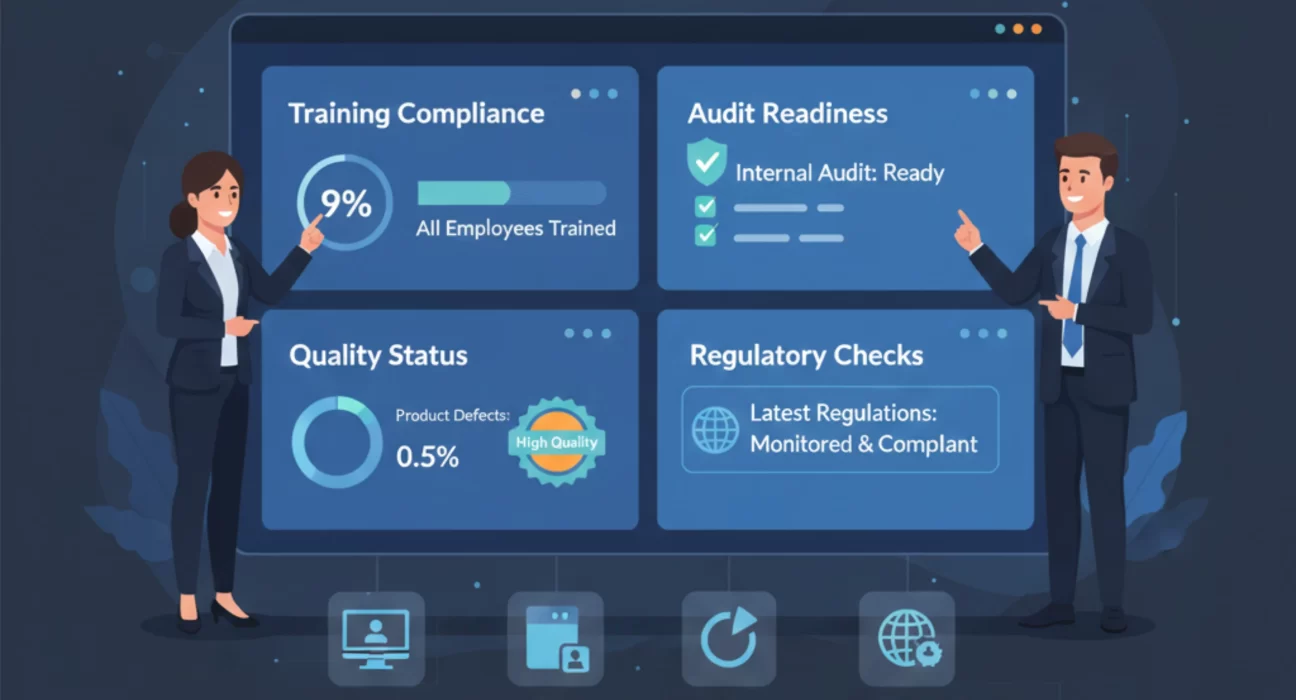
Real-time compliance dashboards show current status across all relevant dimensions. Which employees have current required training? Which quality certifications are approaching expiration? Which safety incidents are overdue for remediation? These dashboards draw from integrated systems to provide unified visibility that’s impossible with disconnected platforms.
Automated compliance monitoring identifies gaps before they become violations. When required training is overdue, the system flags it automatically. When someone moves to a role requiring new certifications, the requirement appears immediately. When quality processes aren’t being followed, monitoring surfaces the issue. Proactive identification allows remediation before audits discover problems.
Exception reporting highlights anomalies that might indicate compliance issues. Employees with access to quality processes they shouldn’t be involved in based on their role. Training completion rates that dropped suddenly in a specific department. Safety incidents with delayed reporting. These patterns might have legitimate explanations, but they warrant investigation. Integrated systems can identify patterns that would be invisible in disconnected systems.
Audit-ready reports generate on demand with current data from all relevant systems. Regulators request employment law compliance documentation? Generate the report showing wage calculations, overtime tracking, leave management, and required record retention. Industry regulators want quality compliance evidence? Produce reports showing process adherence, training currency, audit results, and corrective action completion. The data exists in integrated form, making report generation straightforward rather than requiring weeks of manual compilation.
Historical reconstruction becomes feasible when integrated systems maintain complete audit trails. Demonstrate what someone’s qualifications were at a specific point in time. Show what quality processes were active during a particular period. Prove that required training was current when specific work was performed. This historical visibility supports both compliance defense and operational analysis.
Predictive compliance analytics identify emerging risks based on patterns in integrated data. Training completion rates trending downward might predict future compliance gaps. Increasing time to close quality incidents might signal process problems. Geographic patterns in safety incidents might indicate location-specific issues. These insights enable proactive intervention before problems escalate.
Building Integration for Compliance
Effective compliance reporting integration requires thoughtful design that accounts for regulatory requirements, data quality, and ongoing maintenance.
Authoritative source definition establishes which system owns what data. The HRIS is typically authoritative for employee demographics, role, and organizational assignment. The LMS owns training completion and certification records. The QMS owns quality process compliance. Clear authority prevents conflicting data and ensures everyone knows where to find accurate information.
Data synchronization determines how frequently information flows between systems and what triggers updates. Some data needs real-time synchronization. Role changes should immediately trigger updates to training requirements and quality process assignments. Other data can synchronize on schedules. Daily or weekly updates might be sufficient for reporting purposes while reducing system load.
Validation and reconciliation processes ensure data consistency across integrated systems. Automated checks identify mismatches between systems so they can be investigated and resolved. Is everyone in the HRIS also properly represented in relevant compliance systems? Do job codes match between platforms? Are organizational hierarchies consistent? These validations catch data quality issues before they affect compliance reports.
Audit trail requirements specify what history must be maintained to support compliance. Most regulations require retaining records for specific periods. The integrated system architecture needs to preserve this history even as operational systems purge old data. Archive strategies ensure historical compliance data remains accessible for required retention periods.
Reporting templates aligned with regulatory requirements ensure that generated reports include all necessary information in appropriate formats. Rather than building custom reports for each audit or regulatory submission, maintain templates for common compliance reporting needs. As regulations change, update templates to reflect new requirements.
Access controls restrict compliance data visibility to authorized users while supporting legitimate business needs. Compliance officers need broad access for oversight. Managers need access to their team’s compliance data. Auditors need read-only access during examinations. The integrated system should support these different access patterns while maintaining security and privacy.
The Data Quality Prerequisite
Integration amplifies data quality issues. When systems are disconnected, quality problems in one system don’t affect others. When systems integrate, those problems propagate. You can’t build reliable compliance reporting on poor quality data.
Data cleansing before integration addresses existing quality issues in source systems. Standardize job titles and role codes. Correct organizational hierarchy inconsistencies. Fix employee records with missing or invalid data. Consolidate duplicate records. These fixes should happen in source systems before integration, not as workarounds in integration logic.
Ongoing data governance maintains quality after integration. Define data standards for key fields. Assign ownership for data domains. Establish validation rules that prevent poor quality data from entering systems. Review data quality metrics regularly and remediate issues promptly. Without sustained governance, data quality degrades over time.
Master data management provides consistent reference data across integrated systems. Job codes, department names, location identifiers, role taxonomies. These reference data elements should be managed centrally and distributed to operational systems rather than maintained independently in each platform. Consistent reference data is fundamental to meaningful integrated reporting.
Change management processes ensure that data structure changes are coordinated across integrated systems. Adding new job codes, reorganizing departments, changing role taxonomies. These changes affect multiple systems and the integration between them. Coordinated change management prevents integration breaks and compliance reporting failures.
Continuous Compliance Versus Point-in-Time Reporting
The real value of integrated systems isn’t just easier audit responses. It’s shifting from point-in-time compliance validation to continuous compliance management.
Traditional compliance management validates compliance periodically. Run reports before audits, identify gaps, scramble to remediate. Between validations, compliance status is unknown. This reactive approach means problems accumulate undetected until periodic checks discover them.
Continuous compliance management provides ongoing visibility into compliance status. Dashboards show current state daily. Alerts flag issues immediately when they occur. Trends indicate whether compliance is improving or degrading. This visibility enables proactive management rather than reactive remediation.
The shift from periodic to continuous compliance reduces risk significantly. Issues get detected and resolved quickly rather than accumulating. Audit preparation becomes simpler because compliance status is already known and documented. Regulatory inquiries can be answered immediately rather than requiring weeks to compile responses.
This continuous approach requires cultural change beyond technical integration. Compliance becomes an operational discipline rather than a periodic exercise. Managers review their team’s compliance status regularly. Compliance officers monitor enterprise-wide metrics continuously. Remediation happens promptly rather than in pre-audit crisis mode.
How Ozrit Implements Compliance Integration
Ozrit’s approach to compliance reporting integration starts with mapping your compliance obligations across all relevant regulatory regimes. What reports are required? What data supports those reports? Where does that data currently exist? What quality issues affect reliability? This mapping shapes integration requirements and priorities.
The assessment includes stakeholder interviews with compliance officers, internal audit, legal, HR, quality, and business unit leaders. Each group has different compliance responsibilities and reporting needs. The integration design needs to support all of these requirements through unified architecture rather than point solutions for each function.
Design work defines data flows, synchronization schedules, validation rules, reporting templates, access controls, and audit trail requirements. This design includes detailed specifications that serve as the blueprint for implementation and the basis for testing and validation.
A senior compliance architect owns the program from assessment through production deployment. They coordinate across teams managing different source systems, engage with compliance and legal stakeholders, make design decisions when tradeoffs arise, and ensure delivery meets regulatory requirements. You work with one accountable leader rather than coordinating multiple workstreams independently.
The implementation team typically includes five to eight people depending on scope. Integration developers who build data flows between systems, compliance analysts who define reporting requirements and validate outputs, data quality specialists who ensure information reliability, and testing professionals who verify that reports meet regulatory standards.
Realistic timelines for comprehensive compliance integration programs run six to ten months from kickoff to production. This includes assessment, design, integration development, data quality remediation, reporting template development, testing and validation, and phased rollout. Organizations with particularly complex compliance requirements or significant data quality issues might require longer.
Phased implementation starts with the highest-risk compliance areas and expands to additional requirements over time. This delivers compliance improvements sooner while managing implementation complexity. Early phases provide learning that improves subsequent phases.
Ozrit provides ongoing support after integration goes live because compliance requirements evolve continuously. New regulations get enacted, reporting requirements change, organizational changes affect compliance obligations. The integration needs corresponding updates to remain effective. This support includes 24/7 monitoring of critical compliance data flows and rapid response when issues occur.
The goal is creating sustainable compliance management capabilities that reduce risk and simplify audit response long-term. This requires proper integration design, solid implementation, comprehensive testing, and ongoing maintenance as compliance obligations evolve.
The Real Cost of Compliance Failure
Compliance failures create costs well beyond direct regulatory fines. Understanding the full cost picture justifies investment in proper compliance infrastructure.
Regulatory penalties vary by violation type and jurisdiction but can be substantial. OSHA violations reach tens of thousands per incident. GDPR violations reach percentages of global revenue. Employment law violations include back pay plus penalties. These direct costs are quantifiable and get board attention.
Litigation costs often exceed regulatory penalties. Employment practices litigation, product liability claims, environmental lawsuits. Poor compliance records undermine defense and affect settlements. The inability to demonstrate compliance through documented evidence makes cases more expensive to defend and more likely to settle unfavorably.
Operational disruption from compliance investigations diverts leadership attention from strategic priorities. Responding to regulatory inquiries, supporting audits, implementing remediation plans. These activities consume senior leadership time and organizational energy that should focus on business development.
Reputation damage affects customer relationships, employee recruitment, and investor confidence. Publicized compliance failures signal operational problems beyond the specific violation. Customers question whether you can deliver reliably. Talent questions whether they want to work for an organization with compliance issues. Investors question management competence.
Your compliance reporting capabilities reflect operational discipline and risk management maturity. Organizations that invest in integrated compliance infrastructure demonstrate that risk management matters and deserves proper tools and processes. Organizations that tolerate manual, periodic compliance validation accept unnecessary risk and ongoing inefficiency. The difference shows up in audit results, regulatory relationships, and ultimately in business results when compliance issues affect operations or reputation.