E-business operations create demands that traditional systems struggle to meet. When customers place orders online at any hour, expect accurate inventory information, and want real-time order tracking, the back-office systems supporting those transactions become critical infrastructure. ERP systems provide the foundation that makes modern e-business possible at enterprise scale.
The relationship between ERP and e-business is often misunderstood. Many leaders think of e-business as the customer-facing website or mobile app. That front end matters, but it is only valuable if connected to reliable systems that can actually fulfill what gets promised online. ERP provides those systems. It handles inventory management, order processing, financial transactions, and logistics coordination that turn digital orders into delivered products.
For large enterprises, integrating ERP with e-business platforms is not optional. It is the difference between a functional digital channel and one that creates operational chaos. Understanding how ERP benefits e-business helps C-suite leaders make better decisions about technology investments and implementation priorities.
Real-Time Inventory Visibility Across Channels
The first major benefit is accurate inventory visibility that customers can trust. E-business customers expect to know whether products are available before placing orders. They also expect the information to be current, not outdated data from last night’s batch update.
Without ERP integration, e-business platforms either show inaccurate availability or require manual updates that are always behind reality. This creates two bad outcomes. Either customers order products that are not actually available, leading to cancellations and dissatisfaction, or the website shows items as out of stock when they could be fulfilled, leading to lost sales.
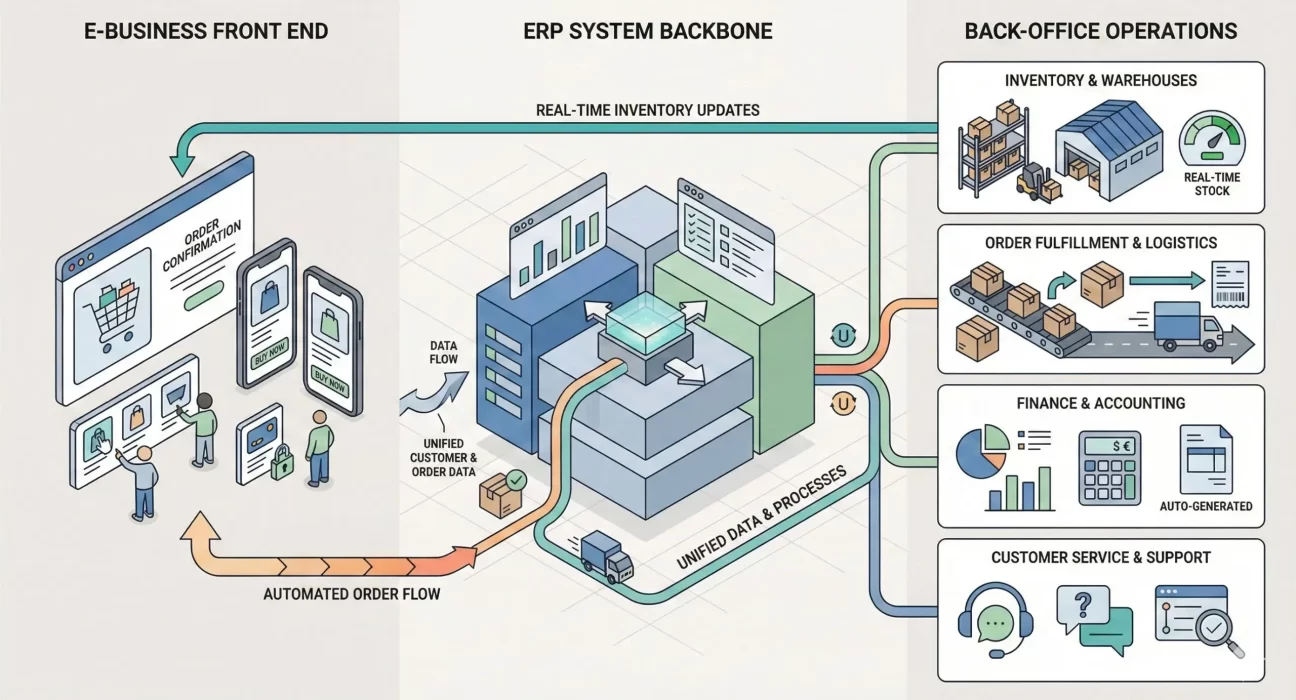
ERP systems maintain real-time inventory positions across all locations. When integrated properly with e-business platforms, this data flows continuously to the customer-facing systems. Inventory counts update as orders are placed, shipments arrive, and products move between locations. Customers see accurate availability that accounts for committed orders and reserved stock.
This matters more as organizations grow. A company with one warehouse can manage inventory coordination manually. A company with ten warehouses serving multiple sales channels needs automated systems that track inventory everywhere and intelligently allocate it based on business rules. ERP provides this capability.
The available-to-promise logic in ERP systems goes beyond simple inventory counts. It considers incoming shipments, production schedules, and existing commitments to calculate when orders can realistically be fulfilled. This enables accurate delivery date commitments instead of optimistic guesses that lead to disappointed customers.
For organizations selling through multiple channels, ERP prevents the overselling that occurs when different channels do not share inventory visibility. A product might be available in the warehouse, but if the retail stores, wholesale partners, and e-commerce site all think they can claim that inventory, someone will be disappointed. ERP manages allocation across channels based on defined priorities and rules.
Streamlined Order Processing and Fulfillment
The second benefit is automated order-to-cash processes that handle e-business volume efficiently. Online orders flow directly into ERP systems without manual data entry. This eliminates transcription errors and reduces the time between order placement and fulfillment start.
ERP systems validate orders against business rules automatically. They check credit limits, verify shipping addresses, confirm product availability, and calculate accurate shipping costs. Orders that meet criteria move directly to fulfillment. Exceptions route to appropriate people for review. This automation allows small teams to process order volumes that would require large staffs with manual systems.
The fulfillment coordination that ERP provides is particularly valuable for e-business. The system determines which warehouse should fulfill each order based on inventory position, shipping costs, and delivery time requirements. It generates picking instructions, shipping labels, and packing documentation automatically. It tracks orders through fulfillment and updates customers on shipping status without requiring warehouse staff to manually send notifications.
Payment processing integrates with ERP financial modules so revenue gets recognized correctly and accounts receivable stays current. For B2B e-business, this includes managing credit terms, payment schedules, and collections processes. For B2C operations, it means handling the various payment methods customers expect while maintaining proper financial controls.
Returns processing also benefits from ERP integration. When customers return products purchased online, the system handles reverse logistics, inventory updates, refunds or exchanges, and the financial implications. Without this integration, returns become manual processes that slow down operations and frustrate customers waiting for resolution.
The scalability advantage becomes clear during peak periods. E-business operations often experience dramatic volume spikes during promotional periods or seasonal peaks. ERP systems handle these increases without requiring proportional staffing increases because the automation scales naturally with transaction volume.
Integrated Customer Experience Across Touchpoints
The third benefit is consistent customer experience across all interaction points. Modern customers expect to move seamlessly between online and offline channels. They might research products online, buy in a store, and arrange return through the website. Or they might order online and pick up at a physical location.
ERP systems enable these experiences by maintaining unified customer and order data that all channels access. When a customer calls the contact center about an online order, the representative sees the same information the customer sees on the website. When someone visits a store to return an online purchase, the store system knows about the original order and can process the return without making the customer prove their purchase.
Account management for B2B e-business particularly benefits from ERP integration. Business customers need access to order history, account statements, contract pricing, and credit information. ERP systems contain this data as part of normal operations. Integrating it into customer self-service portals gives buyers the information they need without requiring sales or service team involvement.
Personalization capabilities improve when e-business platforms can access ERP data. The system knows what customers have purchased previously, what pricing they receive based on contracts or volume, and what products might be relevant based on their industry or past behavior. This enables more effective merchandising and product recommendations than platforms working with limited data.
The fulfillment flexibility that customers increasingly expect also requires ERP integration. Buy online, pick up in store requires coordination between e-commerce systems and store inventory. Ship from store requires visibility into store inventory from the order management system. These capabilities only work when all the systems share data through the ERP platform.
Accurate Financial Management and Reporting
The fourth benefit is proper financial controls and reporting for e-business operations. Digital channels create high transaction volumes with complex revenue recognition requirements, varied payment methods, and international considerations that make financial management challenging without integrated systems.
ERP financial modules automatically record revenue from online sales with proper classification by product line, region, or business unit. They handle sales tax calculation and remittance across multiple jurisdictions. They manage currency conversions for international transactions. Doing this manually for thousands of daily transactions would be impractical and error-prone.
Cost accounting improves when e-business operations run through ERP. The system tracks the actual costs to fulfill online orders including product costs, shipping expenses, payment processing fees, and customer service resources. This enables accurate profitability analysis by channel, customer segment, or product category. Many organizations discover that some e-business activities that appear profitable actually lose money when all costs are properly accounted for.
Cash flow management benefits from the real-time financial visibility that ERP provides. Digital payments from e-business operations flow through the system immediately. This helps treasury teams manage working capital more effectively than when they must wait for batch processing and bank reconciliations to understand the cash position.
The audit trail and compliance capabilities in ERP systems matter significantly for e-business. Every transaction has complete documentation about what was ordered, by whom, at what price, and how it was fulfilled. For public companies and regulated industries, this traceability is essential. For all organizations, it enables investigation when disputes arise or fraud is suspected.
Revenue recognition rules have become more complex with new accounting standards. ERP systems help manage the requirements around performance obligations, contract modifications, and timing of revenue recognition. This is particularly important for e-business operations selling subscriptions, bundled services, or products with ongoing support obligations.
Operational Efficiency Through Process Integration
The fifth benefit is eliminating the duplicate work and manual reconciliation that plague organizations running e-business on disconnected systems. When online sales flow directly into the same ERP system that manages inventory, fulfillment, and financials, information only gets entered once and automatically propagates where needed.
Organizations without ERP integration typically export orders from e-commerce platforms and import them into separate systems for fulfillment and accounting. This creates multiple manual steps where errors occur and delays accumulate. It also means maintaining the same product, customer, and pricing data in multiple systems, which inevitably leads to inconsistencies.
The process standardization that ERP enables also benefits e-business operations. Online orders follow the same workflows as other sales channels within the ERP system. This means staff can shift between channels as volumes fluctuate. Training is simpler because core processes stay consistent. Business rules apply uniformly regardless of how the order originated.
Reporting improves dramatically when all sales channels operate within one integrated system. Leadership can compare performance across channels with confidence that metrics are calculated consistently. Financial consolidation happens automatically rather than requiring manual aggregation from different systems. Analytical capabilities can examine cross-channel customer behavior and preferences.
The integration between ERP and e-business platforms also enables more sophisticated automation over time. Once the basic data flows are established reliably, organizations can add capabilities like automated inventory replenishment based on e-business demand patterns, dynamic pricing that reflects current costs and competitive conditions, or predictive analytics that anticipate customer needs.
The Integration Challenge
These benefits are substantial, but achieving them requires careful integration work. E-business platforms and ERP systems are complex applications built by different vendors with different data models and technical architectures. Making them work together reliably takes expertise and thorough execution.
The integration must handle both real-time and batch data flows. Inventory availability needs to update continuously so customers see current information. Order data needs to flow immediately so fulfillment can start quickly. But some information, like catalog updates or customer account changes, may sync on scheduled intervals. Designing these patterns correctly requires understanding both the business requirements and technical capabilities of each system.
Error handling becomes critical at scale. When thousands of orders flow between systems daily, some will have data quality issues or encounter validation errors. The integration needs to handle these exceptions gracefully without losing transactions or requiring manual intervention for every problem. This means building monitoring, alerting, and recovery capabilities into the integration architecture.
Performance requirements are also demanding. E-business platforms need fast response times so customers do not experience delays. High transaction volumes during peak periods test the capacity of both systems and the integration between them. Poorly designed integrations create bottlenecks that slow down operations or cause timeouts that frustrate customers.
Security and data privacy add complexity. Customer payment information, personal data, and account credentials must be protected as they move between systems. Compliance requirements vary by region and industry. The integration design must incorporate appropriate controls and encryption while maintaining the performance customers expect.
How Ozrit Approaches ERP and E-Business Integration
Ozrit has delivered ERP integrations for major e-business operations where reliability and performance are critical. The company’s approach addresses the technical complexity and operational risks that cause problems in these programs.
Engagements start with experienced integration architects who have connected ERP systems to e-business platforms at scale before. These professionals understand the common pitfalls and can design integration architectures that avoid them. They know which data flows need real-time handling versus batch processing. They anticipate performance bottlenecks and build capacity appropriately from the start.
Ozrit’s structured onboarding process reduces the time required for teams to understand both the client’s ERP environment and e-business operations. The company has frameworks for quickly assessing existing systems, data quality, and integration requirements. This means the team can start productive work in weeks rather than spending months on discovery before beginning actual integration development.
The company maintains over 200 experienced engineers and architects who can be deployed to complex integration programs. These projects often require specialists in specific ERP modules, e-business platforms, and integration technologies. Ozrit can staff projects appropriately from the start and bring in additional expertise when requirements expand.
Delivery follows structured phases with clear milestones and regular testing. Ozrit does not take shortcuts that create quality problems. The integration gets thoroughly tested under realistic load conditions before going into production. Performance testing validates that the system can handle peak volumes. Failover testing ensures operations continue if components fail.
Support continues after go-live with 24/7 monitoring and rapid response capabilities. E-business operations run continuously and cannot tolerate extended outages. When integration issues occur, you need immediate access to people who understand the architecture and can diagnose problems quickly. Ozrit provides this coverage rather than forcing escalations through multiple support tiers before getting help.
E-Business Needs Strong Operational Foundation
E-business success requires more than an attractive website or mobile app. It requires reliable back-office systems that can fulfill what the digital channel promises to customers. ERP provides this foundation through real-time inventory visibility, automated order processing, integrated customer experience, accurate financial management, and operational efficiency.
The integration between ERP and e-business platforms is technically complex and operationally critical. Done poorly, it creates constant problems that damage customer experience and burden operations teams. Done well, it becomes invisible infrastructure that enables the business to scale digital channels confidently.
For C-suite leaders developing e-business strategy, the ERP foundation deserves as much attention as the customer-facing technology. The back-office capability determines what customer experiences are actually possible and sustainable at volume. Organizations that invest in strong ERP integration create competitive advantages that compound over time as digital channels grow in importance.