Ten years ago, cloud migration was the answer to almost every infrastructure question in the boardroom. Executives were told that moving to the cloud would reduce costs, increase agility, and future-proof their technology estate. The message was simple and compelling: get out of the data center, move to AWS or Azure, and watch your IT costs drop while your teams move faster.
What actually happened was different. Most large enterprises did migrate significant workloads to the cloud. But instead of the promised cost savings, many CFOs now review monthly cloud bills that have grown 200% or 300% beyond initial projections. Instead of increased agility, many CIOs manage environments that are more complex than before, with teams struggling to optimize configurations they don’t fully understand. The cloud-first strategy, implemented without sufficient planning or ongoing governance, turned into what many executives now privately call “cloud waste.”
The Promise That Didn’t Scale
The original cloud value proposition made sense for startups and mid-sized companies. Elastic infrastructure, pay-as-you-go pricing, and no capital expenditure on hardware were genuinely transformative for organizations that needed to scale quickly without heavy upfront investment.
But large enterprises operate under different constraints. They run thousands of applications, many of them custom-built over decades. They have complex compliance requirements across multiple jurisdictions. They manage sensitive data that cannot simply be moved without extensive legal and security review. And they have existing vendor relationships, long-term contracts, and technical dependencies that don’t disappear just because leadership announces a cloud-first policy.
When these organizations rushed to adopt cloud-first strategies, they often did so without accounting for these realities. Migration projects were approved based on optimistic business cases that assumed workloads would be re-architected for cloud-native efficiency. In practice, most applications were moved via “lift and shift” migrations that replicated existing architectures in the cloud, delivering none of the efficiency gains but all of the new costs.
Where the Costs Actually Come From
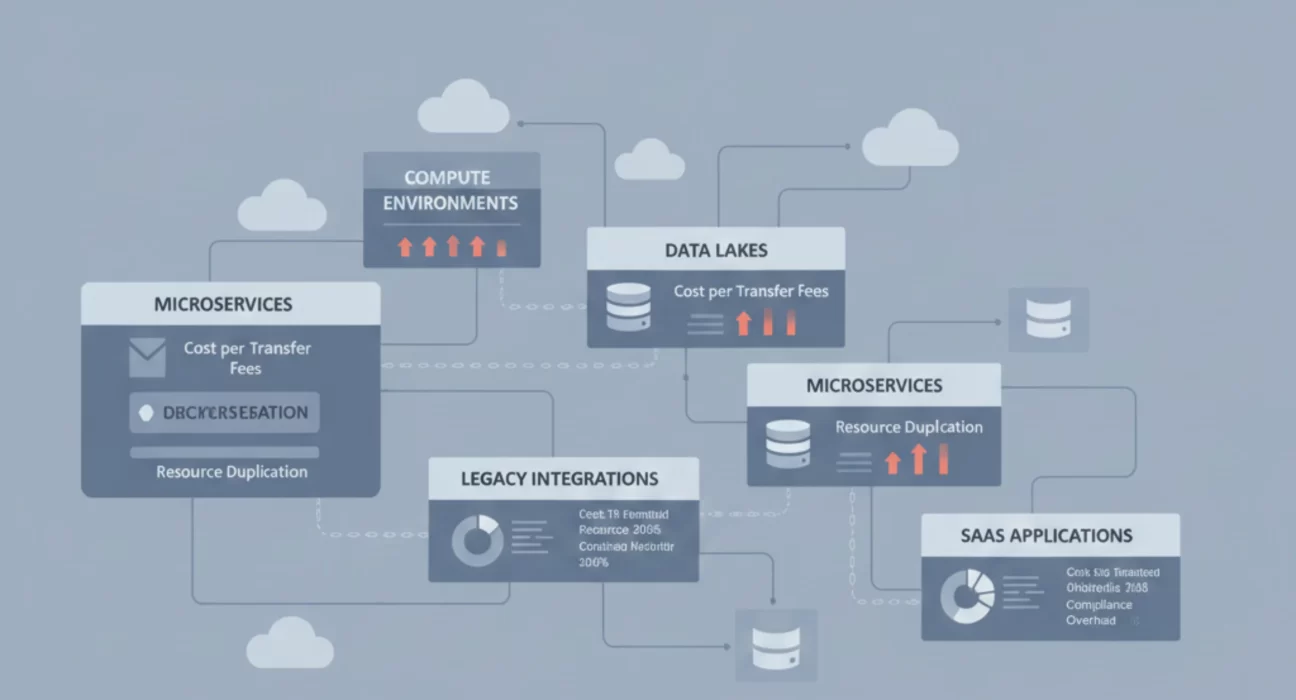
Cloud waste in large enterprises rarely comes from a single dramatic mistake. It accumulates through dozens of smaller decisions made across different teams, often with incomplete visibility into the total cost impact.
Development teams spin up environments for testing and forget to shut them down. Database instances run at peak capacity 24/7 even though actual usage only requires that capacity for a few hours each day. Storage grows unchecked because no one is responsible for reviewing what can be archived or deleted. Reserved instance purchases are made without proper analysis, locking the organization into capacity it doesn’t need. And because cloud billing is complex and distributed across many cost centers, no single person has a clear view of where money is being wasted until the CFO asks why IT spending increased by $15 million this quarter.
The technical teams understand these problems exist, but fixing them requires time and expertise that is already stretched thin. Cloud optimization is not just a technical exercise. It requires understanding application behavior, business priorities, compliance constraints, and vendor pricing models. It requires coordination across infrastructure, application, security, and finance teams. And it requires ongoing attention, not a one-time cleanup project.
The Governance Gap
The deeper problem is governance. In traditional data center environments, infrastructure changes required formal approval processes, procurement cycles, and capacity planning reviews. These processes were often slow and frustrating, but they imposed discipline. You couldn’t accidentally spend $50,000 on servers without multiple people noticing.
Cloud infrastructure removed those natural friction points. Any developer with the right permissions can provision resources that cost thousands of dollars per month, and those costs only become visible weeks later when the bill arrives. The speed and flexibility that made cloud attractive also made it easy to lose control of spending.
Large enterprises tried to solve this with cloud management platforms, tagging policies, and chargeback mechanisms. These tools help, but they don’t solve the fundamental problem: cloud optimization requires active management and clear accountability. Someone needs to regularly review resource utilization, identify waste, make decisions about what to change, and coordinate implementation across multiple teams. In most organizations, no one has that responsibility clearly defined in their role, and no one has sufficient time to do it properly even if they wanted to.
Why This Is Hard to Fix Internally
The obvious answer is to build an internal cloud optimization team. Some enterprises have done this successfully, but it’s harder than it looks. Cloud expertise is expensive and difficult to retain. Engineers who become skilled at AWS or Azure optimization are in high demand and often leave for higher-paying opportunities. Even when you can hire them, it takes months to get them up to speed on your specific environment, your applications, and your organizational constraints.
There’s also a political dimension that makes internal optimization difficult. Telling business units that they need to reduce their cloud spending, change how they provision resources, or shut down environments they consider important is not a popular message. It requires executive sponsorship, clear authority, and a willingness to push back on teams who will argue that every resource they’re using is absolutely necessary.
And even when you have the people and the authority, cloud optimization is not a one-time project. It requires continuous attention as new workloads are added, as usage patterns change, and as cloud providers update their pricing models. Most enterprises don’t have the capacity to maintain this level of ongoing focus alongside everything else their infrastructure teams need to manage.
A Different Approach to Enterprise Cloud Programs
This is where organizations like Ozrit make a practical difference. Rather than selling a software platform or a consulting study, Ozrit approaches cloud optimization as an execution program with clear ownership and accountability.
The model is straightforward. Senior engineers from Ozrit, people who have managed large-scale cloud environments before, work directly with your teams to review your current state, identify specific optimization opportunities, and implement changes. They don’t just provide recommendations in a slide deck. They do the actual work of reconfiguring resources, implementing automation, and establishing processes that prevent waste from accumulating again.
What makes this effective is the combination of deep technical capability and structured delivery. Ozrit maintains a team of over 400 engineers, which means they can staff programs properly without pulling people off other projects midway through. They can bring in specialists for specific cloud platforms, specific types of workloads, or specific compliance requirements. And because they work across multiple enterprise clients, they have seen most of the common patterns of cloud waste before and know what solutions actually work in complex environments.
The onboarding process is designed to reduce risk and establish clear expectations. Before any work begins, Ozrit’s team conducts a technical review to understand your environment, your constraints, and your priorities. They identify quick wins that can demonstrate value early. And they establish clear workstreams with defined owners on both sides, so everyone knows who is responsible for what.
Realistic timelines matter in these programs. Initial assessments typically take two to three weeks. Implementation of optimization changes might run eight to twelve weeks depending on the complexity of your environment and the coordination required with your teams. Ozrit doesn’t promise instant results, but they do commit to measurable progress within defined timeframes, which is what enterprise program governance requires.
The 24/7 support model becomes important once changes are implemented. Cloud environments don’t break on a convenient schedule. Having access to engineers who can respond quickly when something unexpected happens, who already understand your environment, and who have the authority to make decisions reduces the risk of optimization work causing operational disruption.
Moving Beyond the Cloud-First Mindset
The lesson from a decade of cloud adoption is not that cloud is wrong. Public cloud infrastructure is genuinely valuable for many workloads, especially those with variable demand, modern architectures, or rapid scaling requirements.
The lesson is that “cloud-first” as a blanket policy was too simplistic. Different workloads have different economics. Some applications run more cost-effectively in the cloud. Others don’t. Some benefit from cloud-native services. Others are better left in traditional infrastructure or moved to hybrid models. The right strategy is workload-specific, not ideology-specific.
Large enterprises are now moving toward what might be called “cloud-appropriate” thinking. This means making infrastructure decisions based on actual cost analysis, performance requirements, security constraints, and operational complexity rather than defaulting to a one-size-fits-all policy.
But making this shift requires capabilities that most organizations don’t have internally. It requires economic modeling that accounts for total cost of ownership, not just headline cloud pricing. It requires architecture analysis to understand which workloads can be optimized and which need to be re-architected or moved. And it requires the execution capacity to implement changes across potentially thousands of workloads without disrupting business operations.
What Senior Leadership Should Focus On
For executives managing large technology estates, cloud waste is not primarily a technical problem. It’s a governance and execution problem. The technology exists to optimize cloud spending. The challenge is establishing clear accountability, maintaining ongoing attention, and having the expertise to make informed decisions about what to change and how to change it safely.
The organizations that solve this successfully do three things well. First, they establish executive-level visibility into cloud spending with clear owners for cost management in each business unit. Second, they invest in either internal capability or external partnerships that can provide sustained technical expertise, not just periodic consulting engagements. Third, they treat cloud optimization as an ongoing operational discipline, not a one-time project.
The cloud-first era taught large enterprises an expensive lesson about the difference between strategy and execution. The next era will belong to organizations that can execute cloud programs with the same discipline, governance, and accountability they apply to any other major technology investment.